
False M5.9 earthquake alert near Dayton, Nevada caused by automated detection error
The USGS has withdrawn a false alert for a magnitude 5.9 earthquake near Dayton, Nevada, issued at 16:06 UTC on December 4, 2025. The automated ShakeAlert early warning system triggered a false detection, prompting an investigation into its cause. No ground shaking or seismic activity consistent with the alert was recorded, and the event has been deleted from official feeds.
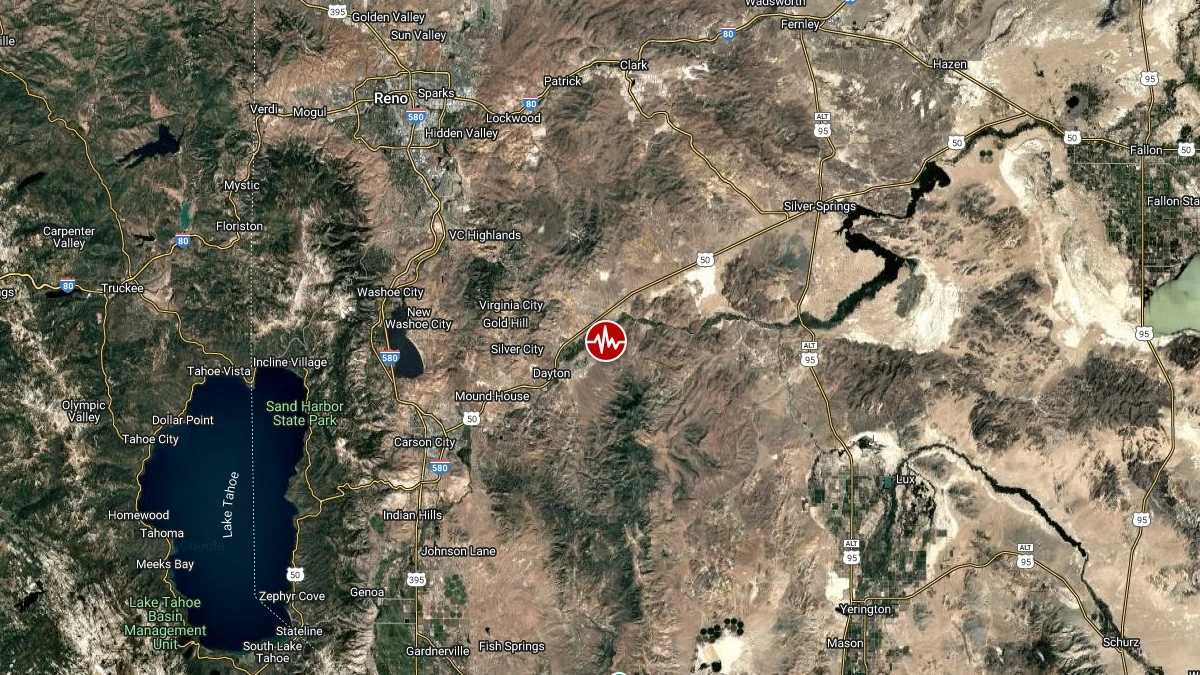
False M5.9 earthquake alert near Dayton, Nevada caused by automated detection error. Credit: TW/SAM, Google
The U.S. Geological Survey (USGS) deleted a false report of M5.9 earthquake near Dayton, Nevada, originally issued at 16:06 UTC on December 4, 2025. The automated ShakeAlert early warning system briefly published the event before it was confirmed to be an error.
Preliminary parameters listed the earthquake as shallow, located about 6 km (4 miles) east of Dayton at a depth of 8 km (5 miles). The alert appeared in public data feeds for several minutes and indicated a significance index of 536.
Ground motion sensors in the region, including those operated by the Nevada Seismological Laboratory, did not register any corresponding seismic waves.
The USGS later confirmed that no earthquake had occurred, adding that it’s working to understand the cause of the false alert.
According to the agency, ShakeAlert’s automated detection algorithms occasionally issue false triggers when environmental or instrumental noise mimics seismic signals. Such events are typically removed after rapid human review.
Western Nevada lies within the Basin and Range Province, an area of active crustal extension and frequent moderate earthquakes.

Teo Blašković founded The Watchers in 2011 and edited it until 2026, covering seismic and volcanic activity, extreme weather, space weather and near-Earth objects. Articles on this page are his archive.
Published in the last 24 hours
- In September 1859, a solar storm lit up the night sky so brightly that gold miners in the Rocky Mountains woke up after midnight and started cooking breakfast, convinced the aurora glowing over their camp was the sunrise Epicenter
- A patch of warm Pacific water that could become the strongest El Niño in more than 70 years sits thousands of miles from any American town, yet it is already the main reason NOAA expects a wetter winter across the South and a milder one across the North
- A 19-year-old Nebraska teacher reportedly tied her pupils together with twine and led them to safety through a blizzard in January 1888 Epicenter
- NASA built the Opportunity rover to last 90 days on Mars, and Martian winds helped keep it alive for nearly 15 years by blowing dust off its solar panels, until a planet-wide dust storm in 2018 blocked sunlight and silenced the rover Epicenter
