
Wettest November on record in Santa Barbara as atmospheric rivers kill 7 in California
Santa Barbara recorded 169.5 mm (6.67 inches) of rain over a three-day period ending November 17 2025, setting a new rainfall record for the county. The series of atmospheric rivers that brought the record rainfall caused at least 7 fatalities in California due to heavy rain, flooding, and rough seas.
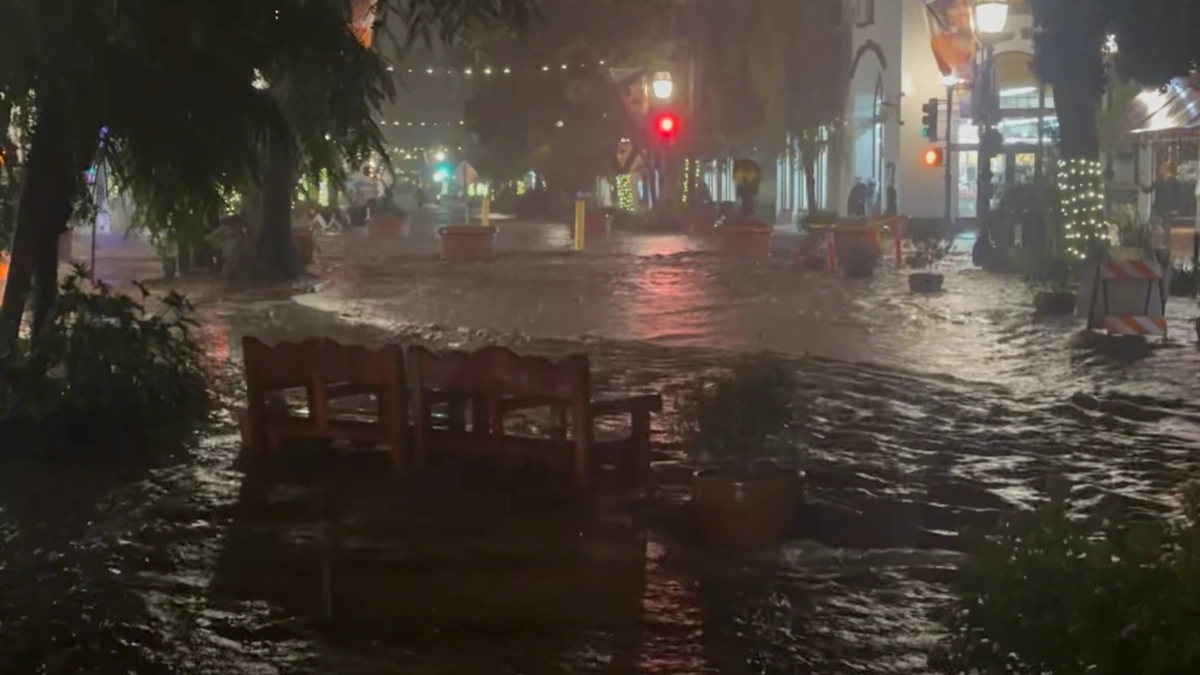
Flooding in Santa Barbara due to record rainfall through November 14-17, 2025. Credit: Will Turner
A powerful AR dropped 169.5 mm (6.67 inches) of rain over Santa Barbara over a three-day period ending November 17.
This broke the previous three-day total November record of 144 mm (5.66 inches) set in 2002, making November 2025 the wettest ever for the Santa Barbara Airport.
The storm triggered widespread flooding, downed trees, and mud-covered roadways as it moved slowly along the coast and maintained a direct moisture connection to the central Pacific.
The downpour was so heavy because it pulled in moisture all the way from Hawaii as it rotated, said Bryan Lewis, a meteorologist with the National Weather Service (NWS) in Oxnard to the LA Times.
As the storm stalled offshore, southerly winds pushed the moisture band directly against the Santa Ynez Mountains. The nearly perpendicular orientation enhanced orographic lift, intensifying precipitation over the coastal slopes and foothills.
This type of setup tends to happen later in the winter and is not typical for this time of year, Lewis said.
At least 7 fatalities have been confirmed so far due to ARs in California over the last week, including a 39-year-old father and his 5-year-old daughter who drowned in Carmel on November 14. The girl who was initially reported missing was found later on November 16, when she was found around 92 m (302 feet) offshore and about 0.8 km (0.5 miles) north of her last known location, according to the Monterey County Sheriff’s Office.
Officials in Santa Barbara reported a roughly 50% increase in emergency-response calls during the peak of the event, particularly late on November 15, when about 12 calls for service were recorded in a 15-minute window as low-lying areas flooded.
Saturated ground conditions contributed to rapid runoff, stalling at least six vehicles at flooded intersections, including Salispuedes and Cota streets and Cacique and Nopalitos streets.
Mud and debris reached roadways such as West Mountain Drive and Cliff Drive at La Marina, and flooding forced temporary closures at the Mission Street underpass and off-ramps along U.S. 101. No serious injuries were reported within the city of Santa Barbara.
Counties from Ventura to Los Angeles recorded flooding, rockslides and debris-flow concerns, particularly in burn-scar areas where hydrophobic soils can accelerate runoff.
Coastal zones reported elevated turbidity and storm-driven runoff at river mouths and beaches. Several rainfall records from the 1960s were reportedly broken across the Southland due to the AR.
By November 17, the main storm had weakened to intermittent showers as it shifted south and east. Forecasters expected 25–50 mm (1–2 inches) of additional rain in localized areas before the system moved fully out of the region.
Two more storms are forecast to follow, with the first being forecast to bring light rainfall from November 17 to 18, with up to 25 mm (1 inch). Meanwhile, the second AR is expected later in the week, though there is significant uncertainty regarding its timing and intensity.

I am an Assistant Editor and Severe Weather & Science Journalist at The Watchers, specializing in real-time severe weather coverage, geophysical event reporting, and research-driven scientific analysis. You can reach me at rishav(at)watchers(.)news.

Commenting rules and guidelines
We value the thoughts and opinions of our readers and welcome healthy discussions on our website. In order to maintain a respectful and positive community, we ask that all commenters follow these rules.