
Heat dome drives record-breaking temperatures across France, 52 stations set all-time highs
At least 52 all-time high temperature records were broken across France on August 11, 2025, with more than 175 weather stations exceeding 40°C (104°F), as a persistent heat dome intensified extreme heat across southwestern Europe.
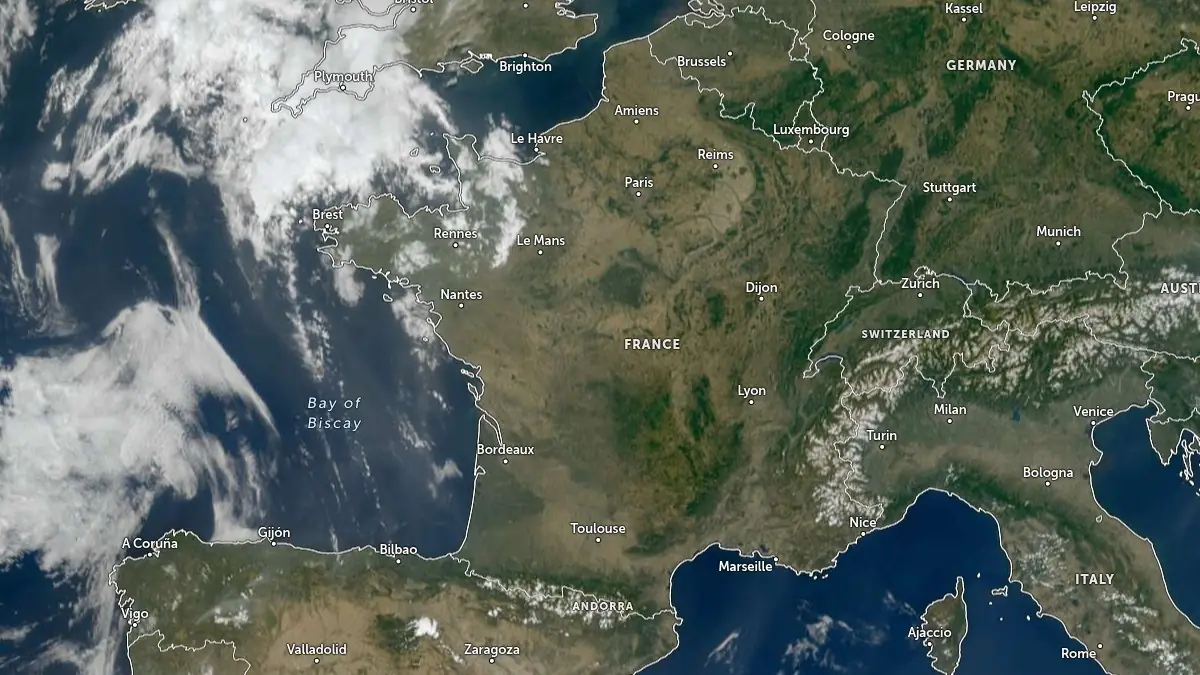
Satellite Image at 12:00 UTC, August 11, 2025. Credit: EUMETSAT/Meteosat, Zoom Earth, The Watchers
A large, slow-moving ridge of high pressure, commonly referred to as a heat dome drove record-breaking heat across Europe in early August 2025, with France reaching its highest recorded temperatures in multiple locations on August 11.
Météo-France data confirmed that at least 52 stations across the country set new absolute temperature records, and over 175 stations measured 40°C (104°F) or higher. Notable values include 41.6°C (106.9°F) in Bordeaux, 42.1°C (107.8°F) in Bergerac and Angoulême, and 43.1°C (109.6°F) in Captieux.
The heatwave placed 12 departments on red alert, the highest warning level and 41 on orange alert. Southwestern France experienced some of the most extreme conditions, with local records surpassed by significant margins.
Meteorologists note that the August 11 event ranks among the most extreme in France’s meteorological record, both for the number of records broken and the geographical extent of the heat.
A historic heat wave will spread across southern France on Monday, August 11th. Peak afternoon temperatures will reach 43 to 45 °C in some valleys, breaking many all-time high station records. Animation by @meteociel pic.twitter.com/UMcWi0JNEB
— severe-weather.EU (@severeweatherEU) August 10, 2025
On August 10, the Gravelines nuclear power plant in northern France was forced to shut down all four of its operating reactors after a “massive and unpredictable” swarm of jellyfish clogged the filter drums of its cooling system, drawing water from a canal linked to the North Sea.
Marine experts note that the shutdown coincided with unusually warm sea surface temperatures in the North Sea, linked to the broader atmospheric heatwave over France. These conditions can accelerate jellyfish reproduction, increase swarm density, and concentrate them near coastal intakes, making cooling system blockages more likely.
The plant’s remaining two reactors were already offline for maintenance, resulting in a total halt of its 5.4 GW (5 400 MW) generating capacity.
A nuclear plant in northern France has been temporarily shut down after a swarm of jellyfish clogged pumps used to cool the reactors, energy group EDF says.#France #Jellyfish #NuclearPlant pic.twitter.com/XOWDvQRGl8
— Al Arabiya English (@AlArabiya_Eng) August 12, 2025
EDF operator data indicates that the affected reactors are being brought back online sequentially over the coming days.
High temperatures were also recorded across southern Europe. Parts of Spain and Albania reached 44°C (111.2°F), while Portugal reported peaks of 43°C (109.4°F).
Spain experienced hundreds of wildfire outbreaks, prompting the evacuation of nearly 6 000 people and causing at least one confirmed fatality in the Madrid region.
The August 2025 heatwave is forecast to persist for several days, maintaining above-average temperatures across much of France, Spain, Portugal, and the western Balkans, with heightened risk of heat-related illnesses, agricultural stress, and wildfire ignition.

I’m a science journalist and researcher at The Watchers, contributing to the Epicenter edition, where I cover peer-reviewed scientific research and emerging discoveries across Earth and space sciences. With a background in astronomy and a passion for environmental science, I’ve worked in shark and coral conservation in Fiji, conducting reef and shark-behavior research, contributing to mangrove restoration, and earning PADI Open Water and Coral Reef Certifications. I bring a blend of scientific rigor and storytelling to illuminate the discoveries shaping our planet and beyond.

Commenting rules and guidelines
We value the thoughts and opinions of our readers and welcome healthy discussions on our website. In order to maintain a respectful and positive community, we ask that all commenters follow these rules.