
July 22 predicted to be the second-shortest day of 2025 as Earth spins faster than usual
Earth is predicted to spin about 1.34 milliseconds faster than usual on July 22, 2025, making it one of the shortest days on record. If the latest data holds up, July 22 is likely to be the second-shortest day of 2025 with July 10 likely being the first with 1.36 milliseconds, once confirmed.
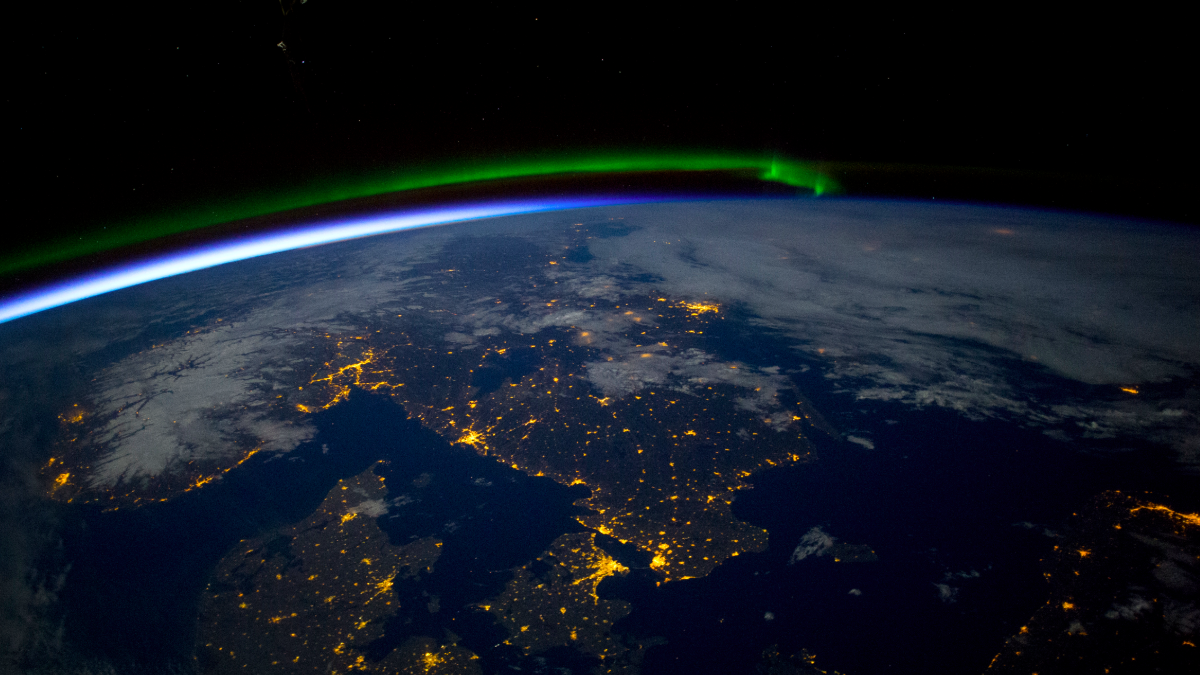
Night time image of Scandinavia taken by astronauts aboard the ISS on April 3, 2025. Credit: NASA Earth Observatory
- Historically, Earth’s rotation was gradually slowing due to tidal friction and mass redistribution. However, in recent years, an anomalous acceleration has been observed.
Earth could experience one of its shortest day on record today, July 22, with predictions estimating that it might complete a full rotation on its axis about 1.34 milliseconds faster than the usual 86 400 seconds.
The 86 400 seconds is equivalent to 24 hours, the period in which Earth typically completes one full rotation on its axis. However, the “length of day” (LOD) refers to the number of milliseconds above or below this standard.
A millisecond (ms) is 0.001 seconds—significantly shorter than the average blink of an eye, which lasts around 100 milliseconds.
The only way to measure these small day-to-day variations in Earth’s rotation speed is by using atomic clocks, introduced in the 1950s.
From when accurate records began in 1973 with the use of atomic clocks, until 2020, the shortest day recorded was 1.05 milliseconds shorter than 24 hours. This means Earth completed one rotation 1.05 milliseconds faster than 86 400 seconds.
However, since 2020, Earth has repeatedly broken its own speed records. The shortest day ever measured occurred on July 5, 2024, when Earth completed its rotation 1.66 milliseconds faster than usual.
Looking ahead to 2025, scientists predicted that July 9, July 22, and August 5 could be the shortest days of the year.
The latest data suggests that July 10 is currently the shortest day of 2025, with Earth’s rotation recorded at 1.36 milliseconds shorter than 24 hours. However, this figure is preliminary and yet to be confirmed.
Earth is expected to complete its rotation 1.34 milliseconds early on July 22, making it a close second. If current predictions hold, August 5 will be about 1.25 milliseconds shorter than usual, placing July 22 as the second-shortest day of the year.
Three predictions shortest days may seem unusual, but there is a reason for it. Short-term variations in LOD are influenced by the Moon’s orbit.
Earth spins faster when the Moon is positioned far to the north or south of Earth’s equator. The Moon will be near its maximum distance from the equator on the three possible dates for the shortest LOD in 2025.
A 2024 study suggested that melting polar ice and rising sea levels may be influencing Earth’s spin. However, rather than causing the acceleration, this redistribution of mass may be moderating it. A more likely cause is the slowing of Earth’s liquid core, which could be redistributing angular momentum in a way that causes the mantle and crust to spin slightly faster.
“The cause of this acceleration is not explained,” said Leonid Zotov, an expert on Earth’s rotation at Moscow State University, in an interview with Timeanddate.com. “Most scientists believe it is something inside the Earth. Ocean and atmospheric models don’t explain this huge acceleration.”
Zotov predicts that Earth’s rotation may soon slow down again. If correct, the recent increase in speed could be a temporary anomaly in the planet’s long-term trend toward slower rotation and longer days.
Although July 22 is predicted to be among the shortest days of 2025, its exact ranking won’t be known until after the day ends. These estimates rely on models and past observations, but only precise measurements from atomic clocks and space-based tracking systems can confirm how long the day actually was.
The International Earth Rotation and Reference Systems Service (IERS) will review and validate this data, with final results typically released several days or weeks later.

I am an Assistant Editor and Severe Weather & Science Journalist at The Watchers, specializing in real-time severe weather coverage, geophysical event reporting, and research-driven scientific analysis. You can reach me at rishav(at)watchers(.)news.

Commenting rules and guidelines
We value the thoughts and opinions of our readers and welcome healthy discussions on our website. In order to maintain a respectful and positive community, we ask that all commenters follow these rules.