
Red Flag Warning in effect for South Dakota, Nebraska, Kansas, Iowa and Missouri
A Red Flag Warning is in effect from South Dakota to southwestern Missouri, including much of Iowa, Nebraska, and parts of Kansas. The warning will remain in effect from 10:00 to 20:00 CST on Friday, February 28, 2025.
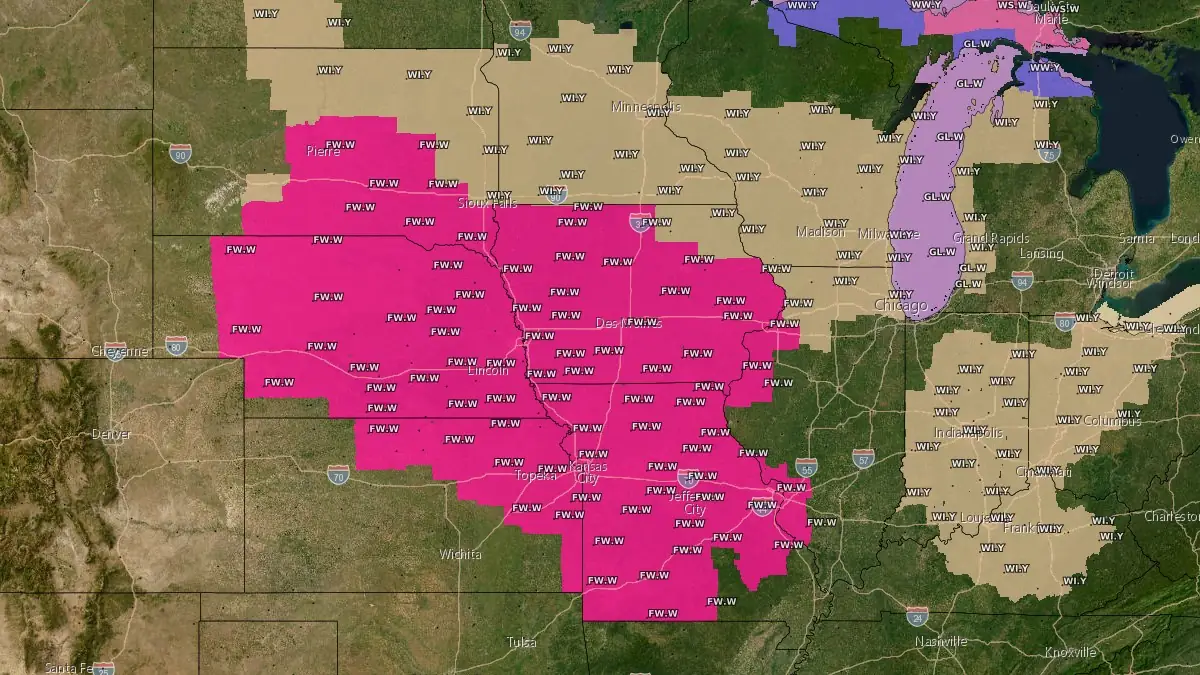
Red Flag Warning valid February 28, 2025. Image credit: NWS, The Watchers
A dry cold front combined with low humidity and warm temperatures has created critical fire weather conditions, prompting a Red Flag Warning for parts of South Dakota, Nebraska, Kansas, Iowa, and Missouri. The warning will remain in effect from 10:00 to 20:00 CST on Friday, February 28.
Residents are urged to be cautious, as even a small spark could ignite a large fire under such conditions.
“A Red Flag Warning means that critical fire weather conditions are either occurring or will develop soon. A combination of strong winds, low relative humidity, and warm temperatures can lead to extreme fire behavior,” said the National Weather Service (NWS).
Humidity could drop to 15% in some areas during the warning period, while wind gusts may reach 72 km/h (45 mph), creating conditions conducive to rapid fire spread.
“Take extra precautions to avoid sparks, and closely monitor any smoldering fires that burned in recent days,” said the NWS.
References:
1 Red Flag Warning – NWS – February 28, 2025

Rishav Kothari is Editor-in-Chief of The Watchers, where he runs the newsroom and covers earthquakes, volcanoes, severe weather and space weather.
Published in the last 24 hours
- Strong El Niño reinforces above-normal winter precipitation outlook across southern and eastern U.S.
- Scientists directly observe how submarine landslides unfold in western Canada Epicenter
- Odisha evacuated 983,642 people before Phailin crossed near Gopalpur on 12 October 2013 with winds of 200-210 km/h gusting to 220, and 44 died, against 9,885 in the 1999 super cyclone. Cyclone Akvan crossed the same coast on 20 November 2026. Epicenter
- Lava fountains reached 1,900 feet (580 m) at Kīlauea Iki in 1959, the highest ever recorded at Kīlauea, as USGS forecasts episode 57 fountaining at Halemaʻumaʻu for November 22-26. Epicenter
