
New degassing pit crater forms at Etna’s Bocca Nuova Crater, Italy
A new degassing pit crater was identified at 3.1 km (10 170 feet) a.s.l. on the southern flank of Etna’s Bocca Nuova Crater on February 28, 2025. A modest lava overflow was also observed from the Southeast Crater at 07:00 LT (06:00 UTC), producing a lava flow on the upper southern flank of the crater.
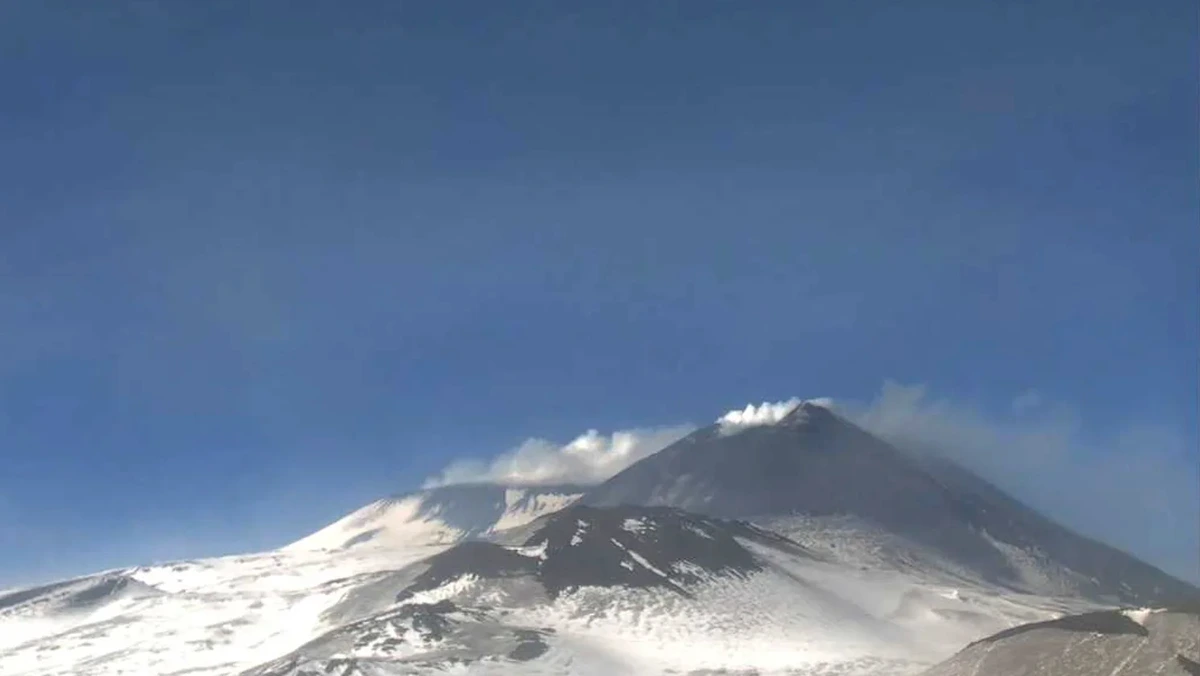
Image credit: INGV
A small degassing pit crater was identified at 3.1 km (10 170 feet) above sea level (a.s.l.) on the southern flank of Bocca Nuova Crater on February 28.
A modest lava overflow was also observed from the Southeast crater at 07:00 LT (06:00 UTC), producing a small lava flow on the upper southern flank of the crater. The overflow, which began in the early morning hours, is now diminishing and cooling.
Monte Conca and Rifugio Citelli clinometric stations recorded transient ground deformation of less than 2 microradians between 07:00 and 10:00 UTC, while other monitoring stations showed no variations.
Strombolian activity, which began at the Southeast Crater last night, continued into February 28.
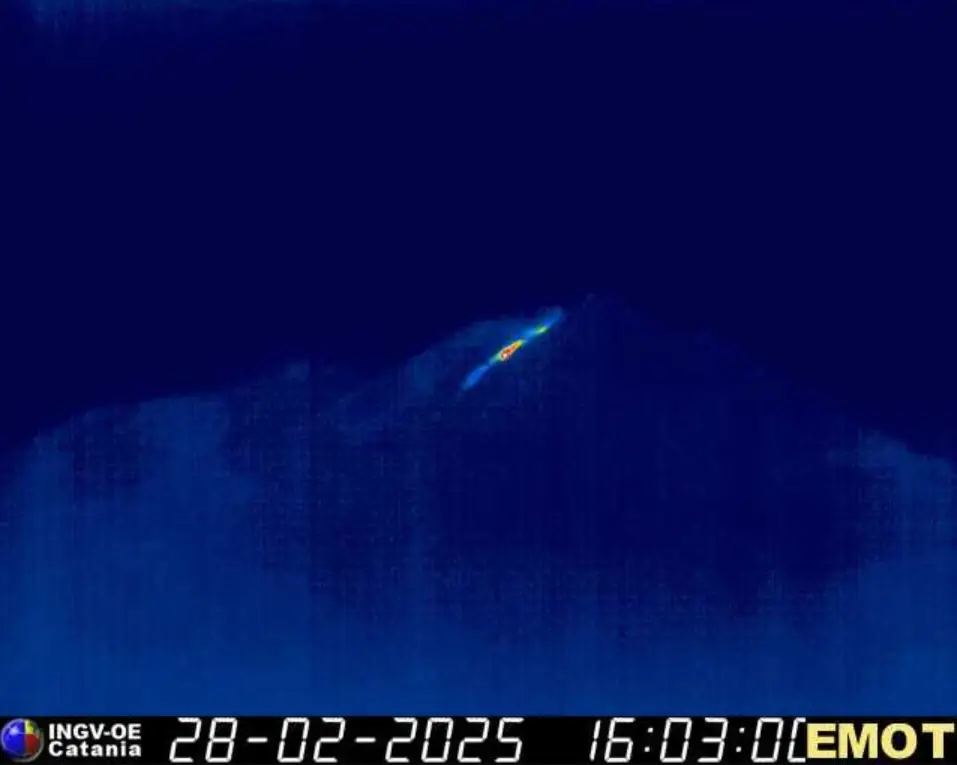
The average amplitude of volcanic tremor has gradually increased since the night of February 27, reaching high levels around 00:30 UTC on February 28 and peaking at 03:30 UTC, where it remains stable. The tremor’s centroid is positioned at the Southeast Crater at approximately 2.9 km (9 514 feet) a.s.l.
Infrasound activity has also been continuous, with moderate-amplitude infrasound events localized at the Southeast Crater. Effusive activity persists at the southern base of Bocca Nuova Crater, contributing to a lava flow extending south of the lava field from recent weeks.
The National Institute of Geophysics and Volcanology (INGV) reported continuous lava effusion from a fissure at the base of Bocca Nuova Crater between February 17 and February 23. During field inspections conducted on February 19, 22, and 24, scientists observed Strombolian activity at the Southeast Crater, with minor ash plumes dispersing near the summit.
While no explosions were visible between February 20 and 21, moderate explosions resumed on February 22 from three vents, intensifying by February 23. On February 24, a fourth explosive vent was identified, and at 13:23 UTC, a lava overflow occurred from the crater’s southern rim.
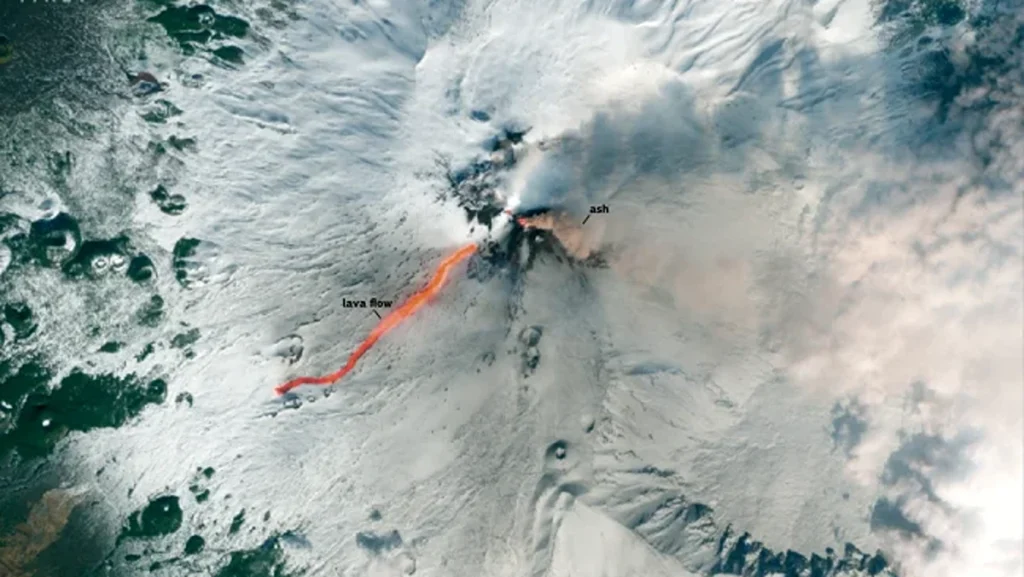
The fissure eruption from February 8 continued, with lava descending the southwestern flank to 1.8 km (6 037 feet) elevation during February 19–20. Lava flows extended between 3 km and 2.5 km (9 842 feet and 8 202 feet) elevation by the end of the week, covering a total length of 4.3 km (2.7 miles).
INGV observed new lava tube breakouts from lower elevations during their February 24 field inspection, with branching lava flows widening the field near the vent. A new vent opened at approximately 3.07 km (10 072 feet) elevation, releasing a small lava flow.
Mount Etna is one of the world’s most studied volcanoes because of its persistent activity. Its historical eruptions, dating back to 1500 BCE, have produced basaltic lava flows. The volcano features several summit craters, with activity often concentrated at the Southeast Crater and Bocca Nuova Crater. Flank eruptions, originating from fissures, can be more explosive and produce high lava effusion rates.
Etna’s ongoing eruption, which began on November 27, 2022, has been classified as a VEI 2 event with both explosive and effusive characteristics.
References:
1 Etna – INGV – February 28, 2025
2 Etna – GVP – Accessed on February 28, 2025

Rishika holds a Master’s in International Studies from Stella Maris College, Chennai, India, where she earned a gold medal, and an MCA from the University of Mysore, Karnataka, India. Previously, she served as a Research Assistant at the National Institute of Advanced Studies, Indian Institute of Science, Bengaluru, India. During her tenure, she contributed as a Junior Writer for Europe Monitor on the Global Politics website and as an Assistant Editor for The World This Week. Her work has also been published in The Hindu newspaper, showing her expertise in global affairs. Rishika is also a recipient of the Women Empowerment Award at the district level in Haryana, India, in 2022.

Commenting rules and guidelines
We value the thoughts and opinions of our readers and welcome healthy discussions on our website. In order to maintain a respectful and positive community, we ask that all commenters follow these rules.