
Air-sea heat flux anomalies show AMOC has not weakened in 60 years
A new study by an international research team found that the Atlantic Meridional Overturning Circulation (AMOC) has remained stable since 1963, contradicting previous claims of a long-term weakening trend.
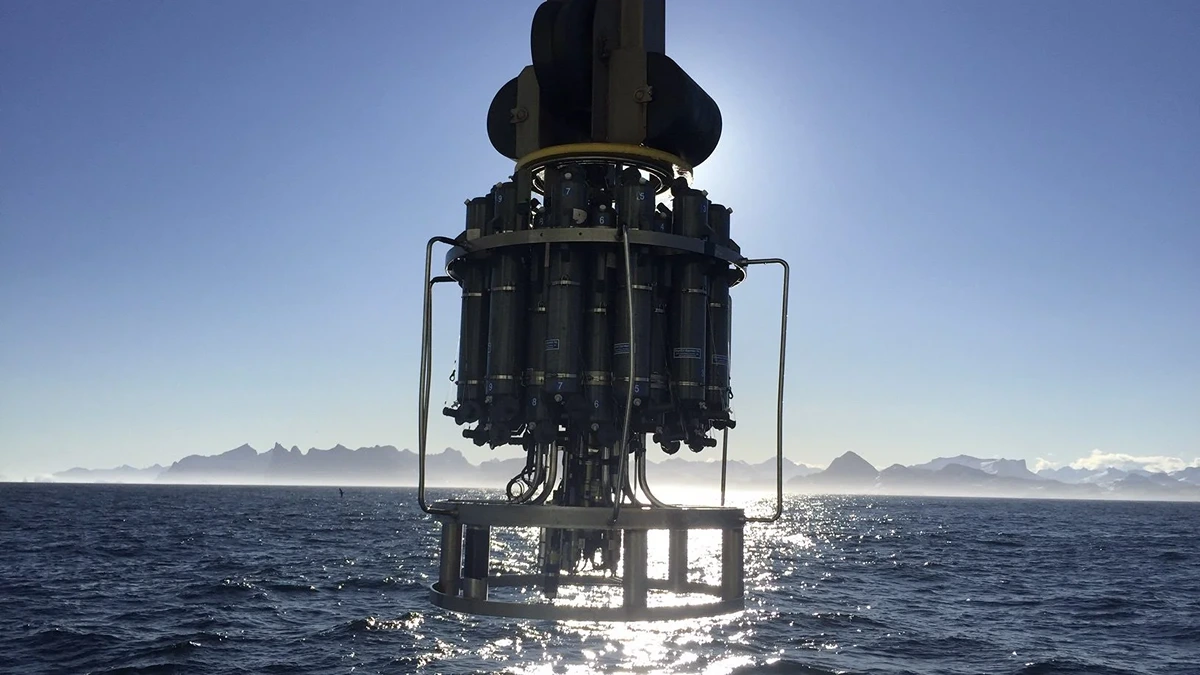
CTD rosette device. Image credit: WHOI
A new study revealed that the Atlantic Meridional Overturning Circulation (AMOC), a key component of global ocean circulation, has remained stable over the past six decades. This contradicts previous research which suggested a long-term weakening trend.
This research was conducted by scientists from the Woods Hole Oceanographic Institution (WHOI), the University of Georgia, the University of Bern, and Sorbonne Université, using a new approach based on air-sea heat flux anomalies rather than traditional Sea Surface Temperatures (SST) reconstructions.
“Our paper says that the Atlantic overturning has not declined yet,” Nicholas P. Foukal, an adjunct scientist in physical oceanography at WHOI and assistant professor at the University of Georgia, said.
“That doesn’t say anything about its future, but it doesn’t appear the anticipated changes have occurred yet.”
A shift in AMOC reconstruction methods
AMOC plays an important role in regulating Earth’s climate by transporting warm, salty water northward and returning cold, deep water southward. A strong AMOC helps maintain temperate climates in Europe and influences weather patterns across the globe. Weakening of the AMOC could lead to severe consequences including disruptions to tropical monsoons, an increase in hurricane intensity, and rising sea levels along the U.S. East Coast.
Until now, researchers have relied on SST anomalies to infer AMOC strength. The method assumes that colder temperatures in the subpolar North Atlantic indicate a weaker AMOC. Recent findings challenge this assumption, suggesting that SST-based reconstructions may be influenced by factors unrelated to AMOC such as atmospheric variability, Arctic sea ice fluctuations, and regional wind patterns.
“We’ve learned that sea surface temperature doesn’t work as well as initially thought. The ocean-atmosphere interactions are more complex than previously assumed, and other factors can cause temperature changes that don’t directly reflect AMOC variability,” Jens Terhaar, a senior scientist at the University of Bern and affiliated scientist at WHOI, explained why past methods fell short.
The research team adopted air-sea heat flux anomalies as a more direct measure of AMOC activity by acknowledging the limitations.
A strong AMOC facilitates the northward transport of warm water, leading to increased heat release into the atmosphere, whereas a weaker AMOC results in reduced heat exchange. The researchers say they achieved a more reliable reconstruction of AMOC trends compared to earlier methods based on sea surface temperature anomalies by analyzing these heat flux patterns.
The new approach marks a shift in how scientists monitor AMOC. Instead of relying on indirect surface temperature patterns, they now focus on heat transfer processes between the ocean and atmosphere as a more accurate diagnostic tool.
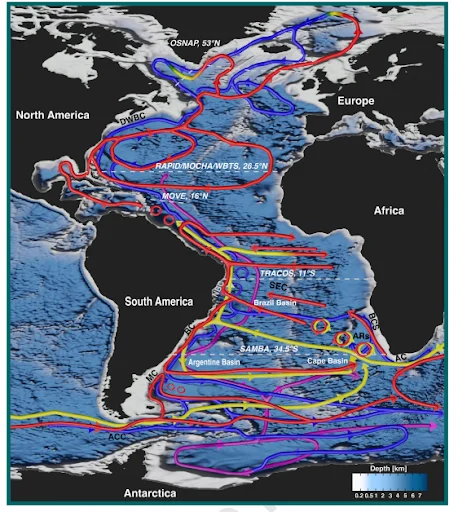
AMOC remained stable since 1963
The researchers analyzed historical AMOC trends by using data from the Coupled Model Intercomparison Project (CMIP6) which includes simulations from 24 different Earth system models. They found no evidence of a long-term weakening from 1963 to 2017.
Previous studies based on SST anomalies often suggested that AMOC had been steadily declining since the mid-20th century. SST anomalies, on the other side, can be influenced by multiple non-AMOC factors leading to misleading interpretations. The study provides a more robust reconstruction of AMOC trends by shifting the focus to air-sea heat flux anomalies.
The study used observational reanalysis data from ERA5 and JRA-55 which incorporate real-world observations into models to estimate past air-sea heat fluxes. The analysis confirmed that AMOC has shown decadal variability but no overall weakening trend. This means that while short-term fluctuations exist, the long-term stability of AMOC remains intact, challenging previous projections that suggested an ongoing decline.
“Based on the results, the AMOC is more stable than we thought,” Linus Vogt, a scientist at LOCEAN, Sorbonne Université, said.
“This might mean that the AMOC isn’t as close to a tipping point as previously suggested.”
Impact on climate science
AMOC has long been regarded as one of the main regulators of Earth’s climate. A collapse or slowdown could result in drastic climate shifts, affecting everything from storm intensities in Europe to rising sea levels along the U.S. East Coast, and even altering the monsoon systems in Africa and Asia.
Many climate models project that AMOC will weaken in the future in response to rising global temperatures, increased glacial meltwater from Greenland, and changing salinity patterns in the Atlantic.
The study provides an important update to climate science by challenging the widely held assumption that AMOC has been weakening continuously for decades. The research indicates that there has been no observed long-term decline yet, meaning AMOC remains stable for now, while climate models still suggest future weakening. The reassessment may influence how scientists refine climate predictions and how policymakers prioritize mitigation strategies.
The availability of reliable air-sea heat flux data from earlier decades is limited, making it difficult to reconstruct AMOC trends beyond the modern observational record. AMOC’s future trajectory will depend on the pace of ice melt, atmospheric CO2 levels, and regional oceanic changes. AMOC could still face challenges in the coming decades if warming trends accelerate.
“It’s almost unanimous at this point that the Atlantic overturning will slow in the future, but whether or not it will collapse is still up for debate,” said Foukal.
“This work indicates that there is still time to act before we reach this potential tipping point.”
Why air-sea heat fluxes matter?
Air-sea heat flux anomalies provide a direct measure of heat exchange between the ocean and atmosphere, making them a stronger proxy for AMOC strength than SST anomalies. Traditional SST-based methods assumed that cooling in the subpolar North Atlantic was driven by a weakening AMOC. SST variability can result from multiple factors unrelated to AMOC including atmospheric pressure patterns, wind-driven changes in ocean currents, and Arctic ice melt, making it an unreliable metric for assessing AMOC strength.
Air-sea heat fluxes, by contrast, track the actual exchange of heat between the ocean and atmosphere, offering a more precise measure of AMOC activity. When AMOC is strong, it releases more heat into the atmosphere over the North Atlantic. A weaker AMOC leads to reduced heat flux, altering atmospheric circulation and influencing climate patterns.
The study found that AMOC and air-sea heat flux anomalies were strongly correlated on decadal and centennial timescales but less so on shorter timescales because of atmospheric variability. This means that while short-term SST changes may not always align with AMOC shifts, long-term heat flux measurements offer a clearer picture of AMOC trends.
References:
1 Atlantic overturning inferred from air-seaheat fluxes indicates no decline sincethe 1960s, Jens Terhaar, Linus Vogt & Nicholas P. Foukal, nature – January 15, 2025 – https://doi.org/10.1038/s41467-024-55297-5 – OPEN ACCESS
2 New study finds that critical ocean current has not declined in the last 60 years – WHOI – January 15, 2025

Rishika holds a Master’s in International Studies from Stella Maris College, Chennai, India, where she earned a gold medal, and an MCA from the University of Mysore, Karnataka, India. Previously, she served as a Research Assistant at the National Institute of Advanced Studies, Indian Institute of Science, Bengaluru, India. During her tenure, she contributed as a Junior Writer for Europe Monitor on the Global Politics website and as an Assistant Editor for The World This Week. Her work has also been published in The Hindu newspaper, showing her expertise in global affairs. Rishika is also a recipient of the Women Empowerment Award at the district level in Haryana, India, in 2022.

Commenting rules and guidelines
We value the thoughts and opinions of our readers and welcome healthy discussions on our website. In order to maintain a respectful and positive community, we ask that all commenters follow these rules.