
Lava flow observed at Etna’s summit craters, Aviation Color Code raised to Orange, Italy
A fresh lava flow emerged from the summit craters at Mount Etna at approximately 17:35 UTC (18:35 LT) on February 8, 2025, prompting INGV to raise the Aviation Color Code to Orange.

Mount Etna on February 8, 2025. Credit: INGV
A new lava flow was observed from Mount Etna’s summit at approximately 18:35 LT (17:35 UTC) on February 8, 2025, as seen through visible and thermal surveillance cameras and confirmed by field personnel from the National Institute of Geophysics and Volcanology (INGV).
The flow originated at an estimated altitude of 3 km (9 843 feet) above sea level (a.s.l.), between the Bocca Nuova crater and the Southeast Crater, extending toward Monte Frumento Supino.
The current lava flow follows a phase of moderate and sporadic explosive activity recorded at the Southeast Crater since February 6, 2025.
INGV raised the Aviation Color Code to Orange at 19:19 UTC, following an earlier increase from Green to Yellow at 19:04 UTC.
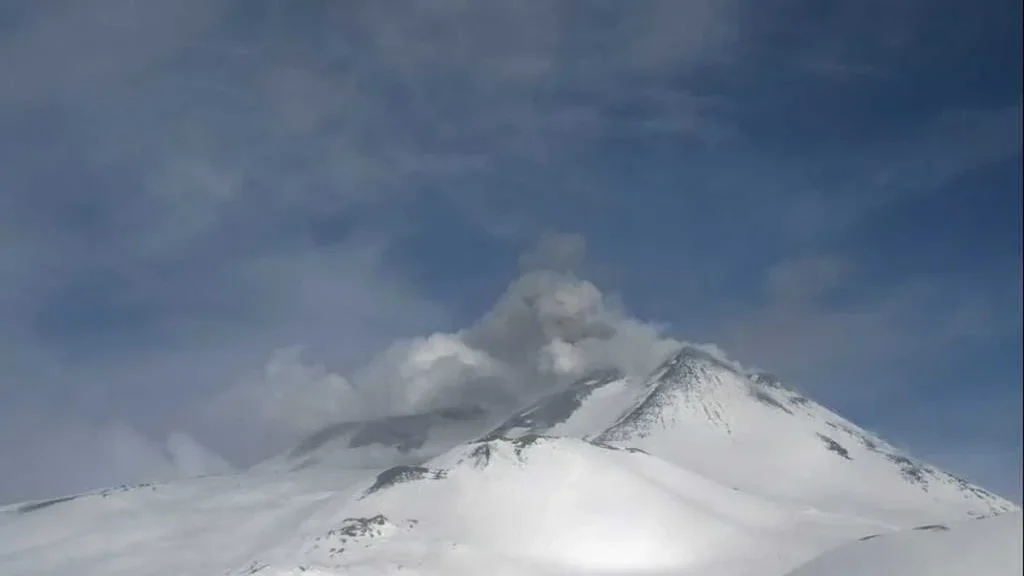
The latest report confirms that no volcanic ash cloud has been produced, meaning no immediate air traffic disruptions.
The volcanic tremor amplitude remained within moderate fluctuations, maintaining a medium-level intensity. The tremor source centroid is located at the Southeast Crater, at an elevation of 2.8 to 3 km (9 180 to 9 850 feet) a.s.l.
Infrasound activity was almost absent but moderate infrasound signals were detected from the Southeast Crater in previous days.
The GNSS network has not recorded major variations and the tiltmeter network shows only a very slight shift (tenths of a microradian) at the summit station of Cratere del Piano (ECP).
During the previous activity from November 6 to 12, 2024, lava fountaining and gas emissions were observed at the summit craters, with ash plumes rising to 9.5 km (31 200 feet) a.s.l. and drifting eastward, affecting Milo, Fornazzo, Mascali, and Torre Archirafi.
Mount Etna is a composite stratovolcano that stands at 3 357 m (11 014 feet) a.s.l. and is one of the world’s most active volcanoes, with an eruptive history spanning over 150 confirmed Holocene periods.
It lies within the Sicily Volcanic Province, part of a subduction zone on continental crust exceeding 25 km (15.5 miles) in thickness.
References:
1 Etna – GVP – Accessed on February 9, 2025
2 Etna – INGV/VONA – February 8, 2025
3 Volcanic activity report for Etna – INGV – February 8, 2025

Rishika holds a Master’s in International Studies from Stella Maris College, Chennai, India, where she earned a gold medal, and an MCA from the University of Mysore, Karnataka, India. Previously, she served as a Research Assistant at the National Institute of Advanced Studies, Indian Institute of Science, Bengaluru, India. During her tenure, she contributed as a Junior Writer for Europe Monitor on the Global Politics website and as an Assistant Editor for The World This Week. Her work has also been published in The Hindu newspaper, showing her expertise in global affairs. Rishika is also a recipient of the Women Empowerment Award at the district level in Haryana, India, in 2022.

Commenting rules and guidelines
We value the thoughts and opinions of our readers and welcome healthy discussions on our website. In order to maintain a respectful and positive community, we ask that all commenters follow these rules.