
Over 9 000 people evacuate Santorini as seismic crisis worsens, UK issues travel advisory, Greece
Over 9 000 residents and tourists evacuated Santorini island by ferry and emergency flights on February 3 and 4, 2025, following a surge in seismic activity that began on January 28. Authorities remain on high alert as the region continues to experience strong earthquakes, including 43 tremors above M4.0 since February 1.
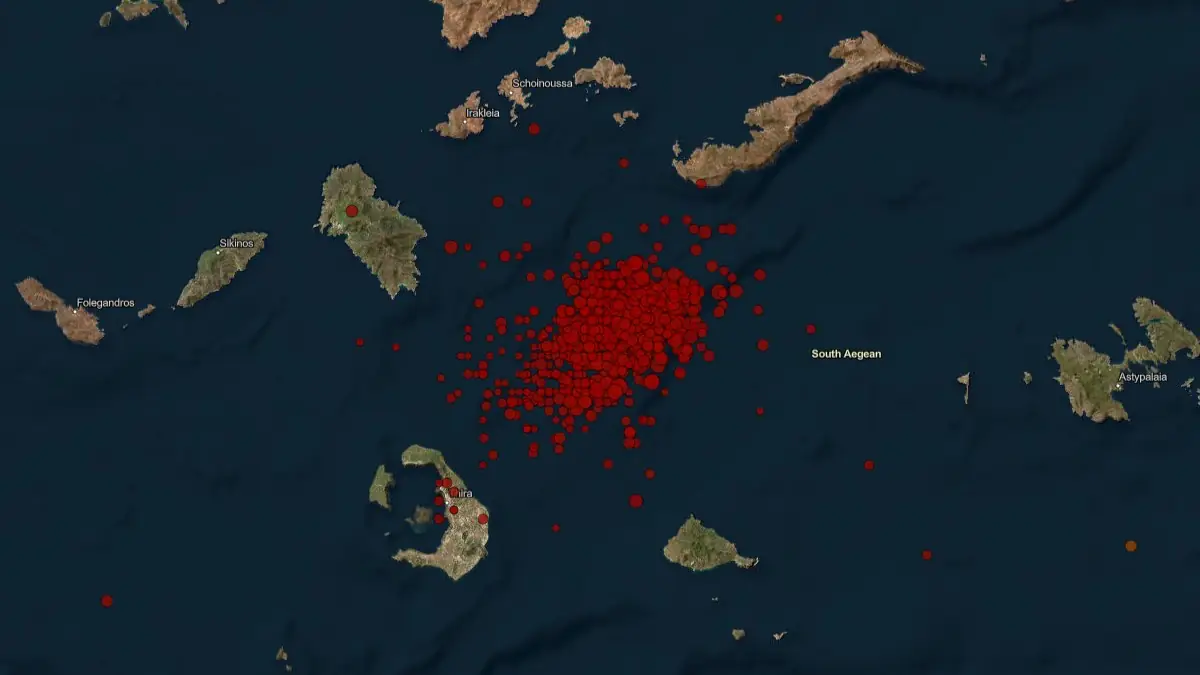
Earthquakes near Santorini volcano, Greece January 28 - February 4, 2025. Credit: TW/SAM, ESRI
Thousands of people are evacuating Santorini during a surge in seismic activity, with over 9 000 residents and tourists departing the island by ferry and emergency flights over the past two days. Ferry operators Blue Star Paros and Kissamos added emergency routes to Piraeus as families waited to board the ferry.
Giorgos Hatzimarkos, the Governor of the South Aegean, estimated that between 5 000 and 6 000 people had left Santorini by February 3, a number that increased to over 9 000 on February 4.
The Greek government has been implementing emergency response plans, including “Talos 2” and “Enceladus 2,” which outline precautionary measures but do not include full-scale evacuations.
“There is no wave of tourist cancellations,” Hatzimarkos emphasized despite public concerns.
Tourism authorities continue to monitor the situation to prevent economic repercussions. Airlines and ferry services have increased their schedules to accommodate those wishing to leave.
Aegean Airlines operated 9 flights from Santorini to Athens on February 3, transporting 1 294 passengers. On February 4, 8 flights were scheduled, with an additional four emergency flights planned.
The National and Kapodistrian University of Athens (NKUA) Seismology Laboratory has recorded over 2 500 earthquakes between June 2024 and February 1, 2025, with more than 1 200 occurring in the last three days alone.
The seismic activity further increased between February 1 and 4 during which 43 earthquakes exceeding a magnitude of 4.0 were recorded, with the strongest measuring M5.0 on February 3 at 14:17 LT (12:17 UTC) and February 4 at 04:46 (02:46 UTC).
The Seismology Laboratory of NKUA has been monitoring seismic activity in the Santorini volcanic complex and the Santorini-Amorgos fault zone. The recent seismic events are the most important from 2011 to 2012, when similar activity was last observed within the Santorini Caldera.
Microseismic epicenters have been concentrated around Nea Kameni and the Imerovigli–Fira region, aligned with the Kameni Line fault system in a northeast-southwest direction. Additional activity has been detected near Kolumbo, an underwater volcano situated 8 km (26 247 feet) northeast of Santorini.
A rapid increase in earthquakes was recorded east of Kolumbo between January 26 and 29, bringing the total count to over 2 500 by February 1. The swarm has since spread to the islet of Anydros. The seismic events include both tectonic and volcanic origins, with concerns about potential interactions between local fault systems and magmatic movements.
Ground deformation studies indicate that horizontal and vertical shifts in the region’s tectonic behavior have been occurring since August 2024.
The NKUA Geophysics Laboratory has identified a shift in horizontal motion towards an east-northeast direction, with uplift rates comparable to those recorded from 2011 to 2012. A new GPS survey is being conducted to track spatial ground movement around Nea Kameni and Kolumbo.
“As Africa subducts beneath Europe along an arc south of Crete, the sinking plate melts, generating volcanic activity,” said Avraam Zelilidis, Professor of Geology at the University of Patras, who attributed the earthquakes to magmatic movements.
Other seismologists including Kostas Papazachos, suggest that the sequence could be a foreshock series leading to a larger earthquake.
Seismologists remain divided on the risk of a major event. While some believe the earthquake swarm could stabilize, others caution that a larger earthquake exceeding M6.0 is possible.
“It seems that a seismic fault has been activated, and it is quite large, capable of producing an earthquake above 6.0 Richter,” Professor Manolis Skordilis from the Aristotle University of Thessaloniki noted.
The Greek Organization for Earthquake Planning and Protection (OASP) has issued warnings, advising residents to avoid old or structurally weak buildings and stay clear of steep slopes. Schools in Santorini, Amorgos, Ios, and Anafi have been closed until February 7 as a precautionary measure.
Seismic risk assessments indicate that while the ongoing sequence is likely tectonic, concerns remain about potential volcanic activity.
“Three out of the four signs of a volcanic eruption have occurred in Santorini,” Övgün Ahmet Erçan, the Turkish Geophysics Professor, warned.
Greek scientists, on the other hand, insist that there is no direct link between the current earthquakes and volcanic activity.
The UK Foreign, Commonwealth & Development Office has updated its travel advice for Greece, particularly for the islands of Santorini (Thira), Anafi, Ios, and Amorgos, due to increased seismic activity. Travelers are advised to avoid large indoor gatherings, old or abandoned buildings, and certain ports, including Amoudi, Armeni, Korfos, and the Old Port of Fira.
Additionally, caution is urged when traveling in areas with a high risk of landslides, and in the event of a strong tremor, individuals should immediately move away from coastal areas.
Local authorities in Amorgos have designated emergency assembly points and instructed residents to stay alert for tsunami risks.
The Ministry of Climate Crisis and Civil Protection has also deployed emergency rescue teams, aerial monitoring drones, and additional seismic instruments to the region.
References:
1 Thousands of people are leaving Santorini, authorities on alert – Swarm earthquake scenario gaining traction due to continuous tremors – Live updates – OEMA – February 4, 2025
2 Foreign travel advise – Greece – GOV.UK – February 2, 2025

Rishika holds a Master’s in International Studies from Stella Maris College, Chennai, India, where she earned a gold medal, and an MCA from the University of Mysore, Karnataka, India. Previously, she served as a Research Assistant at the National Institute of Advanced Studies, Indian Institute of Science, Bengaluru, India. During her tenure, she contributed as a Junior Writer for Europe Monitor on the Global Politics website and as an Assistant Editor for The World This Week. Her work has also been published in The Hindu newspaper, showing her expertise in global affairs. Rishika is also a recipient of the Women Empowerment Award at the district level in Haryana, India, in 2022.

FYI — Santorini rocked by more earthquakes hours after it was hurled into state of emergency —
Santorini, a popular tourist hotspot in Greece, is in crisis mode after thousands of tremors forced authorities to take drastic action – and nearly 15,000 people have fled since Sunday
– Mirror (UK) – ByBradley JollyNews Reporter – 01:01, 7 Feb 2025 – UPDATED 01:29, 7 FEB 2025 –
.
— EXCERPTS — Greek seismologist Akis Tselepis warned that the same fault line responsible for the catastrophic 1956 earthquake — which killed 50 people and injured hundreds — has been reactivated.
– The expert told The Sun: “The seismic activity is not withdrawing, on the contrary, it is gaining in momentum. The worst-case scenario is that we will again see an earthquake of the same magnitude.” –
.
– The island’s dramatic cliffs have been scarred by landslides, with clouds of dust rising as rocks crash into the sea. Police have cordoned off large parts of the island, which is in the Aegean Sea. It is one of Greece’s smaller islands, dwarfed by the likes of Crete, Evia and Rhodes around it.
– Since February 1, a staggering 108 earthquakes measuring more than 4.0 on the Richter scale have been recorded in Santorini — more than in the entire year of 2023. In total, more than 7,700 tremors – smaller vinrations – have shaken the region in just one week.
.
AND — Israel prepares for possible tsunami following earthquakes in Greece —
– World Israel News – February 6, 2025 –
.
– EXCERPT – Thousands of small earthquakes in the Santorini Islands in recent days have raised concerns about the potential for a larger earthquake in the region, which could lead to a tsunami in the Mediterranean.
– Ariel Heimann, a senior geologist at the Institute for National Security Studies (INSS), described the concern over the seismic activity in Santorini and said, “Approximately 2,000 earthquakes have occurred in Santorini over the past week, with the strongest measuring between 4 and 5.3 in magnitude, including 24 in the past 24 hours.” –
.
AND — How long could the Santorini ‘seismic crisis’ last? —
– Malu Cursino – BBC News – Thu, February 6, 2025 at 10:13 PM CST –
.
— EXCERPTS — The “clusters” of quakes have puzzled scientists who say such a pattern is unusual because they have not been linked to a major shock. So what’s going on?
.
– What is happening in Santorini? –
– Experts agree the island is experiencing what Greece’s prime minister has called an “extremely and intricate geological phenomenon”.
– “It is really unprecedented, we have never seen something like this before in [modern times] in Greece,” says Dr Athanassios Ganas, research director of the National Observatory of Athens. –
.
AND — Santorini Earthquake Emergency Explained: Could the Volcano Erupt? —
– Greek Reporter – By Nick Kampouris – February 7, 2025 –
.
EXCERPT — Could Santorini’s Kolumbo volcano erupt? —
– Kolumbo is a volcano that lies under the Aegean Sea. It is located about seven kilometers (4 miles) northeast of Santorini’s caldera and it is located along the Hellenic Volcanic Arc.
– It is one of the most active and hazardous volcanoes in the Aegean Sea but has remained dormant since its last eruption almost four centuries ago, in 1650 AD. That eruption was catastrophic: it blasted pumice and ash across the region, releasing toxic gases that caused fatalities on Santorini and triggered a tsunami that affected coastal areas of much of the Aegean islands and the Greek mainland.
– However, despite its destructive history, scientists believe that Kolumbo is unlikely to erupt soon. –
.
— USGS Earthquake Hazards Program – Latest Earthquakes Worldwide —
– 07 FEB 2025 – 07:16:15 – 5.1 (Magnitude) – 10 km (Depth) – DODECANESE ISLANDS, GREECE –
.
FYI — The Municipality of Santorini has been declared in a state of emergency —
– More than 6,400 earthquakes have occurred in the Santorini-Amorgos zone from January 26 to February 3 –
Proto Thema
.
UPDATE — Santorini in state of emergency after strongest quake in days of tremors —
– EXCERPT – A state of emergency has been declared in Santorini after the strongest earthquake was recorded in days of near-constant tremors, which have almost emptied the famous Greek tourist haven of visitors and residents.
– A quake with a magnitude of 5.2 coursed through Santorini on Wednesday evening, the first to exceed 5.0 since the tremors began last week.
– The Greek Civil Protection Ministry on Thursday placed the island under a state of emergency until March 3 to respond to the seismic activity.
– Around 11,000 people are thought to have fled the island, which attracts more than 3.4 million tourists a year and is home to some 20,000 permanent residents. –
CNN Travel – By Chris Liakos and Christian Edwards, CNN – Updated 9:18 AM EST, Thu February 6, 2025
.