
Lithospheric ‘dripping’ occurring beneath Türkiye’s Central Anatolian Plateau
Geoscientists at the University of Toronto, working with Turkish experts, have discovered lithospheric ‘dripping’ beneath Turkey’s Central Anatolian Plateau. This phenomenon occurs when dense parts of the mantle lithosphere descend into the overlying asthenosphere, reshaping the region’s surface by deepening the Konya Basin and elevating surrounding places.
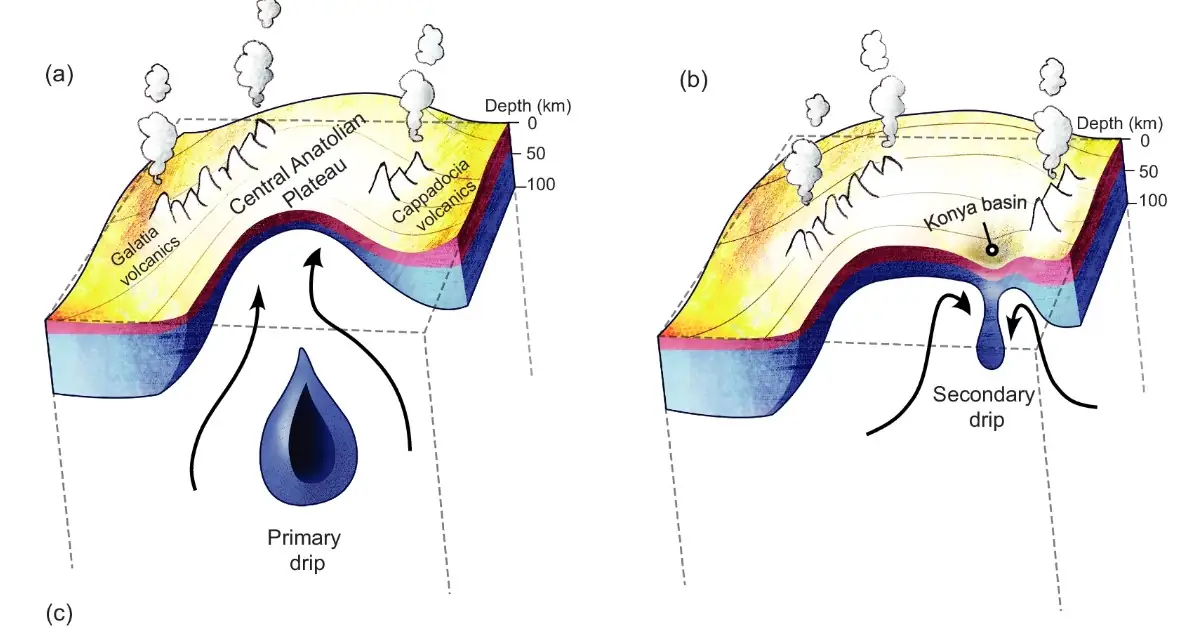
Image credit: Nature/Authors
- Researchers used satellite data and laboratory simulations to explain how the ‘dripping’ mechanism promotes tectonic shifts, providing insights into planetary geology that might be applied to Mars and Venus.
- The study revealed that this process has occurred across millions of years.
The study discussed lithospheric dripping, in which dense portions of the Earth’s mantle lithosphere (the rigid outer layer) separate and drop into the fluid-like asthenosphere below. This produces dramatic changes in surface topography, such as the sinking of the Konya Basin and the elevation of neighboring places.
Over millions of years, this process changed the Central Anatolian Plateau, resulting in its current geological features. The findings also indicated that lithospheric dripping could be a new type of tectonic activity with far-reaching ramifications for planetary geology, including Mars and Venus.
The study focused on Turkey’s Central Anatolian Plateau, which is tectonically active and has a complex geological past. The plateau, positioned at the convergence of the Eurasian, Arabian, and African tectonic plates, has seen remarkable changes due to these interactions.
Within this region, the Konya Basin, a vast depression, has been severely impacted by lithospheric leaking and deepening due to subsurface processes. This study explains why the basin collapses despite the adjacent plateau’s uplift.
Lithospheric leaking is caused by the instability of the dense lithospheric mantle and the less dense asthenosphere. The mantle lithosphere densifies with time, usually due to chemical changes or cooling. When it can no longer maintain its weight, it seeps into the underlying mantle.
“Looking at the satellite data, we observed a circular feature at the Konya Basin where the crust is subsiding, or the basin is deepening,” says lead author Julia Andersen, a Ph.D. candidate in U of T’s Department of Earth Sciences in the Faculty of Arts & Science. “This prompted us to look at other geophysical data beneath the surface where we saw a seismic anomaly in the upper mantle and a thickened crust, telling us there is high-density material there and indicating a likely mantle lithospheric drip.”
A team of geoscientists led by Julia Andersen, a Ph.D. candidate at the University of Toronto, in collaboration with Istanbul Technical University and Çanakkale Onsekiz Mart University in Türkiye, confirmed the occurrence of this geological process occurring beneath Türkiye’s Central Anatolian Plateau.
The work, published in Nature Communications, sheds light on how lithospheric leaking impacts the region’s environment and has implications for understanding tectonic processes worldwide.
Following a year of experimental simulations and studies, the drip mechanism has only recently been confirmed. To validate the presence of lithospheric dripping, the research team employed a combination of analog modeling and digital imaging methods. The analog model, built with materials that mimic the Earth’s crust and mantle features, enabled scientists to reproduce the process in a laboratory setting.
By scaling these models to represent natural conditions, they could detect drip creation and fall inside the mantle lithosphere. The experiment was continuously observed with high-resolution cameras and particle imaging velocimetry, resulting in exact observations of crustal movements. This novel approach demonstrated that the drip process was a significant driver of geological changes beneath the Central Anatolian Plateau.
“The key conclusion of this work is that basin evolution and plateau uplift may be linked in a multistage process of lithospheric removal within a large-scale orogenic plateau system. Supported by geological, geophysical, and geodetic data, our model results explain the enigmatic active subsidence of the Konya Basin amidst the rising Central Anatolian plateau interior,” the researchers concluded.
References:
¹ Multistage lithospheric drips control active basin formation within an uplifting orogenic plateau – Andersen, A.J., Göğüş, O.H., Pysklywec, R.N. et al. – Nat Commun 15, 7899 (2024) – September 13, 2024 – https://doi.org/10.1038/s41467-024-52126-7 – OPEN ACCESS

Harsha Borah is an experienced content writer with a proven track record in the industry. Harsha has worked with LitSpark Solutions and Whateveryourdose, honing skills in creating engaging content across various platforms. A gold medalist in a state-level writing competition organized by Assam Tourism, Harsha’s travelogue on Tezpur was widely appreciated. Harsha’s article, "The Dark Tale of the Only Judge in India to Be Hanged," ranks second on Google and has garnered over 11 000 views and 8 900 reads on Medium. Outside of writing, Harsha enjoys reading books and solving jigsaw puzzles.

Commenting rules and guidelines
We value the thoughts and opinions of our readers and welcome healthy discussions on our website. In order to maintain a respectful and positive community, we ask that all commenters follow these rules.