
Coldest early May on record in European Russia
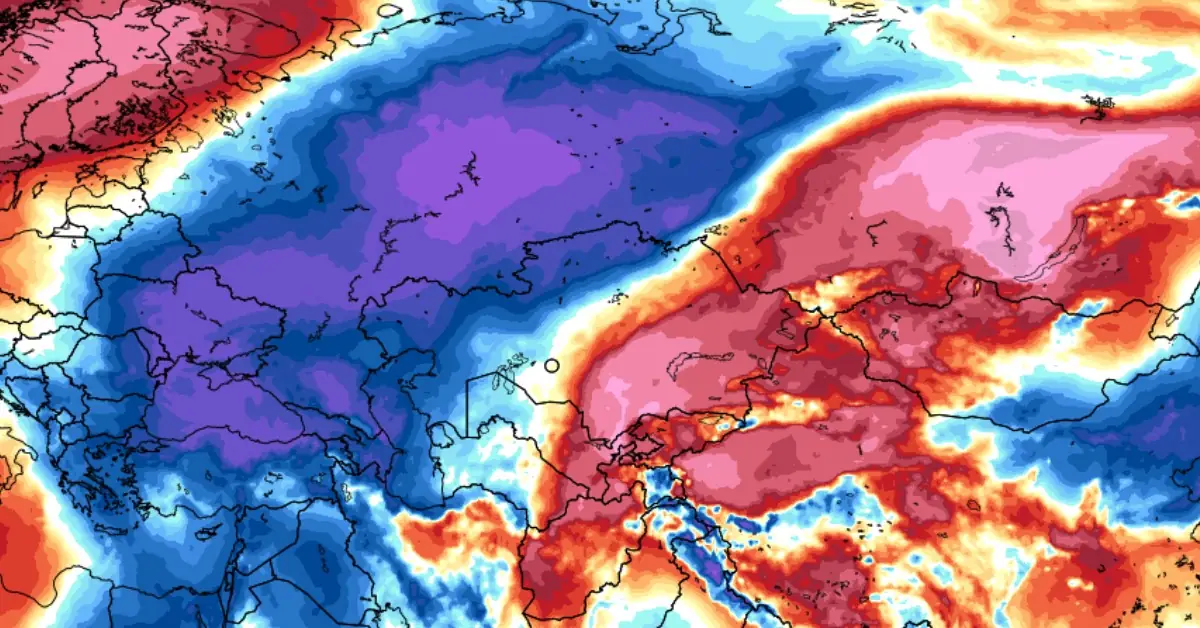
Image credit: TropicalTidbits, GFS (temperature anomaly model 850 hPa, May 14, 2024)
The first ten days of May in the European part of Russia may be recognized as the coldest on record, according to Roman Vilfand of the Russian Hydrometeorological Center. Cold air masses from the Arctic Ocean caused temperatures to drop significantly, affecting not only Russia but also Turkey with severe weather.
The first ten-day period of May in the European part of Russia may be recognized as the coldest in the history of observations, according to Roman Vilfand, the scientific head of the Russian Hydrometeorological Center. The region experienced an unusual meteorological situation, where cold air masses from the Arctic Ocean were drawn in, leading to significantly lower temperatures.
Vilfand explained to TASS that two different weather systems—a western anticyclone and an eastern cyclone—contributed to this cold air movement from the Arctic Ocean.
This rare phenomenon caused temperatures in the first ten days of May to drop by 8 – 10 °C (14 – 18 °F) relative to the climatic norm. He also noted that the current weather in the European part of Russia is lagging behind typical patterns by three to four weeks.
As a result of this cold spell, temperatures through May 15 were expected to be 5 – 7 °C (9 – 13 °F) below the norm. The cold air masses originated from the Kara Sea and the Laptev Sea, significantly impacting the region’s climate.
On May 13, the cyclone from the European part of Russia reached Turkey, causing a sharp drop in temperatures, strong winds, and heavy rains in some areas. By the evening, snow began to fall in Kocaeli province’s Kartepe district, and in the mountains of Bolu province, about ten villages were covered with a 5 cm (2 inches) layer of snow. Snowfall continued on Tuesday night in Kastamonu province.
Ardahan, Turkey today…❄️pic.twitter.com/AoHGReXzT2
— Volcaholic (@volcaholic1) May 14, 2024
The General Department of Meteorology of Turkey has issued a “yellow” level weather danger alert in six provinces due to the threat of heavy precipitation. The cold air advection from Russia has significantly disrupted the usual weather patterns, leading to these severe weather conditions in Turkey.
References:
1 Early May in Russia broke the observation record – RuNews24 – May 13, 2024

Teo Blašković founded The Watchers in 2011 and edited it until 2026, covering seismic and volcanic activity, extreme weather, space weather and near-Earth objects. Articles on this page are his archive.
Published in the last 24 hours
- Strong El Niño reinforces above-normal winter precipitation outlook across southern and eastern U.S.
- Scientists directly observe how submarine landslides unfold in western Canada Epicenter
- Odisha evacuated 983,642 people before Phailin crossed near Gopalpur on 12 October 2013 with winds of 200-210 km/h gusting to 220, and 44 died, against 9,885 in the 1999 super cyclone. Cyclone Akvan crossed the same coast on 20 November 2026. Epicenter
- Lava fountains reached 1,900 feet (580 m) at Kīlauea Iki in 1959, the highest ever recorded at Kīlauea, as USGS forecasts episode 57 fountaining at Halemaʻumaʻu for November 22-26. Epicenter

The fluctuations in the surface temperature is a basic feature during the rapid shift in of Earth’s magnetic field