
CME impacts Earth, producing G3 – Strong geomagnetic storming

Image credit: The Watchers (stock photo)
A coronal mass ejection (CME) produced by filament eruption on August 2, 2023, combined with a smaller CME produced on August 1 and reached our planet at 02:53 UTC on August 5.
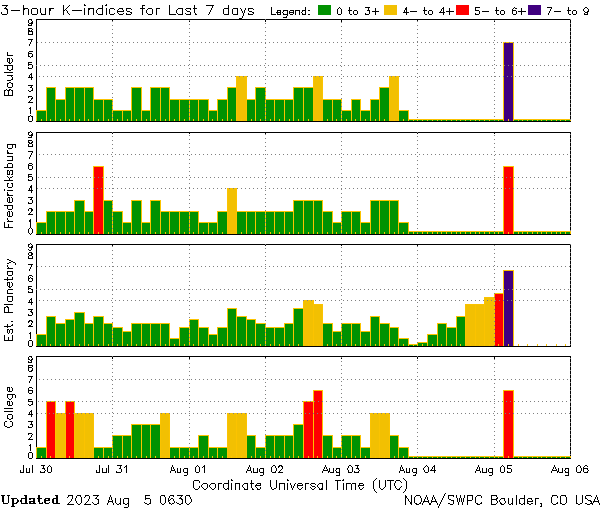
The geomagnetic field responded with a G1 – Minor geomagnetic storm at 03:35 UTC. Geomagnetic K-index of 6 (G2 – Moderate geomagnetic storm) threshold was reached at 04:20 UTC, followed by G3 -Strong geomagnetic storm (K-index of 7) at 05:59 UTC. The conditions briefly subsided by 07:21 UTC to G1 – Minor storm levels.
G3 – Strong geomagnetic storm potential impacts (area of impact primarily poleward of 50 degrees Geomagnetic Latitude):
- Induced currents – Power system voltage irregularities possible, false alarms may be triggered on some protection devices.
- Spacecraft – Systems may experience surface charging; increased drag on low Earth-orbit satellites and orientation problems may occur.
- Navigation – Intermittent satellite navigation (GPS) problems, including loss-of-lock and increased range error may occur.
- Radio – HF (high frequency) radio may be intermittent.
- Aurora – Aurora may be seen as low as Pennsylvania to Iowa to Oregon.
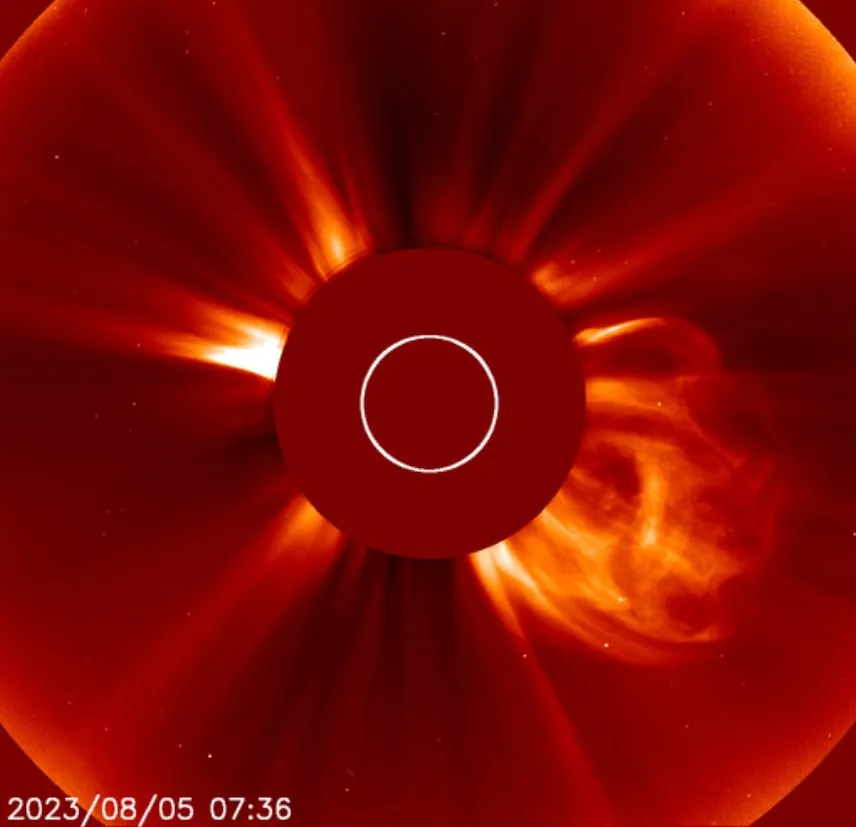
Solar activity in 24 hours to 00:30 UTC on August 5 reached moderate levels. Region 3386 (beta) produced a long-duration M1.9 solar flare at 04:24 UTC on August 5. The associated CME was observed in SOHO LASCO C2 coronagraph imagery beginning at 04:28 UTC. It was the largest event of the period.
The analysis of the event shows the potential for a glancing blow around early to midday on August 7.
The greater than 2 MeV electron flux reached moderate levels during the period, while the greater than 10 MeV proton flux was at background levels.
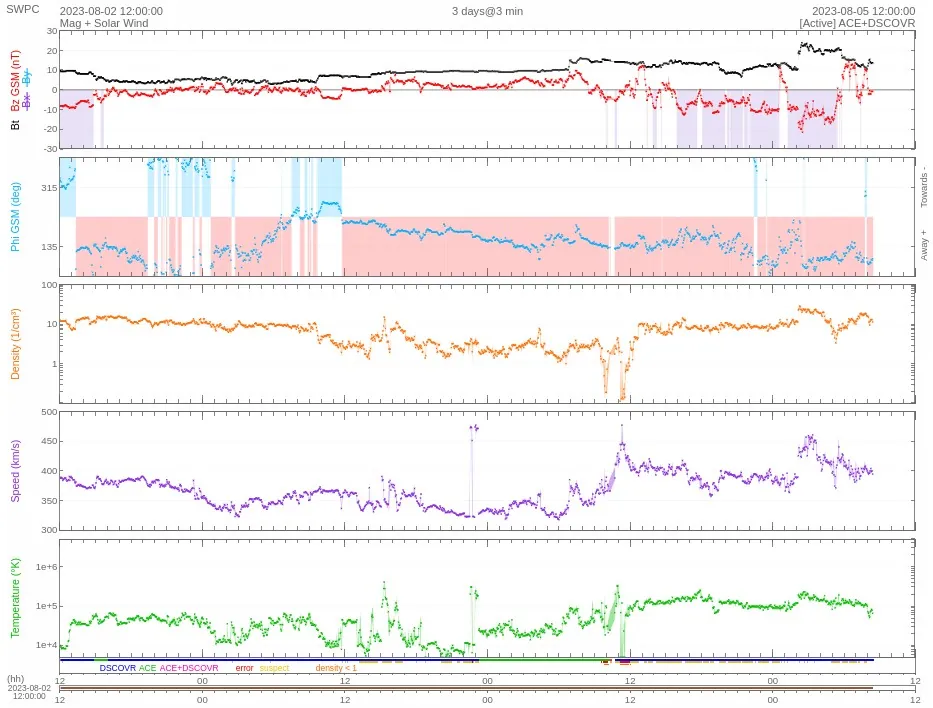
Solar wind parameters became enhanced around 06:55 UTC on August 4, possibly due to weak transient activity. Total field increased from 10 nT to a maximum of 16 nT with the Bz component +/-12 nT. Solar wind speed briefly increased to around 450 km/s around midday before diminishing to near 400 km/s. Phi angle was positive.
M-class (R1-R2/Minor-Moderate) flare activity is likely on August 5, followed by low solar activity with just a chance for M-class flares on August 6 and 7.
The greater than 2 MeV electron flux is expected to be at normal to moderate levels through August 7. The greater than 10 MeV proton flux is expected to be at background levels during the same period, with a slight chance for an S1 – Minor radiation event today due to the flare potential of Region 3380.
Unsettled and active geomagnetic field levels are expected on August 6 as CME effects slowly diminish. A possible glancing blow from the August 4 CME will likely cause unsettled to active levels on August 7.
References:
1 Forecast Discussion – Issued 2023 Aug 05 0030 UTC – Prepared by the U.S. Dept. of Commerce, NOAA, Space Weather Prediction Center

I'm a dedicated researcher, journalist, and editor at The Watchers. With over 20 years of experience in the media industry, I specialize in hard science news, focusing on extreme weather, seismic and volcanic activity, space weather, and astronomy, including near-Earth objects and planetary defense strategies. You can reach me at teo /at/ watchers.news.

Commenting rules and guidelines
We value the thoughts and opinions of our readers and welcome healthy discussions on our website. In order to maintain a respectful and positive community, we ask that all commenters follow these rules.