
G1 – Minor geomagnetic storm underway, NOAA forecasts possible G2 conditions
A G1 – Minor geomagnetic storm is in progress on February 22, 2026, with Kp index values reaching 5 since 03:00 UTC, according to the NOAA Space Weather Prediction Center (SWPC). At 08:00 UTC, the agency issued a G2 – Moderate warning valid through 15:00 UTC, forecasting a possible rise to Kp 6 later in the day as solar-wind conditions remain elevated.

Image credit: ESA, CC BY-SA 3.0 IGO
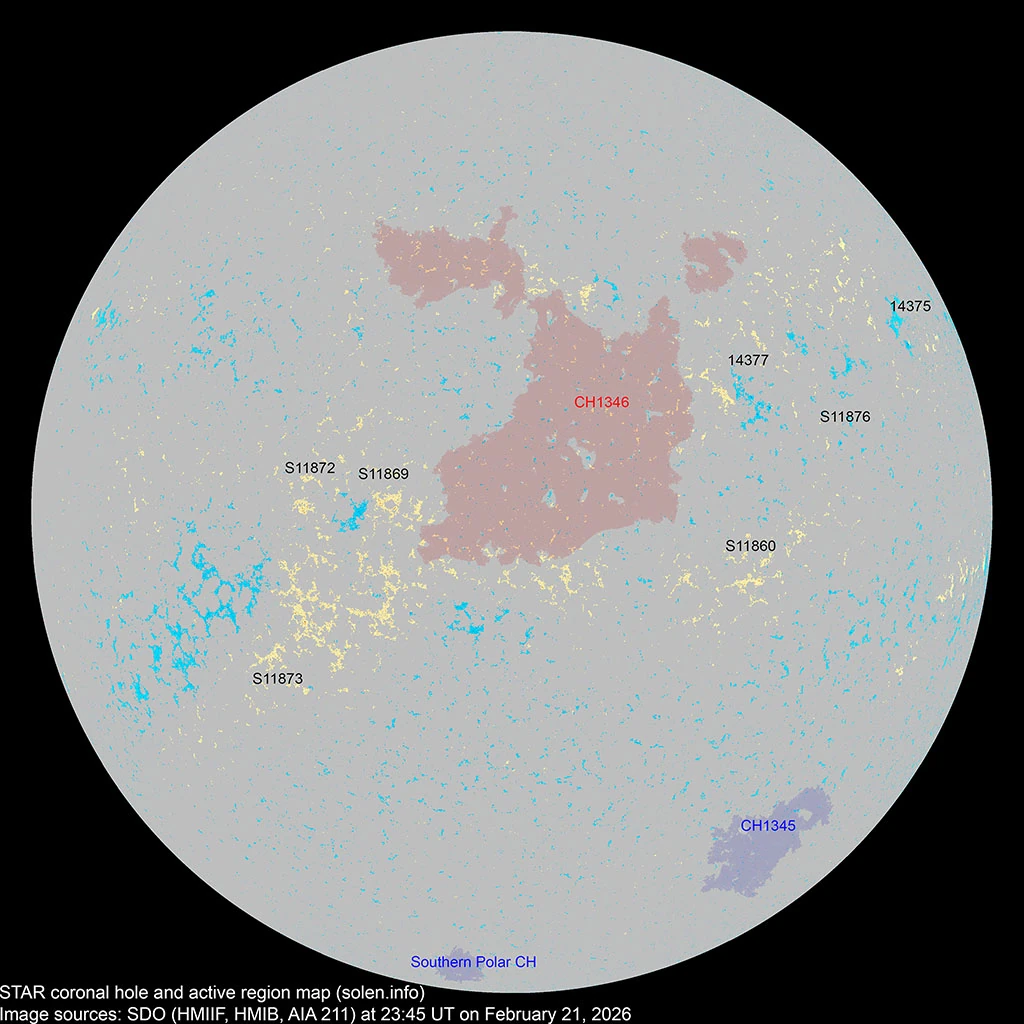
Data from NOAA show the disturbance began when Kp reached 5 during the 03:00–06:00 UTC period, followed by another interval of Kp 5 between 06:00 and 09:00 UTC. The event is associated with a coronal hole high-speed stream (CH HSS) interacting with Earth’s magnetic field following a solar-sector boundary crossing on February 21.
Potential impacts under G1 storm conditions include weak power-grid fluctuations at high latitudes, minor irregularities in satellite orientation, slight increases in drag on low-Earth-orbit satellites, and occasional short-lived HF-radio propagation fades at high latitudes.
Auroral visibility during G1 activity is generally confined to polar and subpolar regions, including Canada, Scandinavia, Scotland, and the northernmost United States, such as Michigan and Maine.

If G2 – Moderate storm levels develop later in the day, additional impacts may include more noticeable power-grid voltage alarms at high latitudes, intermittent degradation of high-frequency radio propagation, and increased drag on low-Earth-orbit satellites.
Under G2 conditions, auroras could extend farther south, potentially visible across northern-tier U.S. states, including New York, Wisconsin, and Washington.


Solar wind speeds increased from 460 km/s to about 560 km/s in 24 hours ending 00:30 UTC on February 22, while total magnetic field strength reached 15 nT with the Bz component fluctuating between +12 and −10 nT.
NOAA expects enhanced solar-wind conditions to continue through February 24 due to the combined effects of a co-rotating interaction region (CIR) and the ongoing high-speed stream. Intermittent G1 storm periods are likely, with brief G2 conditions possible if solar-wind pressure intensifies.
The greater-than-2 MeV electron flux reached moderate to high levels, while the proton flux stayed at background values.


Solar activity remains very low, with only one B and one C-class flare detected today, as of 09:20 UTC.
There are currently no active regions on the Earth side of the Sun after Region 4374 rotated off the visible solar disk.
The last M-class solar flare was detected at 04:35 UTC on February 16 (M2.4).
References:
1 Forecast Discussion – NOAA/SWPC – Issued at 00:30 UTC on February 22, 2026

I'm a dedicated researcher, journalist, and editor at The Watchers. With over 20 years of experience in the media industry, I specialize in hard science news, focusing on extreme weather, seismic and volcanic activity, space weather, and astronomy, including near-Earth objects and planetary defense strategies. You can reach me at teo /at/ watchers.news.

Commenting rules and guidelines
We value the thoughts and opinions of our readers and welcome healthy discussions on our website. In order to maintain a respectful and positive community, we ask that all commenters follow these rules.