
G2 – Moderate geomagnetic storm watch in effect for April 17 and 18
A G2 – Moderate geomagnetic storm watch is in effect for April 17 and 18, 2026, due to an incoming coronal hole high-speed stream expected to enhance solar wind conditions by late April 17. The event could cause minor operational impacts on high-latitude power systems, satellites, and HF radio communications, while increasing the chance of aurora sightings across northern U.S. states.
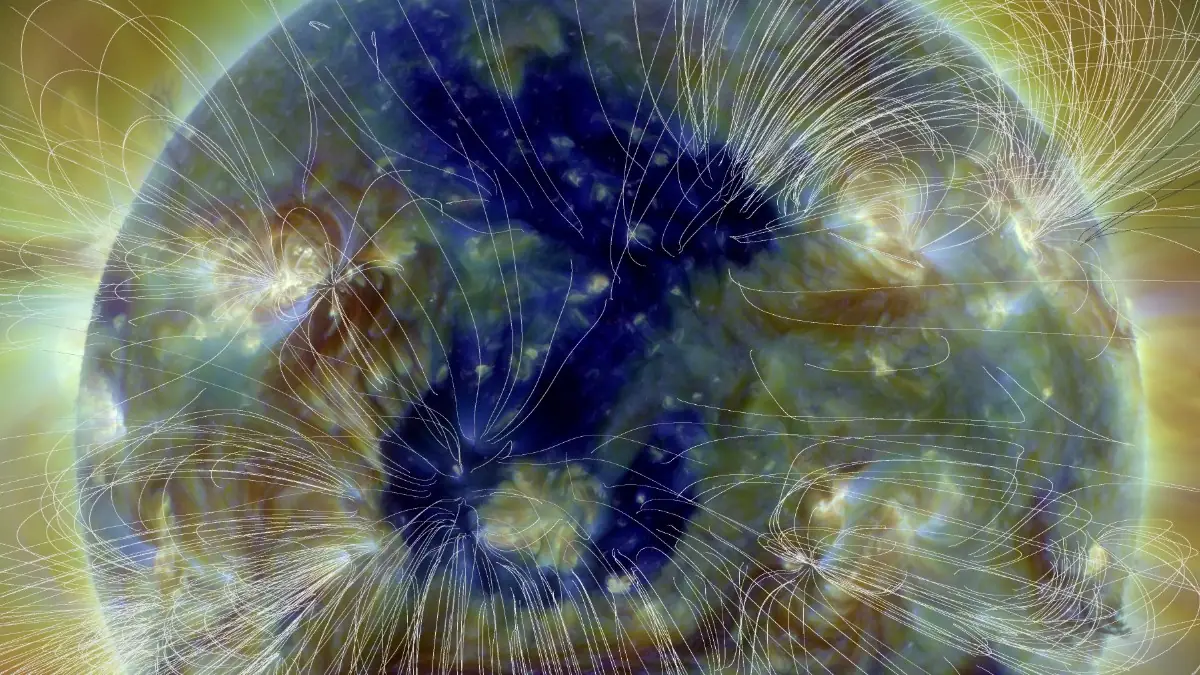
Coronal hole imaged on April 16, 2026. Credit: NASA/AIA, The Watchers
NOAA’s Space Weather Prediction Center (SWPC) issued a G2 – Moderate geomagnetic storm watch for April 17 and 18, due to an approaching negative polarity coronal hole high-speed stream (CH HSS) expected to disturb Earth’s magnetic field late on April 17 and through April 18.
The highest expected storm level is below G1 – Minor on April 16, rising to G2 – Moderate on both April 17 and April 18.
G2 storms can produce voltage alarms in high-latitude power systems and may affect transformer operations during prolonged disturbances. Satellite operators can experience orientation irregularities and increased drag on low Earth orbit spacecraft, while high-frequency radio communications may degrade at higher latitudes.
The primary impact area under G2 storms is poleward of 55° geomagnetic latitude, placing the highest infrastructure and communications sensitivity across northern Canada, Alaska, and other high-latitude regions.
Aurora may become visible as far as New York, Wisconsin, and Washington state, depending on local weather, cloud cover, light pollution, and whether geomagnetic activity reaches forecast peak levels during nighttime hours.
The strongest geomagnetic response often depends on how efficiently the solar wind couples with Earth’s magnetosphere, including the orientation of the interplanetary magnetic field. A sustained southward Bz component can increase storm intensity, while weaker coupling can keep activity below forecast thresholds.

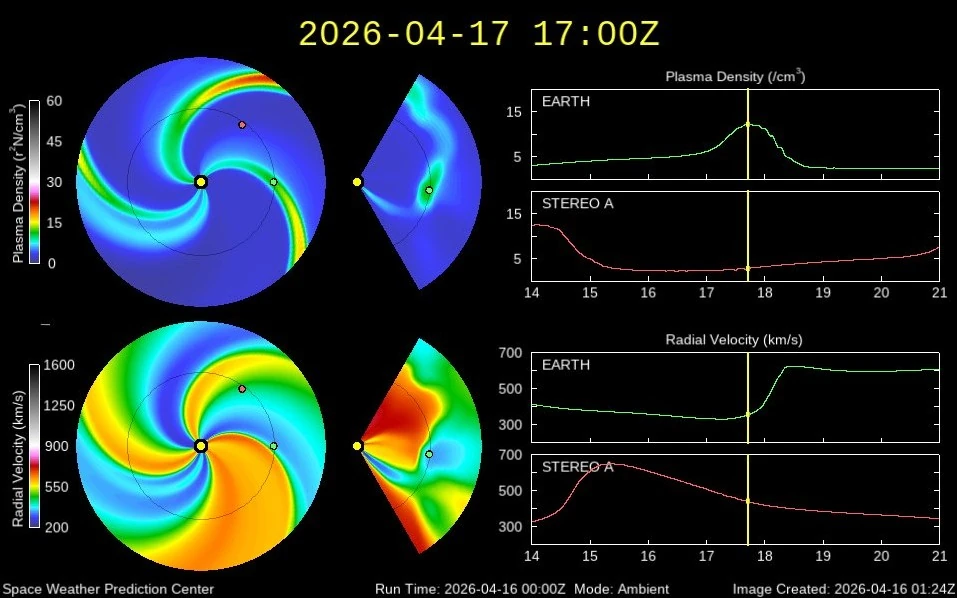
Forecasters expect solar wind conditions to become enhanced by mid to late April 17 as a co-rotating interaction region arrives ahead of the high-speed stream. SWPC said solar wind speeds of 600-700 km/s (373-435 mph) are likely during the event based on recurrent values, with elevated conditions expected to persist through April 18.

Solar activity remained low in 24 hours to 12:30 UTC on April 16, with only B- and C-class flares observed from active Region 4419. Two CMEs observed off the northeast and southeast limbs on April 15 were assessed as having no Earth-directed component, while additional CMEs observed off the northwest and west limbs were identified as backside events.
Solar activity is expected to remain low overall through April 18, although Region 4419 retains a chance of producing isolated M-class flares capable of minor to moderate radio blackouts.
References:
1 Forecast Discussion – NOAA/SWPC – Issued at 12:30 UTC on April 16, 2026

Teo Blašković founded The Watchers in 2011 and edited it until 2026, covering seismic and volcanic activity, extreme weather, space weather and near-Earth objects. Articles on this page are his archive.
Published in the last 24 hours
- In February 2022, SpaceX launched 49 Starlink satellites into a solar storm so mild that forecasters rated it minor, and within days 38 of them had fallen back and burned up, because the storm had swollen the thin air they were flying through Epicenter
- On a Friday night in October 1992, a fireball over the eastern US was filmed by fans at high school football games before it punched through the trunk of a teenager’s $400 Chevy Malibu in Peekskill, New York, and she sold the wrecked car for $10,000 Epicenter
- Green Lake, Hawaii's largest freshwater lake, was gone by the afternoon of June 2, 2018, after lava from Kilauea filled its basin. The water was about 20 feet deep, not the 200 feet often claimed. Epicenter
- Flying glass cut a teacher in Russia but none of her 44 pupils, because when a meteor flashed across the sky in 2013, she told them to get under their desks Epicenter

STEVE event with green aurora seen Otago NZ local 10pm 18th April. Thanks Teo, Watchers appreciating your work.