
Geomagnetic storm reaches G3 levels after March 18 CME impacts Earth
A G3 – Strong geomagnetic storm developed late on March 20 into early March 21, 2026, after a coronal mass ejection that left the Sun on March 18 impacted Earth. The storm intensified after at least two CME arrivals, with solar wind speeds reaching 567 km/s and the interplanetary magnetic field turning strongly southward to −28 nT.
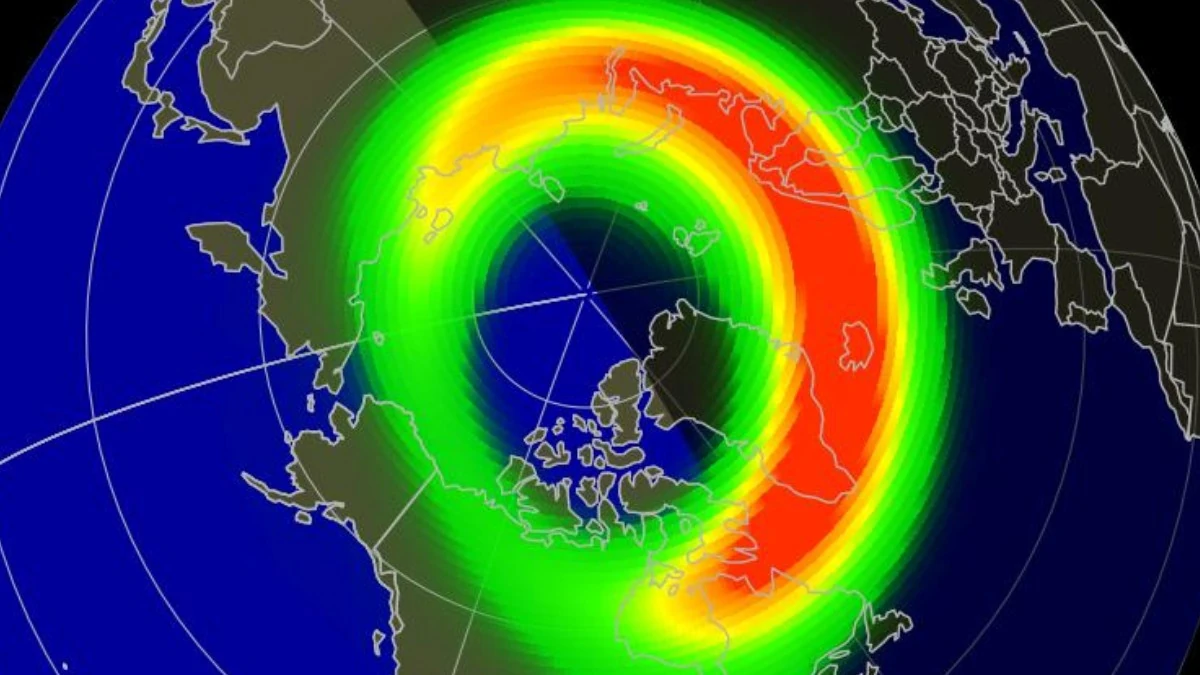
Aurora model for 22:43 UTC on March 20, 2026. Credit: SWPC
A G3 – Strong geomagnetic storm was recorded late on March 20 into early March 21, following the arrival of a coronal mass ejection (CME) that left the Sun on March 18, according to the NOAA Space Weather Prediction Center (SWPC).
Solar wind observations show at least two CME structures arrived at Earth, with the first detected around 01:32 UTC on March 20 and the second near 20:18 UTC the same day. Solar wind speeds increased to approximately 567 km/s, while the total interplanetary magnetic field reached 36 nT.
The southward component of the magnetic field (Bz) dropped to −28 nT — a configuration that enables efficient coupling between the solar wind and Earth’s magnetic field.
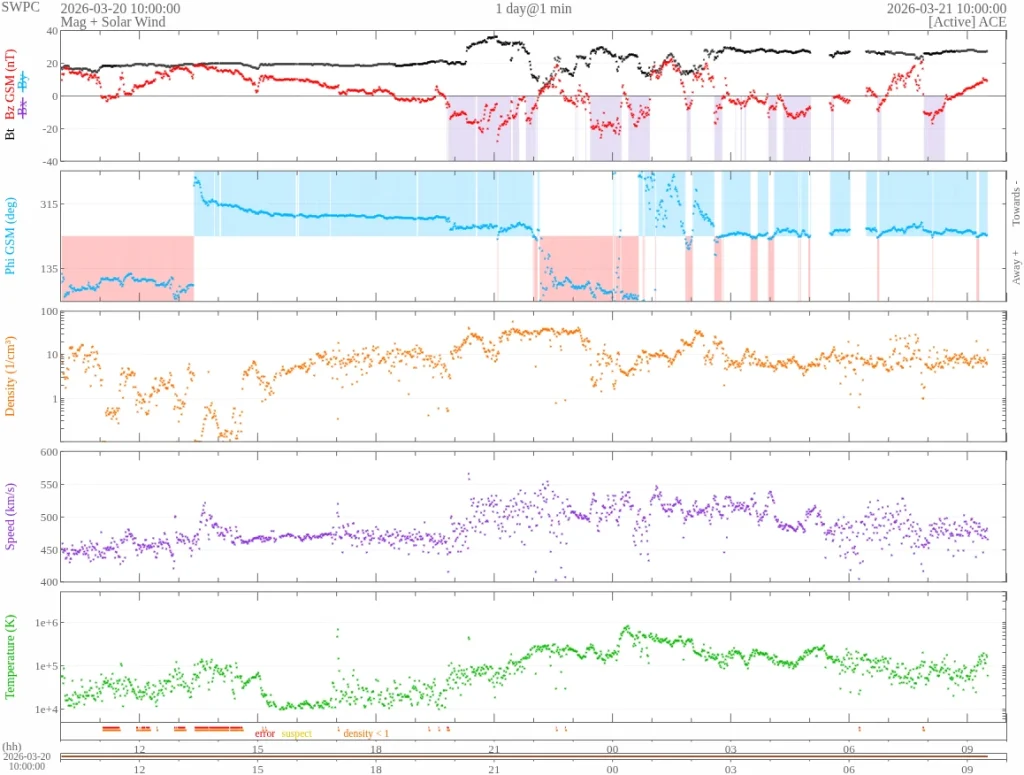
This combination of elevated solar wind speed and sustained southward Bz drove geomagnetic activity into the G3 – Strong range. Under such conditions, space-based systems may experience increased atmospheric drag, while high-frequency (HF) radio communication and satellite navigation systems can be degraded. Power systems at higher latitudes may require operational adjustments to maintain grid stability.
Forecast guidance from SWPC indicates that geomagnetic activity is expected to gradually decrease as CME effects weaken through March 22. However, additional disturbances are anticipated as a coronal hole high-speed stream (CH HSS) begins to influence the solar wind environment, potentially sustaining G1 – Minor conditions into March 22 and maintaining unsettled to active conditions on March 23.


The timing of this event coincides with the March equinox period, when geomagnetic coupling efficiency is typically enhanced due to seasonal alignment between Earth’s magnetic field and the interplanetary magnetic field. This seasonal factor can contribute to stronger geomagnetic responses even when solar input is moderate.
NOAA SWPC classifications define G3 storms as capable of causing operational impacts to satellites, navigation systems, and power infrastructure at high latitudes, while also expanding auroral visibility to mid-latitude regions.
Solar activity remained at very low levels over the past 24 hours, with only two numbered sunspot regions present on the solar disk, both exhibiting limited development and no significant flare production.
A full halo coronal mass ejection (CME) was observed beginning at 13:36 UTC on March 20. However, analysis indicates this event originated from the far side of the Sun and is not Earth-directed.
Solar activity is expected to remain low through March 23, with only isolated C-class flares likely.

References:
1 Forecast Discussion – NOAA/SWPC – Issued at 00:30 UTC on March 21, 2026

Teo Blašković founded The Watchers in 2011 and edited it until 2026, covering seismic and volcanic activity, extreme weather, space weather and near-Earth objects. Articles on this page are his archive.
Published in the last 24 hours
- The Leonid meteor shower peaks on the night of November 17, exactly 60 years after the 1966 storm, when some observers reported meteors falling at up to 40 a second, though this year’s show should be closer to 15 an hour
- When Arctic air reached South Florida in January 2020, Miami fell to 40°F and the National Weather Service warned residents to watch for cold-stunned iguanas dropping out of the trees Epicenter
- In May 2024, the strongest solar storm in 20 years put northern lights over the southern US, and across the Plains, GPS-guided tractors built to plant within an inch drifted about 10 feet off their rows Epicenter
- In 1943, a flight instructor in Texas flew a two-seat training plane into the eye of a hurricane because he was curious, then landed and took the base weatherman up for a second pass Epicenter
