
Dense clouds of Saharan dust spreading over Europe and Atlantic Ocean

Image credit: Aerosol optical depth at 550 nm - 15:00 UTC, July 13, 2021 forecast. Copernicus EU/CAMS, TW
Earth-observing satellites are picking up two dense clouds of Saharan dust — one moving NE over the Mediterranean Sea into Europe and the other W over the Atlantic Ocean.
The European cloud has already reached southern Spain, Corsica, and most of Italy and is spreading further NE toward central Europe, Slovenia, Croatia, and the rest of the Balkan Peninsula and Greece on July 13.
On July 14 and 15 parts of it will spread further into NE Europe and Scandinavia.
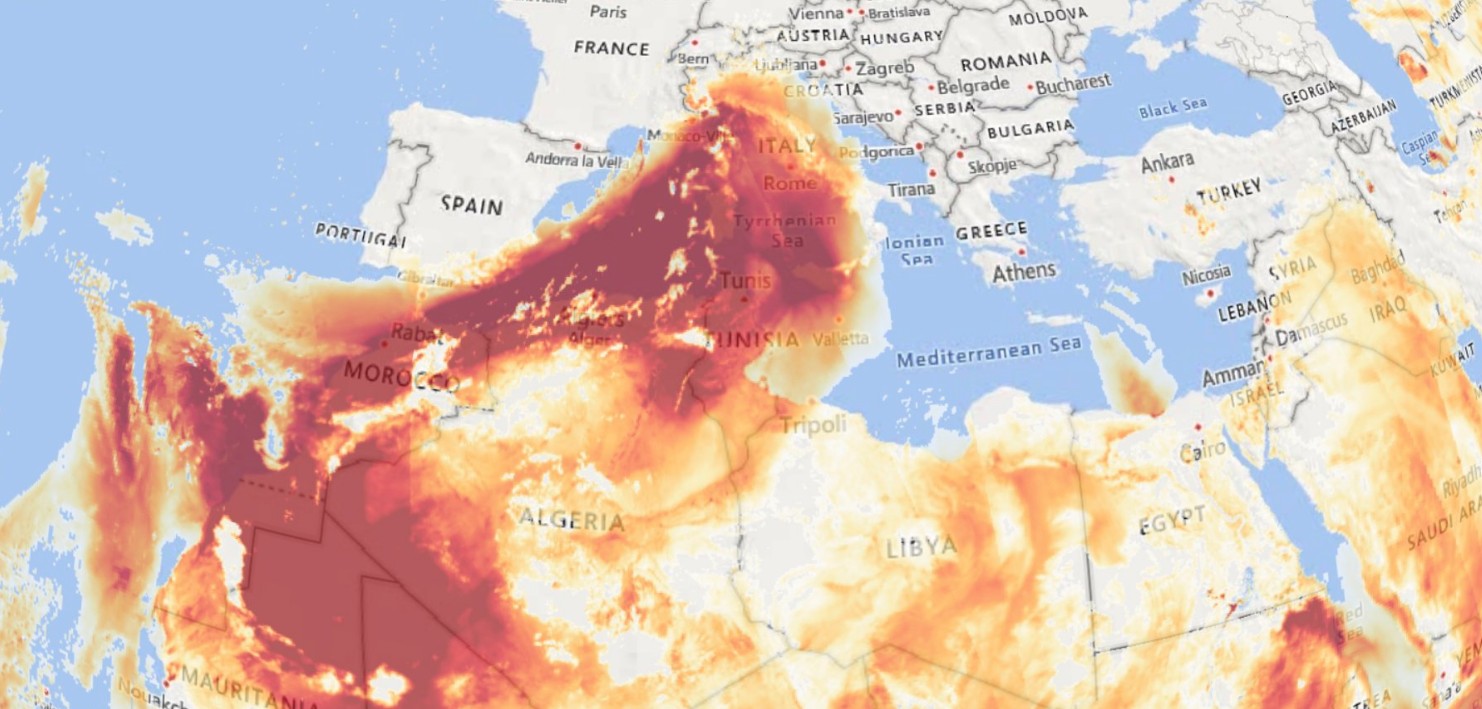
Image credit: Copernicus EU/Sentinel-5P: Aerosol Index (NRT), ADAM Platform/Antonio Vecoli. Acquired on July 12, 2021

Image credit: NASA/Terra MODIS. Acquired July 12, 2021

Image credit: NASA/NOAA Suomi NPP/VIIRS. Acquired July 12, 2021
The second cloud is spreading west into the Atlantic Ocean, heavily affecting all islands west of Morocco and Western Sahara.
Waves of dust picked up over the past couple of days have already reached the Caribbean and spread through the region.
This new wave should reach it by July 18 or 19.

Image credit: ECMWF


Image credit: NOAA/GOES-East, Zoom.Earth, TW. Acquired on July 13, 2021

Aerosol optical depth at 550 nm – 00:00 UTC, July 18, 2021 forecast. Copernicus EU/CAMS, TW

Teo Blašković founded The Watchers in 2011 and edited it until 2026, covering seismic and volcanic activity, extreme weather, space weather and near-Earth objects. Articles on this page are his archive.
Earlier reporting
Nothing on Watchers was published in the last 24 hours. These are older articles.
- Polar vortex winds at 60°N drop from 22.13 to 5.44 m/s in eight days in rare November disruption; major SSW remains forecast
- Flood watches cover the Southwest ahead of a Four Corners heavy-rainfall event, U.S.
- In 1920, a man out hunting on a farm in Namibia sat down on a strange black rock, scratched it with his knife and saw metal shine underneath. It was Hoba, a 60-ton meteorite, the largest ever found, and there is no crater around it Epicenter
- On December 26, 2004, a 10-year-old British girl on a Phuket beach recognized the frothing sea from a recent geography lesson, and her warning helped clear the beach before the tsunami struck Epicenter

Does Sahara sand cause the same problems for aircraft that volcanic ash does?
Does anyone have a general chemical composition of the dust? I ask because there has been a push in the past to “seed” the ocean with iron as part of a geoengineering effort to enhance carbon uptake from ocean organisms. If the dust is iron-rich it would seem like an interesting “experiment” to follow. Thanks.