
Close-up view of new cinder cone at Klyuchevskoy volcano, Russia
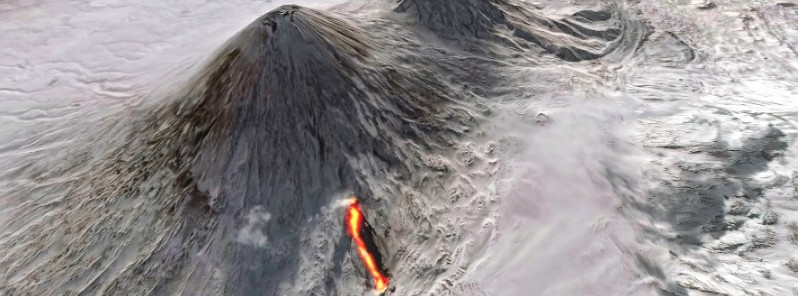
Featured image: Flank eruption at Klyuchevskoy volcano on February 23, 2021. Credit: Alexey Demyanchuk/Volkstat.ru
A moderate explosive-effusive flank eruption and gas-steam activity continue at Klyuchevskoy volcano, Kamchatka, Russia.
KVERT warns the danger of ash explosions up to 4 – 5 km (13 120 – 16 400 feet) a.s.l. from the flank crater and the lava flow front (phreatic explosions at the contact of the flow with the Erman glacier) remain.
The flank eruption continues on the northwestern slope of the volcano at an altitude of 2 800 m (9 186 feet) a.s.l. with Strombolian activity at the cinder cone. The fumarole activity at the summit also continues.
On March 16, a field detachment from the Kamchatka volcano station surveyed the flank eruption.
The expedition left from the village of Klyuchi on three snowmobiles to an altitude of about 2 600 m (8 530 feet) a.s.l. from where they had to continue on foot due to rocky slopes exposed by strong winds.
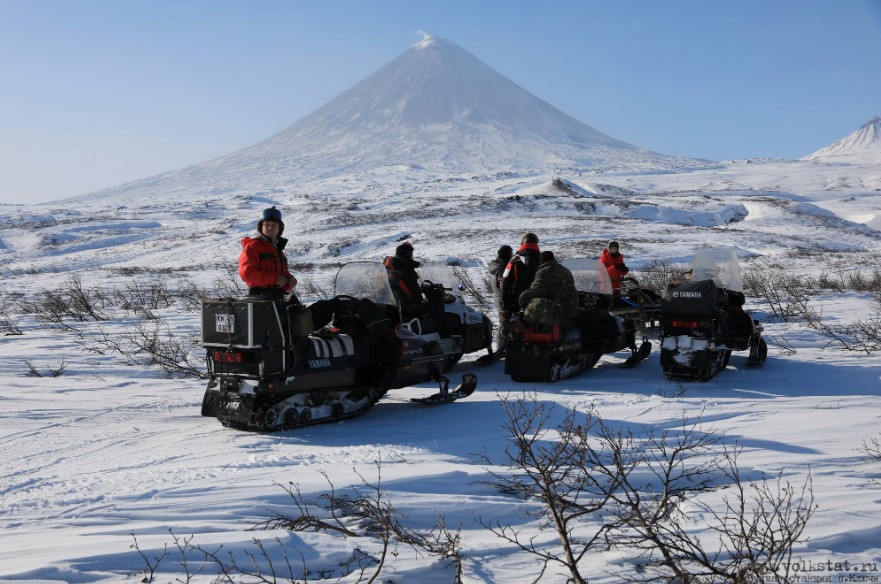
Image credit: Kamchatka volcano station/Y. Demyanchuk (volkstat.ru)
The team observed eruptions every few seconds with ash and gas rising up to 100 m (330 feet) above the edge of the cinder cone and lava pouring on the north side.
Since the weather was favorable, many tourists came by snowmobiles and helicopters.
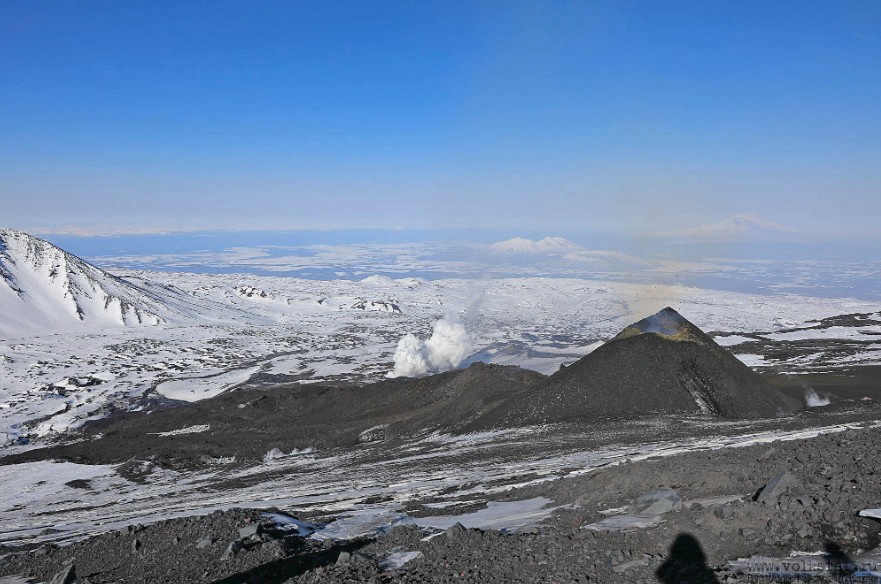
Image credit: Kamchatka volcano station/Y. Demyanchuk (volkstat.ru)
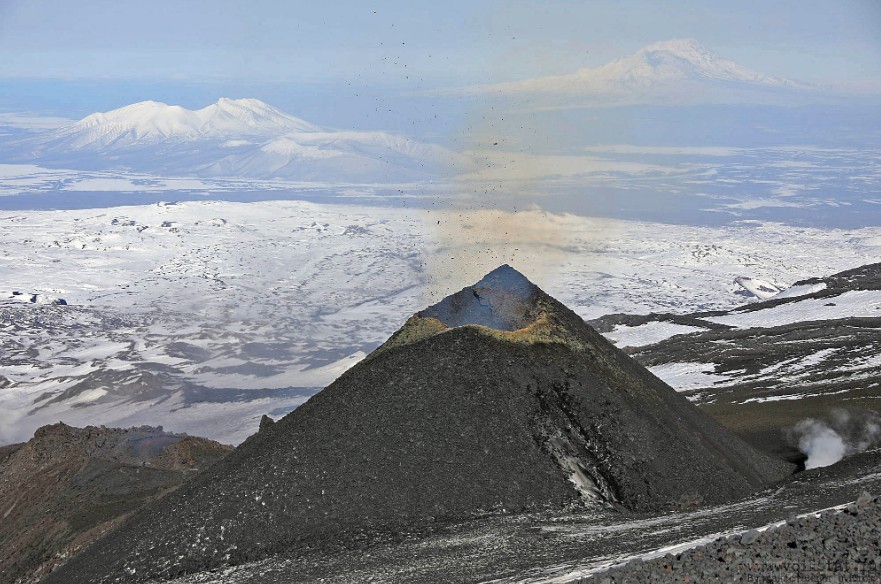
Image credit: Kamchatka volcano station/Y. Demyanchuk (volkstat.ru)
See more images and videos of the flank eruption at volkstat.ru
#volcan #volcano #Klyuchevskoy Et d'autres sur le site/And some more on the website https://t.co/PTiEx2EKfR pic.twitter.com/biOFUsIU2Z
— CultureVolcan (@CultureVolcan) March 18, 2021
Kamchatka’s 7000 year old Klyuchevskaya Sopka – the highest active volcano in Eurasia – continues to erupt as the second cone is forming at 2850м. Video from local guide and photographer Maksim Fesyunov pic.twitter.com/6jJCnh8fRb
— The Siberian Times (@siberian_times) March 18, 2021
Extreme travellers Boris Smirnov, Alexey Kulaev, Artem Gromov & Pavel Gavrilov record formation of new cone on highest active volcano in Eurasia. ‘The whole time that we were there it was very cold – the thermometer in the morning showed -47C' https://t.co/XiUyFwl0IL pic.twitter.com/3X7BIZIzFQ
— The Siberian Times (@siberian_times) March 13, 2021
On March 13, satellite imagery obtained by Sentinel-2 showed lava flow was at least 1.5 km (0.93 miles) long.
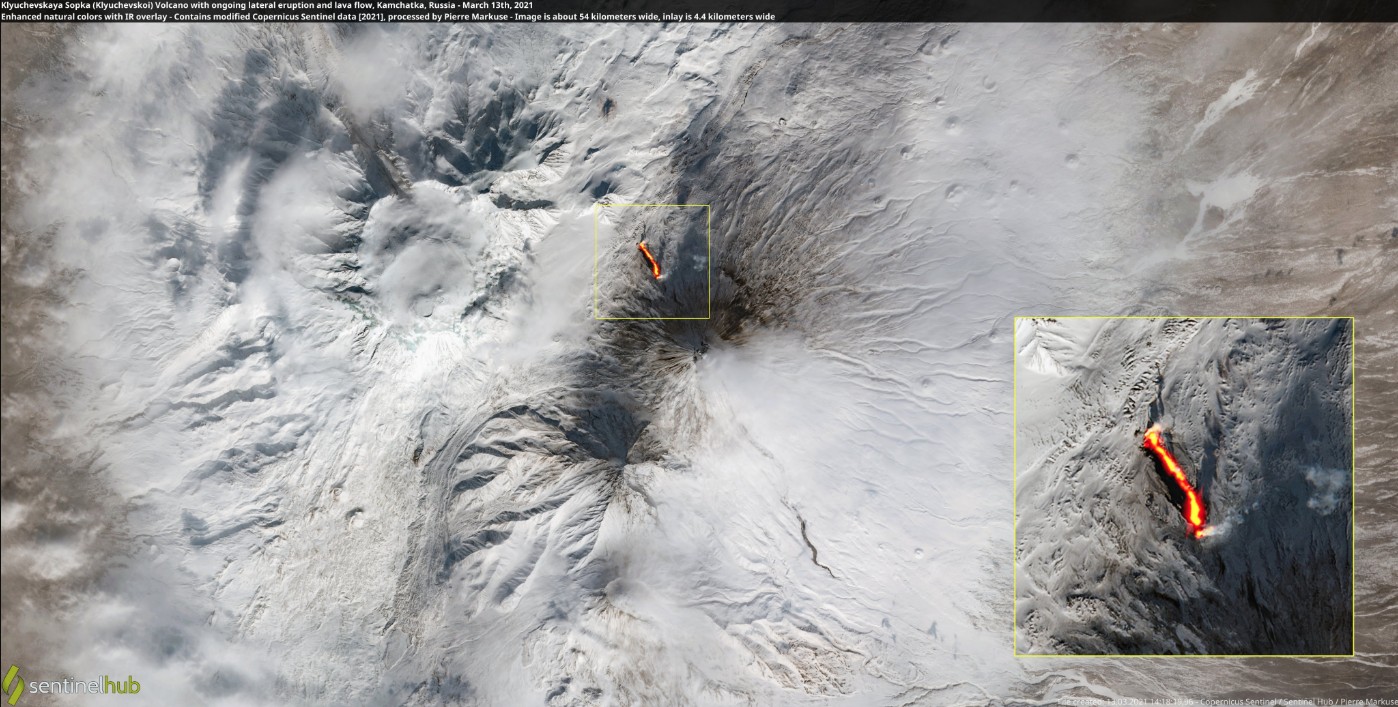
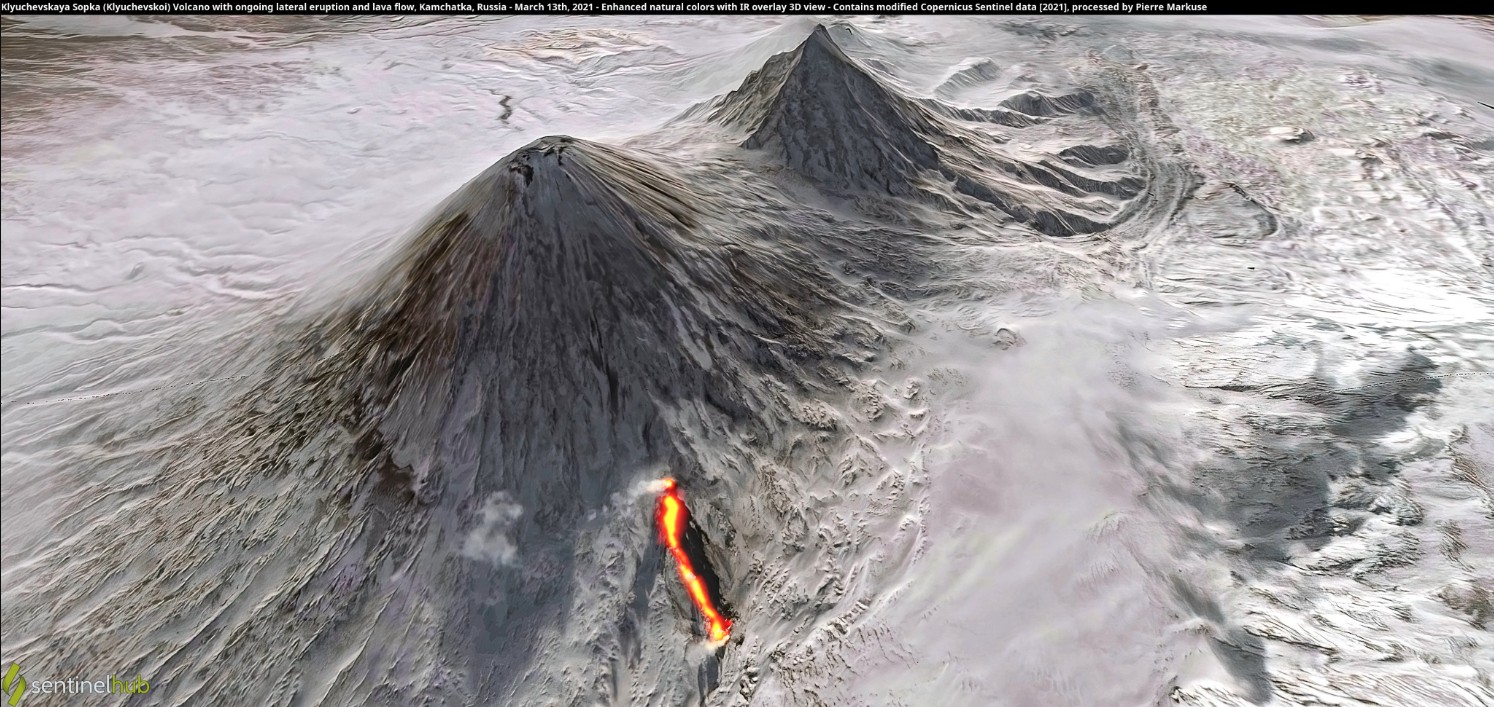
Klyuchevskoy volcano on March 13, 2021. Credit: Copernicus EU/Sentinel-2, Pierre Markuse

Klyuchevskoy volcano on March 15, 2021. Credit: Copernicus EU/Sentinel-2, Pierre Markuse
Geological summary
Klyuchevskoy (also spelled Kliuchevskoi) is Kamchatka's highest and most active volcano. Since its origin about 6 000 years ago, the beautifully symmetrical, 4 835 m (15 862 feet) high basaltic stratovolcano has produced frequent moderate-volume explosive and effusive eruptions without major periods of inactivity. It rises above a saddle NE of sharp-peaked Kamen volcano and lies SE of the broad Ushkovsky massif.
More than 100 flank eruptions have occurred during the past roughly 3 000 years, with most lateral craters and cones occurring along radial fissures between the unconfined NE-to-SE flanks of the conical volcano between 500 m and 3 600 m (1 640 – 11 811 feet) elevation.
The morphology of the 700 m (2 296 feet) wide summit crater has been frequently modified by historical eruptions, which have been recorded since the late-17th century.
Historical eruptions have originated primarily from the summit crater, but have also included numerous major explosive and effusive eruptions from flank craters. (GVP)

I'm a dedicated researcher, journalist, and editor at The Watchers. With over 20 years of experience in the media industry, I specialize in hard science news, focusing on extreme weather, seismic and volcanic activity, space weather, and astronomy, including near-Earth objects and planetary defense strategies. You can reach me at teo /at/ watchers.news.

Commenting rules and guidelines
We value the thoughts and opinions of our readers and welcome healthy discussions on our website. In order to maintain a respectful and positive community, we ask that all commenters follow these rules.