
Record-breaking rainfall hits Split, causing widespread flooding, Croatia

Image credit: dalmacijadanas.hr
Record-breaking rainfall hit the Croatian city of Split on Thursday, December 3, 2020, causing traffic chaos and flooding homes and businesses.
The meteorological station at Marijan registered 118.8 mm (4.6 inches) of rain between 07:00 and 13:00 LT (06:00 – 12:00 UTC), which is comparable to the station's largest 24-hour rainfall for any day of the year.
This is now the city's largest 24-hour rainfall for the month of December and the third-highest for any time of the year.
The last time Split saw this much rain was on August 25, 1975 — 131.6 mm (5.1 inches). The city's all-time 24-hour record was set on September 6, 1948, with 228.5 mm (8.9 inches).
The country's highest 24-hour rainfall record was set in September 1986 when the city of Zadar registered 345 mm (13.5 inches).


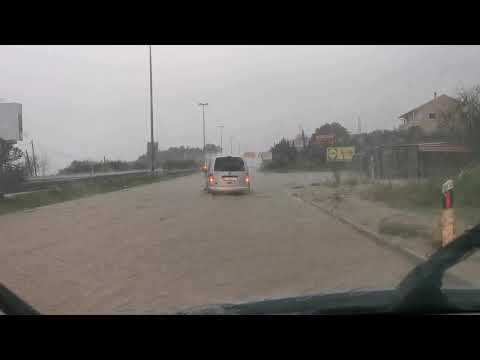
Almost all roads throughout the city were flooded, with some of them reportedly turning into raging rivers.
Floodwaters in some parts of the city reached as high as 1.5 m (4.9 feet), causing traffic chaos and flooding homes and businesses.
Authorities urged residents to take extra caution and stay home when possible as more heavy rain is in the forecast in the days ahead.

Teo Blašković founded The Watchers in 2011 and edited it until 2026, covering seismic and volcanic activity, extreme weather, space weather and near-Earth objects. Articles on this page are his archive.
Published in the last 24 hours
- How did one flash of lightning, lasting about seven seconds, stretch 829 km across five US states, beat the previous record by 61 km, and only be recognized as the longest ever measured nearly eight years later?
- In 1954, a grapefruit-sized meteorite crashed through a roof in Sylacauga, Alabama, and struck Ann Hodges as she napped on her couch Epicenter
- A meteorite blew a crater beside a village near Lake Titicaca in 2007, and dozens of villagers who went to see it got headaches and nausea, though tests found nothing the rock had added to the water Epicenter
- The people who pay closest attention to the weather are the ones storms have already cost the most, a study of 946 students found, with one damaging storm making little difference to how much attention a student paid, but two or more making a clear one Epicenter
