
Intense activity at Popocatepetl, volcanic ash to 7.6 km (25 000 feet) a.s.l., Mexico

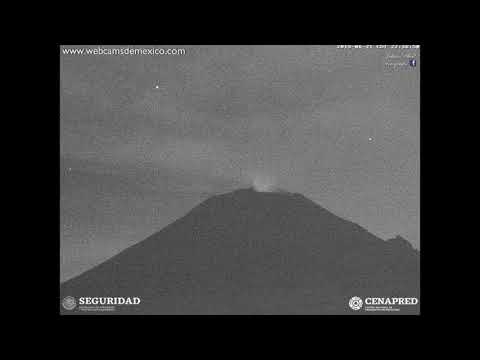
Featured image: Popocatepetl volcano erupting on June 22, 2019. Credit: CENAPRED, webcamsdemexico
A strong eruption took place at Popocatepetl volcano, Mexico at 01:57 UTC on June 22 (20:57 local time, June 21). Incandescent fragments were thrown a short distance from the crater.
Intense activity continued at Popocatepetl volcano on June 22 with a strong eruption at 01:57 UTC. According to the Washington VAAC, volcanic ash was observed on webcam and satellite imagery moving W at 28 km/h (17 mph) and rising up to 7.6 km (25 000 feet) above sea level at 02:01 UTC.
Remnant volcanic ash emission was extending approximately 214 km (134 miles) SW of the summit at 09:50 UTC and was expected to dissipate within 6 hours.


RT rescatepce10:
Después del evento explosivo a las 20:53 en el #Popocatépetl, tenemos #lluviaDeCeniza en #Ozumba #EdoMex, #semaforodealertavolcánica #AmarilloFase2 #ceniza pic.twitter.com/9P4s9Rk7fx por #webcamsdemexico https://t.co/uPT5zlSiLT
— VANGUARDIASONORA.com (@VanguardiaSon) June 22, 2019
In 24 hours to 15:00 UTC on June 21, 144 exhalations were identified, accompanied by water vapor, gas and light amounts of ash. Additionally, 21 minutes of low amplitude tremor were recorded.
Geological summary
Volcán Popocatépetl, whose name is the Aztec word for smoking mountain, rises 70 km (44 miles) SE of Mexico City to form North America's 2nd-highest volcano. The glacier-clad stratovolcano contains a steep-walled, 400 x 600 m (1 312 x 1 968 feet) wide crater.
The generally symmetrical volcano is modified by the sharp-peaked Ventorrillo on the NW, a remnant of an earlier volcano.
At least three previous major cones were destroyed by gravitational failure during the Pleistocene, producing massive debris-avalanche deposits covering broad areas to the south. The modern volcano was constructed south of the late-Pleistocene to Holocene El Fraile cone.
Three major plinian eruptions, the most recent of which took place about 800 CE, have occurred from Popocatépetl since the mid Holocene, accompanied by pyroclastic flows and voluminous lahars that swept basins below the volcano. Frequent historical eruptions, first recorded in Aztec codices, have occurred since precolumbian time. (GVP)

Teo Blašković founded The Watchers in 2011 and edited it until 2026, covering seismic and volcanic activity, extreme weather, space weather and near-Earth objects. Articles on this page are his archive.
Published in the last 24 hours
- Male toads abandoned a pond in Italy five days before a deadly 2009 earthquake, while a scientist was counting them Epicenter
- An asteroid was spotted 19 hours before it exploded over Sudan in 2008, and students picked its pieces off the desert Epicenter
- A wave up to 3 m (10 feet) high rose out of Lake Michigan on a sunny June morning in 1954 and swept fishermen off Chicago’s piers, and when a second came 10 days later, warnings had cleared the shore Epicenter
- Just 12 inches of rushing water can carry away most cars, and more than half of US flood drownings happen to people who drive into flood water Epicenter
