
Shallow M6.5 earthquake, strong aftershocks hit Rat Islands, Aleutian Islands, Alaska
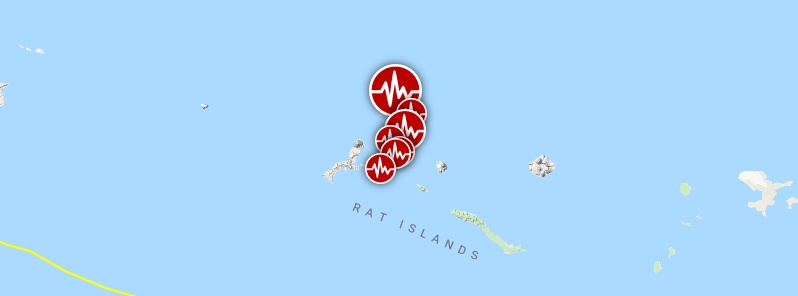
Image credit: Google, TW/SAM
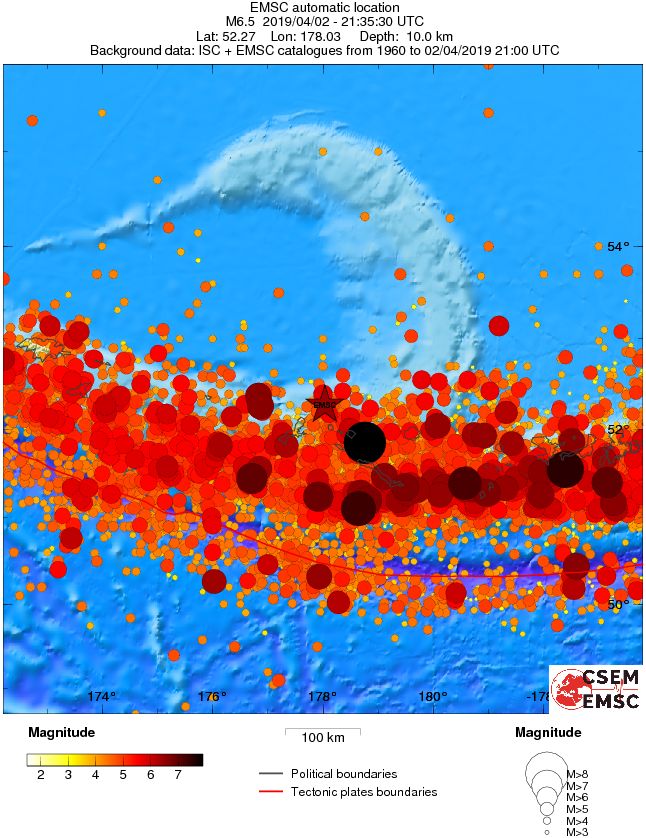
A strong and shallow earthquake registered by the USGS as M6.5 hit Rat Island, Aleutian Islands, Alaska at 21:35 UTC on April 2, 2019. The agency is reporting a depth of 19.1 km (11.8 miles). EMSC is reporting M6.5 at a depth of 10 km (6.2 miles).
The quake was followed by several moderate to strong aftershocks over the next couple of hours – M5.2, M4.7, M4.2, M4.6, M4.2 and M4.2.
The epicenter was located 27 km (17 miles) W of the northern tip of Kiska island, 23 km (14 miles) N of Segula island and 93 km (58 miles) NW of Amchitka.
There are no people living within 100 km (62 miles).
There is no tsunami risk from this earthquake.


The USGS issued a green alert for shaking-related fatalities and economic losses. There is a low likelihood of casualties and damage.
Overall, the population in this region resides in structures that are resistant to earthquake shaking, though vulnerable structures exist. The predominant vulnerable building types are unreinforced brick masonry and reinforced masonry construction.

Rat Islands, Alaska earthquakes – April 2 and 3, 2019. Credit: Google, TW/SAM
Regional seismicity

Teo Blašković founded The Watchers in 2011 and edited it until 2026, covering seismic and volcanic activity, extreme weather, space weather and near-Earth objects. Articles on this page are his archive.
Published in the last 24 hours
- M6.6 earthquake hits the Banda Sea 148 km west-southwest of Tual, Indonesia, at 68 km depth, USGS issues Green alert
- A Kansas farmer looked straight up into a tornado in 1928 and saw a hollow tube at least half a mile tall, its walls lit by constant flashes of lightning Epicenter
- New Mexico’s Navajo Reservoir rose nearly 60 feet in seven weeks this fall, after a winter with almost no snow, as storms flooded the San Juan River Epicenter
- The storms drenching California this week are fed by a river in the sky, a band of water vapor that can carry up to 15 times the flow of the Mississippi River, and this winter’s near-record El Niño could keep aiming more of them at the West Coast
