
Impulsive M7.3 solar flare erupts from Region 2673
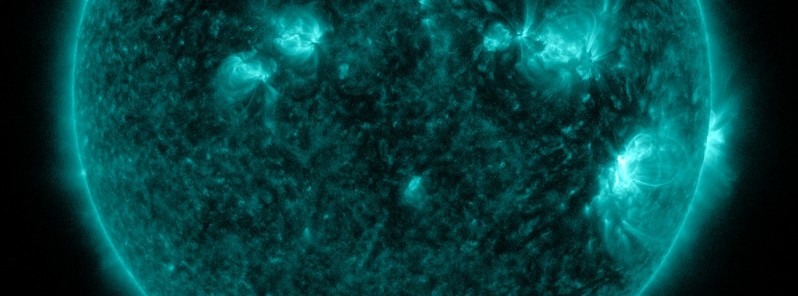
Image credit: NASA/SDO AIA 131
An impulsive solar flare measuring M7.3 at its peak time erupted from Region 2673 at 10:15 UTC on September 7, 2017. The event started at 10:11, peaked at 10:15 and ended at 10:18 UTC. It comes a day after two major X-class solar flares erupted from the same region.
The event was associated with a 10cm Radio Burst lasting 2 minutes with peak flux of 810 sfu. This can be indicative of significant radio noise in association with a solar flare. This noise is generally short-lived but can cause interference for sensitive receivers including radar, GPS, and satellite communications.
In addition, a Type IV radio emission was associated with the event, suggesting a strong Coronal Mass Ejection (CME) was produced as well as a solar radiation storm.
Region 2673 still has 'beta-gamma-delta' magnetic configuration and is capable of producing more M- and X-class solar flares. It will most likely continue erupting as it makes its transit through the Sun's farside.
Although the region is now approaching Sun's west limb and will soon start its farside rotation, we are still not out of harm's way, as it could still launch CMEs toward us.


Update:
A major solar flare measuring X1.3 at its peak time (14:36 UTC) is currently in progress.
More information about that event can be found at the following link:
3rd X-class solar flare: Major X1.3 solar flare erupts from Region 2673


Teo Blašković founded The Watchers in 2011 and edited it until 2026, covering seismic and volcanic activity, extreme weather, space weather and near-Earth objects. Articles on this page are his archive.
Published in the last 24 hours
- The storms drenching California this week are fed by a river in the sky, a band of water vapor that can carry up to 15 times the flow of the Mississippi River, and this winter’s near-record El Niño could keep aiming more of them at the West Coast
- Malawi continues Bris AI weather forecasting tests ahead of operational integration Epicenter
- Right about now, Voyager 1 is crossing a line no human-made object has ever reached, a full light-day from Earth, which means a message NASA sends tonight won't arrive until tomorrow night, and the spacecraft's answer won't make it home until the night after that
- G1 geomagnetic storm watch remains in effect as NOAA forecasts Kp 4.67 late on November 17 and early on November 18
