
Small comet or asteroid impacts Jupiter

Image credit: John McKeon. Annotation: TW.
Two astronomers have captured images of a small comet or asteroid as it impacted Jupiter at 00:18 UTC on March 17, 2016. The videos of the same event were captured from Austria and Ireland.
The object is probably in the tens-of-meters wide range, according to Phil Plait. "I know that sounds small, but remember, Jupiter has ferocious gravity, and velocity is critical here! The energy released by an object slamming into another depends linearly on the mass (double the mass, double the energy), but on the square of the velocity: double the velocity, quadruple the energy," Plait said.

Video courtesy of John McKeon
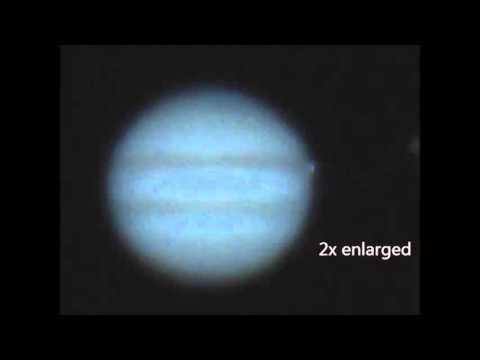
Video courtesy of Gerrit Kernbauer
"On average (and ignoring orbital velocity), an object will hit Jupiter with roughly five times the velocity it hits Earth, so the impact energy is 25 times as high. The asteroid that burned up over Chelyabinsk, Russia, in 2013 was 19 meters across, and it exploded with the energy of 500 000 tons of TNT. Now multiply that by 25, and you can see how it doesn’t take all that big a rock to hit Jupiter for us to be able to see it from Earth," Plait explained.
Such objects impact Jupiter 10 – 50 times per year, a recent study concluded.

Teo Blašković founded The Watchers in 2011 and edited it until 2026, covering seismic and volcanic activity, extreme weather, space weather and near-Earth objects. Articles on this page are his archive.
Published in the last 24 hours
- Asteroid 2026 WJ to pass Earth at 1.7 lunar distances at 04:20 UTC on November 22, with 2026 WD following at 4.4 lunar distances on November 23
- High Risk of excessive rainfall covers Florida’s Space Coast as St. Johns River near Cocoa reaches 5.67 m
- Cyclone Akvan crossed the north Andhra Pradesh and south Odisha coasts close to Gopalpur on November 20 with 70-80 km/h winds gusting to 90, and has weakened into a deep depression
- A broad low over southeastern Florida and the northwestern Bahamas has a 30 percent chance of subtropical or tropical development within 48 hours and a 50 percent chance within 7 days, the National Hurricane Center says
