
Environmental disaster for years to come – Massive breach of toxic waste pond at Mount Polley Mine, Canada
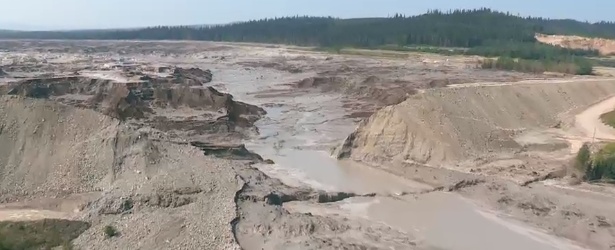
Image credit: Aerial image of the Mount Polley mine disaster
A dam at a waste pond on Mount Polley Mine in the Cariboo region of British Columbia, Canada, full of toxic heavy metals burst on August 4, 2014, releasing 10 million cubic meters of wastewater and 5 million cubic meters of toxic slurry into Hazeltine Creek, Quesnel Lake and Polley Lake. The magnitude of this huge environmental disaster became painfully apparent this week, but the full extent of the damage may remain unknown for years or even decadest to come.
Nearby residents have been issued a complete water ban several days after the breach, however, the government mostly lifted it this week believing the spill won't have a significant impact on people or aquatic life. Environmentalists strongly disagree with this while mining experts warn that the incident is the largest mining disaster in Canadian history, possibly even global.
Local residents and critics of the British Columbia provincial government say officials may be playing down the spill’s negative effects.
As Canada has gone all-in on resource extraction in the last decade or so, with prime minister Stephen Harper promising to turn the country into one of the largest natural resource exporters in the world, governments across the country, including in British Columbia, have developed close ties with extraction industries. (TheGuardian)
"There are already concerns that the total damage will be immense. The sheer volume of toxic slurry from the pond – equivalent to 2,000 Olympic-sized swimming pools – caused Hazeltine Creek to expand from four feet in width to 150, and some of the sludge has made its way into Quesnel Lake and Polley Lake," GlobalNews reports.
According to experts, the full extent of the damage may remain unknown for years or even decades, as toxins from the mine slowly build up in the environment.
“Water will continue to run through literally tons of this sediment and grass will grow through the sediment,” said Brian Olding, an environmental consultant who authored a report on the Mount Polley Mine in 2011.
“Imagine if a moose eats that grass, and then an aboriginal person comes and shoots that moose. Then we have a food contamination issue on our hands.” (TheGuardian)
Video courtesy of GlobalNews
Mount Polley Mine is an open pit copper and gold mine which kept years worth of mining waste – tailings. When it burst on August 4 almost everything it had flew out into Hazeltine Creek, Polley Lake and Quesnel lake.
Video courtesy of GlobalNews
Video courtesy of GlobalNews
Tailings, also called mine dumps, culm dumps, slimes, tails, refuse, leach residue or slickens, are the materials left over after the process of separating the valuable fraction from the uneconomic fraction (gangue) of an ore. According to Wikipedia, common minerals and elements found in tailings include:
- Arsenic
- Barite
- Calcite
- Fluorite
- Radioactive materials – Naturally present in many ores
- Mercury
- Sulfur
- Cadmium
- Hydrocarbons – Introduced by mining and processing equipment (oils & greases)
Read more:
- Imperial Metals says Mount Polley mining waste mess won’t delay startup of new mine in B.C.
- With ban lifted, residents refuse to drink water after Mount Polley mine disaster
- Mount Polley Tailings Pond Mine Company Evicted By First Nations Band

Teo Blašković founded The Watchers in 2011 and edited it until 2026, covering seismic and volcanic activity, extreme weather, space weather and near-Earth objects. Articles on this page are his archive.
Earlier reporting
Nothing on Watchers was published in the last 24 hours. These are older articles.
- On October 22, 2017, a single flash of lightning stretched 515 miles from eastern Texas to near Kansas City, a distance that takes eight hours to drive, and nobody realized how far it had gone until scientists went back through the satellite data years later Epicenter
- CPC posts a slight risk of heavy rain from the Gulf Coast to the Northeast urban corridor November 25-29, and a moderate risk of West Coast wind and Sierra snow on November 25
- Florida's east coast faces a moderate flash flood risk Wednesday through Friday, with 4 to 8 inches of rain forecast and the St. Johns River near Cocoa already in major flood at 17.13 feet
- Cyclone Akvan to make landfall between Nellore and Visakhapatnam around noon on November 20, IMD forecasts 120-130 km/h winds gusting to 145

How many more environmental disasters (caused by man) do we have to witness before 'man' realizes 'he' is stuffing with nature big time. Not only are situations like this poisoning our natural environments, it is goes part of the way to poisoning the human race as well…what next?
for the record, 'aboriginals' are not the only people who hunt moose. Plenty of white people hunt moose too. In fact I live on a small island on the west coast of b.c. and I know plenty of white people who drive up to the caribou region in hunting season specifically to hunt moose since there are none here.