
Vancouver breaks daily heat record set in 1898 as temperatures rise across British Columbia
Vancouver reached 23.9°C (75°F) on Monday, May 4, 2026, breaking the city’s daily maximum temperature record of 22.2°C (72°F) set in 1898. Multiple communities across British Columbia also set daily temperature records.
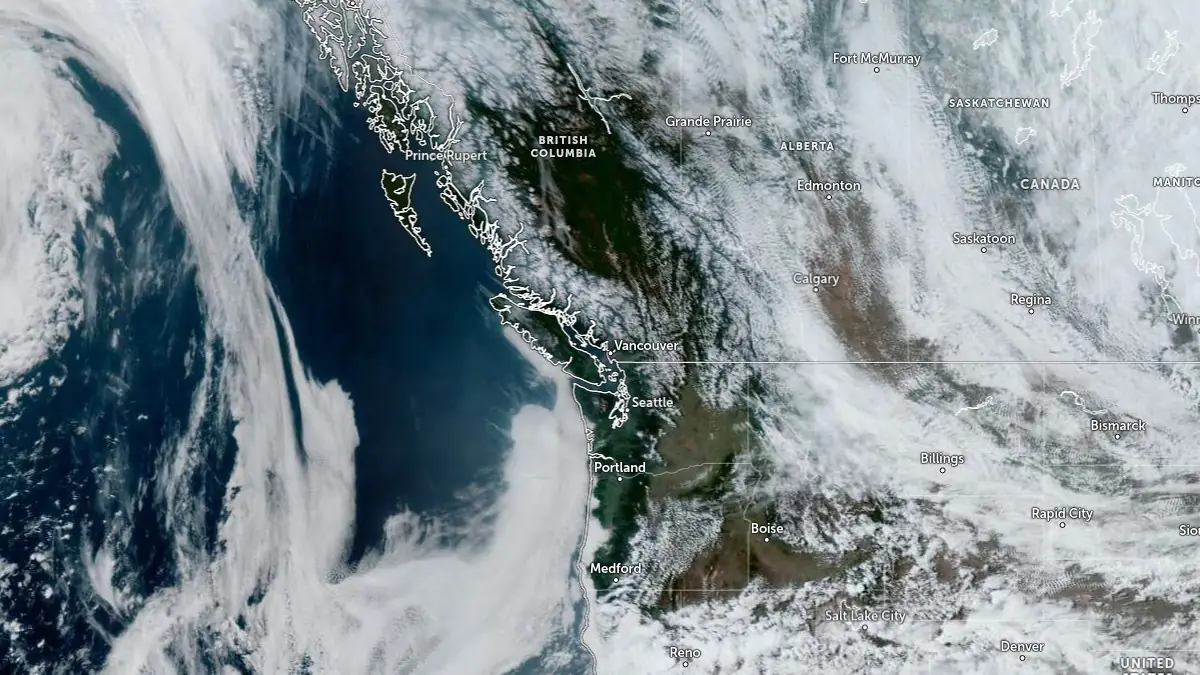
Satellite image acquired at 22:50 UTC on May 4, 2026. Credit: NOAA/GOES, Zoom Earth, The Watchers
A stationary ridge of high pressure brought above-seasonal temperatures to British Columbia on May 4 and 5, Environment Canada reported in its provincial weather summary issued at 18:07 PDT on Tuesday, May 5.
Daily records include Lytton at 33.5°C (92.3°F), breaking the previous record of 32.3°C (90.1°F) set in 2013, with records kept since 1921; Smithers at 25.8°C (78.4°F), breaking 25.2°C (77.4°F) set in 2013, with records kept since 1938; Kitimat at 25°C (77°F), breaking 23.0°C (73.4°F) set in 1998, with records kept since 1951; and Sandspit at 16.3°C (61.3°F), breaking 15.7°C (60.3°F) set in 1981, with records kept since 1945.
At least 19 British Columbia communities set new daily records on May 4, including Vancouver, Richmond, Squamish, Port Alberni, and Pemberton. Pemberton reached 31.5°C (88.7°F), the highest reported value among the listed May 4 locations.
BC Hydro said increased use of fans and air conditioners pushed provincial electricity demand to about 7 600 MW, marking the highest May demand level recorded by the utility.
May is a seasonal transition period in the Northern Hemisphere, when above-seasonal warmth begins increasing wildfire susceptibility in areas experiencing early drying.
References:
1 Weather summary for British Columbia – Environment Canada – May 5, 2026
2 Electricity demand and temperatures hit record levels in B.C. – CFJC Today – May 5, 2026

Teo Blašković founded The Watchers in 2011 and edited it until 2026, covering seismic and volcanic activity, extreme weather, space weather and near-Earth objects. Articles on this page are his archive.
Published in the last 24 hours
- Hawaii's largest freshwater lake was 200 feet deep at 10 a.m. on June 2, 2018. By that afternoon, lava from Kilauea had boiled it away Epicenter
- Flying glass cut a teacher in Russia but none of her 44 pupils, because when a meteor flashed across the sky in 2013, she told them to get under their desks Epicenter
- A South Dakota man put the widest and heaviest hailstone on US record in his freezer, and a power cut melted part of it before NOAA measured it at 8 inches across and nearly 2 pounds in 2010 Epicenter
- Black kites and brown falcons in northern Australia have been seen snatching smoldering sticks from wildfires, flying them into unburned grass and dropping them, starting new fires that send lizards, rodents and insects running straight toward the waiting birds Epicenter
