
Mars atmosphere loss: neutral processes
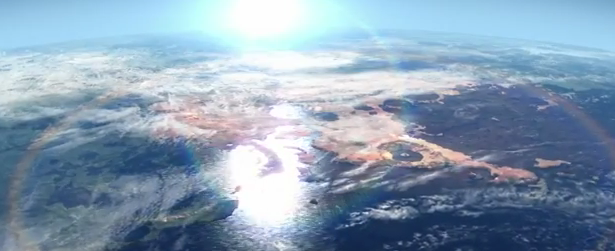
Image credit: NASA
When you take a look at Mars, you probably wouldn't think that it looks like a nice place to live. It's dry, it's dusty, and there's practically no atmosphere. But some scientists think that Mars may have once looked like a much nicer place to live, with a thicker atmosphere, cloudy skies, and possibly even liquid water flowing over the surface.
So how did Mars transform from a warm, wet world to a cold, barren desert? NASA's MAVEN spacecraft will give us a clearer idea of how Mars lost its atmosphere (and thus its water), and scientists think that several processes have had an impact.
Scientists think that the collision of neutral hydrogen molecules may have helped to drive the Martian atmosphere into space over billions of years.

Video credit and caption: NASA Goddard

Teo Blašković founded The Watchers in 2011 and edited it until 2026, covering seismic and volcanic activity, extreme weather, space weather and near-Earth objects. Articles on this page are his archive.
Published in the last 24 hours
- Male toads abandoned a pond in Italy five days before a deadly 2009 earthquake, while a scientist was counting them Epicenter
- An asteroid was spotted 19 hours before it exploded over Sudan in 2008, and students picked its pieces off the desert Epicenter
- A wave up to 3 m (10 feet) high rose out of Lake Michigan on a sunny June morning in 1954 and swept fishermen off Chicago’s piers, and when a second came 10 days later, warnings had cleared the shore Epicenter
- Just 12 inches of rushing water can carry away most cars, and more than half of US flood drownings happen to people who drive into flood water Epicenter

Bashar (channelled ET communication) says a very close passing comet was the primary aspect of the loss of atmosphere.
Also if I recall, that the originally evolving human stock on Earth was genetically modified to provide incarnational vehicles for ex-Martians as part of a larger cosmological intent.
Bashar's communications regarding consciousness are excellent – I cant verify the rest – but I can open to a vastly more multidimensional cosmology, within which our surface consciousness has developed its particular egocentric exceptionalism and isolationism throughout a period of 'quarantine' which is now ending. While some aspects of this are ET and cosmology related, the context is the opening to mutidemensionality – to Consciousness not defined by time and space but which uses such focuses non linearly. That is to say, to Superconsciousness that had been entirely Unconscious.
Physics uncovers more and more of the nature of energy events yet the mythic structure of personal consciousness that pretends to be at the driving wheel is a veneer of Newtonian over the inheritance of religious 'separation' myth.
I agree with the previous commentor. There seems to be plenty of evidence that shows that Mars once had a thriving civilization. A comet or large body may have made a close pass and literally blew the atmosphere off into space…Mars isn't massive enough to hold on to its atmosphere if it is distrubed and whipped into higher velocity.
I think it was a sudden apocalyptic event…a huge comet, after a cataclysmic collision , (we can see the scar even now on mars surface)wiped out all the atmosphere transforming mars to a dead planet…not a progressive event.