
Iceland to resume disputed fin whale hunt in June

Featured image: Fin whale (Credit: An1mal.org)
Iceland plans to resume its disputed commercial fin whale hunt in June with a quota of at least 154 giant mammals plus some 20% from last season possibly. Beside the second largest whale species (after the blue whale), Iceland also hunts smaller minke whales. Iceland resumed commercial whaling in 2006.
Kristjan Loftsson, chief executive of Hvalur, the only company that catches the fin whale, said that two vessels are being prepared for the hunt and they will head out to sea in early June. In 2010, Hvalur caught 148 fin whales but none in 2011 and 2012 due to the disintegration of its only market in quake- and tsunami-hit Japan. Iceland exported 500- 600 tons of fin whale meat to Japan in 2011. Most of this year’s whale meat would be also exported to Japan. In 2011, the United States threatened Iceland with economic sanctions over its commercial whaling, accusing the country of undermining international efforts to preserve the ocean giants.
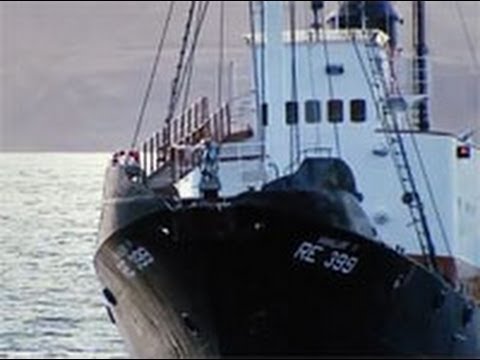
Iceland and Norway are the only two countries still openly practicing commercial whaling in defiance of the moratorium. Japan also hunts whales but insists this is only for scientific purposes even if most of the meat ends up on the market for consumption.
The species is also hunted by Greenlanders under the Aboriginal Subsistence Whaling provisions of the IWC. Estimates suggest that the population of the remaining fin whales in the world’s seas range from less than 100,000 to roughly 119,000.
The International Whaling Commission imposed a global moratorium on whaling in 1986 amid alarm at the declining stock of the marine mammals. Fin whales are protected in the Southern Ocean and North Pacific since the 1970s and in the North Atlantic by the moratorium from 1986; some special permit and commercial whaling under objection has occurred since. Fin whale populations in the Southern Hemisphere were heavily exploited by industrial whaling in the Southern Ocean, especially between the 1930s and 1960s.
Fin whale populations were exploited throughout the North Atlantic. Present total abundance in the North Atlantic is over 35,000 animals although not all areas have been surveyed. Assessments of the population status in the central North Atlantic and off West Greenland have shown populations there to be in a healthy state. The status of fin whales in other parts of the North Atlantic has not been fully assessed. Fin whale populations were exploited throughout the North Pacific. There are insufficient data to undertake an assessment of their present status. However, partial estimates for the eastern North Pacific reveal around 10,000 animals with some evidence of annual increase rates of 4-5%.
Fin whales are found in all the world’s major oceans, from polar to tropical waters. It is absent only from waters close to the ice pack at both poles and relatively small areas of water away from the open ocean. The highest population density occurs in temperate and cool waters. Its food consists of small schooling fish, squid, and crustaceans including copepods and krill.
Fin whale
| Average length (m): | Southern Hemisphere: 21-22.3 (females are larger) Northern Hemisphere: 19-20 (females are larger) |
| Average weight (tonnes): | 45-75 |
| Conservation: | A primary target for modern whaling. Heavily reduced, particularly in the North Pacific and Southern Hemisphere. Evidence of recovery in the North Atlantic and parts of the Southern Hemisphere. |
| Distribution: | Worldwide, ranging from temperate to polar waters and less commonly in the tropics |
| Migration: | Between high-latitude feeding grounds in summer and lower-latitude breeding grounds in winter – some evidence to suggest that some populations may shift in winter to occupy the summer habitats of others |
| Primary prey: | Krill and small schooling fish |
| Feeding: | Lunging and gulping |
STOP WHALING NOW!
Sources: IWC, TerraDaily, The Icelandic Marine Research Institute

Earlier reporting
Nothing on Watchers was published in the last 24 hours. These are older articles.
- On October 22, 2017, a single flash of lightning stretched 515 miles from eastern Texas to near Kansas City, a distance that takes eight hours to drive, and nobody realized how far it had gone until scientists went back through the satellite data years later Epicenter
- CPC posts a slight risk of heavy rain from the Gulf Coast to the Northeast urban corridor November 25-29, and a moderate risk of West Coast wind and Sierra snow on November 25
- Florida's east coast faces a moderate flash flood risk Wednesday through Friday, with 4 to 8 inches of rain forecast and the St. Johns River near Cocoa already in major flood at 17.13 feet
- Cyclone Akvan to make landfall between Nellore and Visakhapatnam around noon on November 20, IMD forecasts 120-130 km/h winds gusting to 145
