
Farside active region shoots bright CME toward Venus
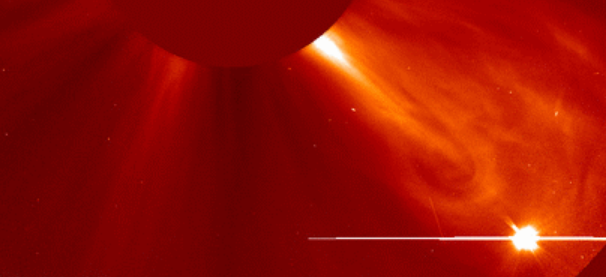
Image credit: NASA - SOHO C2
An active region in the Sun’s far-southern hemisphere erupted on March 23, 2013 around 13:00 UTC hurling bright Coronal Mass Ejection (CME) toward the Venus. A glancing impact is expected on March 25th. Venus has no global magnetic field to protect it from CME’s so the impact will likely strip a small amount of atmosphere from the planet’s cloudtops.
 Bright object visible at the right bottom corner of SOHO C2 imagery shows planet Venus. SOHO’s C2 images show the inner solar corona up to 8.4 million kilometers (5.25 million miles) away from the Sun.
While Earth side of the Sun shows few weak regions an low activity, farside regions are hurling more CME’s toward Venus… the image below by STEREO Ahead EUVI 195 shows at least 7 active regions currently in transit.
 Image courtesy of SolarHam
Sunspots
There are currently 5 numbered regions on disk. As of March 24, 2013 at 00:30 UTC they are: Region 1695, classified with Alpha magnetic configuration, and Regions 1701 and 1704 with the same magnetic configuration. Regions 1702 and 1703 are classified with Beta magnetic configuration.

NOAA SWPC forecasters estimated 5% chance for M-class and 1% chance for X-class solar flare on March 24 and 25th. A drop to 1% chance for both classes is expected on March 26th. The geomagnetic field is expected to be at quiet levels for the next three days.

Teo Blašković founded The Watchers in 2011 and edited it until 2026, covering seismic and volcanic activity, extreme weather, space weather and near-Earth objects. Articles on this page are his archive.
Published in the last 24 hours
- Male toads abandoned a pond in Italy five days before a deadly 2009 earthquake, while a scientist was counting them Epicenter
- An asteroid was spotted 19 hours before it exploded over Sudan in 2008, and students picked its pieces off the desert Epicenter
- A wave up to 3 m (10 feet) high rose out of Lake Michigan on a sunny June morning in 1954 and swept fishermen off Chicago’s piers, and when a second came 10 days later, warnings had cleared the shore Epicenter
- Just 12 inches of rushing water can carry away most cars, and more than half of US flood drownings happen to people who drive into flood water Epicenter
