
Giant magnetized outflows from our Galactic Center
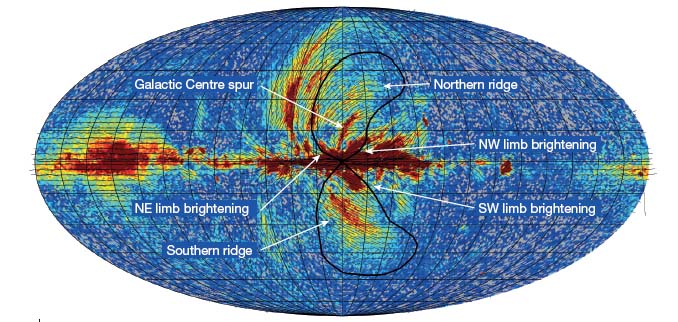
Featured image: A false-color image of our Milky Way as seen in a projection that shows the galactic center at the center of the image, the plane of the galaxy stretching across the central band, and the two arc-shaped radio lobes of emission seen extending north and south of the plane. Several of the newly discovered magnetic structures are labeled. Credit: Carretti et al., and Nature
Two years ago, CfA astronomers reported the discovery of giant, twin lobes of gamma-ray emission protruding about 50,000 light-years above and below the plane of our Milky Way galaxy, and centered on the supermassive black hole at our galaxy’s core.
The scientists argued then that the bubbles were produced either by an eruption from the black hole sometime in the past, or else by a burst of star formation in that vicinity.
It now appears that these giant bubbles of hot gas can be seen at radio wavelengths as well. Writing in the new issue of the journal Nature, CfA astronomer Gianni Bernardi and eight of his colleagues describe finding humongous lobes of radio emission emanating from the Galactic Center. Moreover, the emission is polarized, a general property that electromagnetic radiation can have; some sunglasses take advantage of the fact that reflected sunlight becomes polarized. In the case of radio wavelengths, the explanation for polarization is the presence of strong magnetic fields.
The scientists calculate that the radio lobes, which closely match the gamma-ray lobes in overall dimensions but which contain three ridge-like substructures, are probably polarized by the presence of strong magnetic fields that extend out of the galactic plane in both directions for tens of thousands of light-years, and which contain an energy roughly equivalent to the total current output of the Sun for a time equal to the lifetime of the universe.
They argue that the activity is driven by star-formation activity, rather than black-hole activity, and that it originates in a region around the Galactic Center about 650 light-years in size. Not least, the scientists argue that the ridges seen in the magnetically-shaped outflow are the result of several episodes of star-formation that constitute a phonograph-like record of star formation in this region over at least the past ten million years.
Source: CfA – Harvard-Smithsonian Astrophysical Observatory

Teo Blašković founded The Watchers in 2011 and edited it until 2026, covering seismic and volcanic activity, extreme weather, space weather and near-Earth objects. Articles on this page are his archive.
Earlier reporting
Nothing on Watchers was published in the last 24 hours. These are older articles.
- Right about now, Voyager 1 is crossing a line no human-made object has ever reached, a full light-day from Earth, which means a message NASA sends tonight won't arrive until tomorrow night, and the spacecraft's answer won't make it home until the night after that
- On October 22, 2017, a single flash of lightning stretched 515 miles from eastern Texas to near Kansas City, a distance that takes eight hours to drive, and nobody realized how far it had gone until scientists went back through the satellite data years later Epicenter
- CPC posts a slight risk of heavy rain from the Gulf Coast to the Northeast urban corridor November 25-29, and a moderate risk of West Coast wind and Sierra snow on November 25
- Florida's east coast faces a moderate flash flood risk Wednesday through Friday, with 4 to 8 inches of rain forecast and the St. Johns River near Cocoa already in major flood at 17.13 feet

I do believe this phenomena some how ties in with the Galactic Super Wave theory that Dr. Paul LaViolotte researched and predicted back in i983 which have been scrutinized and found to be true. here is link of said predictions for all like minded people who want to know what is really going on: http://www.etheric.com/LaViolette/Predict.html