
CME impact & G3 class geomagnetic storm – October 1, 2012

Image credit: Aurora display captured from Whitehorse,Yukon by Jonathan Tucker on September 30, 2012
The September 28th Coronal Mass Ejection (CME) impacted Earth’s magnetic field at 22:20 UTC last night, September 30, 2012 sparking strong Geomagnetic storms at high latitudes today. The Bz component of the interplanetary magnetic field (IMF) sharply deviated to -35 nT during the impact. A weak interplanetary shock wave hit Earth at 10:20 UTC followed by a stronger CME strike at approximately 22:20 UTC. Earth’s magnetic field is still reverberating in response to these impacts.

Geomagnetic K-index reached Kp=7 levels on October 1st at 03:00 UTC and NOAA/SWPC issued G3 (Strong) Geomagnetic Storm Level alert which is slightly higher than initially predicted. At G3 level voltage corrections may be required, false alarms could trigger on some protection devices, surface charging may occur on satellite components, drag may increase on low-Earth-orbit satellites, and corrections may be needed for orientation problems, intermittent satellite navigation and low-frequency radio navigation (GPS) problems may occur, HF radio may be intermittent, and aurora has been seen as low as Illinois and Oregon (typically 50° geomagnetic lat.). Observers in Norway are already reporting significant ground currents.
ALERT: Geomagnetic K-index of 7
Synoptic Period: 0000-0300 UTC
NOAA Scale: G3 – Strong
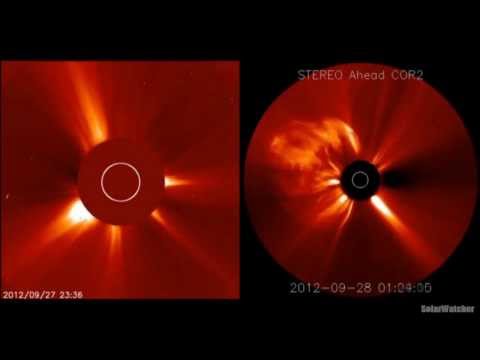
Video by SolarWatcher
Currently the IMF is directed steadily northward and the geomagnetic activity is decreasing. As the IMF magnitude remains elevated (around 15 nT), further geomagnetic disturbances are not excluded.
Departing sunspot 1583 poses a threat for M-class solar flares,but for now still not Earth-directed. There are no large coronal holes on the Earth side of the sun.


Teo Blašković founded The Watchers in 2011 and edited it until 2026, covering seismic and volcanic activity, extreme weather, space weather and near-Earth objects. Articles on this page are his archive.
Published in the last 24 hours
- High Risk of excessive rainfall covers Florida’s Space Coast as St. Johns River near Cocoa reaches 5.67 m
- Asteroid 2026 WJ to pass Earth at 1.7 lunar distances at 04:20 UTC on November 22, with 2026 WD following at 4.4 lunar distances on November 23
- Cyclone Akvan crossed the north Andhra Pradesh and south Odisha coasts close to Gopalpur on November 20 with 70-80 km/h winds gusting to 90, and has weakened into a deep depression
- A broad low over southeastern Florida and the northwestern Bahamas has a 30 percent chance of subtropical or tropical development within 48 hours and a 50 percent chance within 7 days, the National Hurricane Center says

[…] The Watchers – CME impact & G3 class geomagnetic storm … […]