
Mining asteroids for precious minerals and volatiles
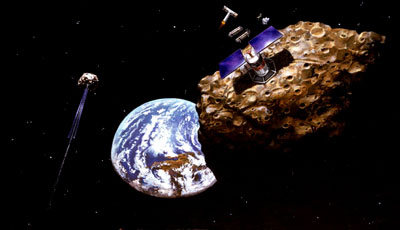
Image credit: NASA
As speculations claim essential resources for modern industry will extinct in upcoming years, ideas of mining the asteroids to extract minerals and bring them to Earth promise to cope with such inevitable problem. Scientists claim that minerals and volatiles including iron, nickel, lead, titanium, gold, platinum and several others could be mined from asteroids and other near-earth objects; utilizing water and ice on asteroids for building fuel depots. It has also been revealed that most of the minerals that we use in modern industrial production, actually came from asteroids which hit the Earth after cooling of the crust some million years ago.
There are some 9000 asteroids larger than 150 feet orbiting near Earth, some of which contain more platinum than we mine from Earth in an entire year. That is worth billions and if worth combined with other minerals, asteroid mining could very well add trillions of dollars to global GDP. Asteroid mining infrastructure may include orbital transportation hub, a larger version of space station to be used for coordinating cargo flights. Space fuel depots will be required, scientists are currently working on methods to transfer fluids in Zero gravity. Also, there shall be need for optical laser communication systems which transmit comparable to radio and consume half the power.

Some wealthy entrepreneurs, including Google’s chief executive Larry Page and film director James Cameron have joined hands to form Planetary Resources, Inc. with executive chairman Eric Schmidt, a venture planning to mine asteroids with the help of robotics. They’ve planned to launch two to five private space-based telescopes to look for valuable asteroids, near-earth asteroids are likely to be observed during early stages. Thereafter, company is hoping to send swarm of spacecrafts for detailed mapping of asteroid with estimated cost of $25-30 million within 5-7 years. After that, plan is to mine ore and refine if possible, then return material to earth safely, all with use of robotics monitored remotely.

Some scientists have regarded the plan with skepticism, who claim even if platinum and gold are nearly worth $35 per gram, plan is not cost-effective. Upcoming NASA mission OSIRIS-REx will cost about $1 billion USD to extract 60 grams of material from an asteroid and deliver to Earth. So far, only Japanese space agency’s Hayabusa spacecraft has been successful in returning dust particles from an asteroid; which suggests for the realizing its plans, Planetary Resources Inc. will have to develop technologies to make such an extraction cum return-to-earth plan possible as well as bring cost down to prove its cost-effectiveness.
Eric Anderson, founder of commercial space tourism company Space Adventures said, “The resources of Earth pale in comparison to the wealth of the solar system”, who is co-founder of new company along with Peter Diamandis, who started the X Prize foundation. According to Mr. Diamandis,
“If you look back historically at what has caused humanity to make its largest investments in exploration and in transportation, it has been going after resources, whether it’s the Europeans going after the spice routes or the American settlers looking toward the west for gold, oil, timber or land.”
Asteroid mining will bring wealth in the form of valuable minerals like platinum, though platinum mines in South Africa alone are said to have enough ore to produce for another 300 years. Yet, promoters say water on asteroids can be utilized for drinking and after breaking into its constituents, both hydrogen and liquid oxygen can be used to produce rocket fuel. Also, technological advancement for such mission shall pave the path to further space explorations which have so far been impossible.
Sources: Planetary resources, Asteroid mining – Wikipedia

Earlier reporting
Nothing on Watchers was published in the last 24 hours. These are older articles.
- On October 22, 2017, a single flash of lightning stretched 515 miles from eastern Texas to near Kansas City, a distance that takes eight hours to drive, and nobody realized how far it had gone until scientists went back through the satellite data years later Epicenter
- CPC posts a slight risk of heavy rain from the Gulf Coast to the Northeast urban corridor November 25-29, and a moderate risk of West Coast wind and Sierra snow on November 25
- Florida's east coast faces a moderate flash flood risk Wednesday through Friday, with 4 to 8 inches of rain forecast and the St. Johns River near Cocoa already in major flood at 17.13 feet
- Cyclone Akvan to make landfall between Nellore and Visakhapatnam around noon on November 20, IMD forecasts 120-130 km/h winds gusting to 145

The greed of humanity has no boundaries it seems!!!
Until they figure a way to economically have the mining spacecrafts leave and return, without consuming too many resources, not going to happen. We need anti-gravity technology.