
Yellowstone geysers became active again
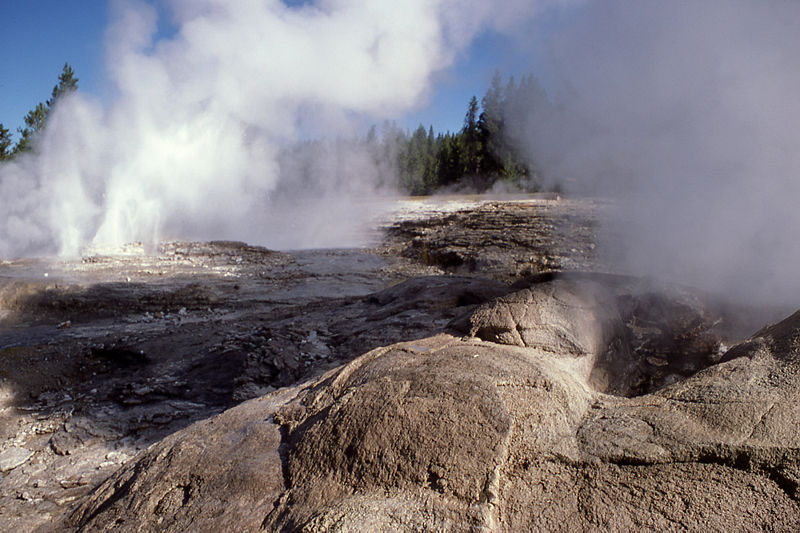
Image credit: J. Schmidt
According to article published in YellowstoneGate a handful of Yellowstone National Park geysers appear to be active again after periods of dormancy, including one geyser that last erupted almost two decades ago.
Morning Geyser, quiet for 18 years, is now active, and there is news that an electronic monitor on Echinus in Norris Geyser Basin picked up an eruption. North Goggles Geyser has also started erupting more regularly than the lone annual display it has typically shown over the past few years. The last time it was this active was 2004. Joining the list of newly reactivated thermal features are Fan and Mortar geysers, which may be beginning an active cycle.
YELLOWSTONE VOLCANO STATUS – June 24, 2012
Country: United States
Subregion Name: Wyoming (USA)
Volcano Type: Calderas
Last Known Eruption: 1350 BC ± 200 years
Location:44°25’48” N 110°40’12” W
Summit Elevation 9203 ft (2805 m)
Current Volcano Alert Level: NORMAL
Current Aviation Color Code: GREEN
YELLOWSTONE VOLCANO OBSERVATORY MONTHLY UPDATE
During the month of May 2012, the University of Utah reports 30 earthquakes were located in the Yellowstone National Park region. The largest was a magnitude 2.1 event on May 24 at 12:47 AM MDT, located about 22 miles southeast of West Thumb, YNP. No earthquake swarms were detected in May.
Yellowstone earthquake activity is at a relatively low background level.
Slow subsidence of the caldera, which began in early 2010, continues. Current deformation patterns at Yellowstone are well within historical norms.
Sources: yellowstonegate.com, volcanoes.usgs.gov

Teo Blašković founded The Watchers in 2011 and edited it until 2026, covering seismic and volcanic activity, extreme weather, space weather and near-Earth objects. Articles on this page are his archive.
Published in the last 24 hours
- High Risk of excessive rainfall covers Florida’s Space Coast as St. Johns River near Cocoa reaches 5.67 m
- Asteroid 2026 WJ to pass Earth at 1.7 lunar distances at 04:20 UTC on November 22, with 2026 WD following at 4.4 lunar distances on November 23
- Cyclone Akvan crossed the north Andhra Pradesh and south Odisha coasts close to Gopalpur on November 20 with 70-80 km/h winds gusting to 90, and has weakened into a deep depression
- A broad low over southeastern Florida and the northwestern Bahamas has a 30 percent chance of subtropical or tropical development within 48 hours and a 50 percent chance within 7 days, the National Hurricane Center says

i would like updates every month because i live in Cody Wy pls get more updates for a piece of mind. thanks
[…] https://watchers.news/2012/06/24/yellowstone-geysers-became-active/ Podziel się na: […]
[…] Yellowstone geysers became active again […]
[…] Adonai TheWatchers […]