
A coronal mass ejection (CME) hit Earth’s magnetic field – K index rising, watch for auroras!!!
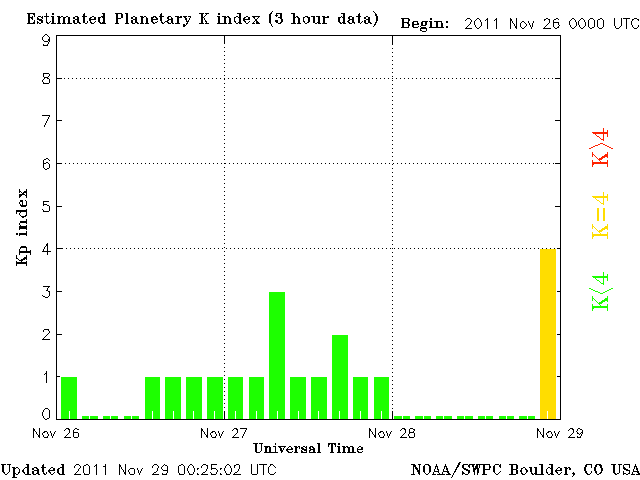
Image credit: TW
A coronal mass ejection (CME) hit Earth’s magnetic field at approximately 2145 UTC on Nov. 28th. The impact was relatively weak and did not spark a strong geomagnetic storm yet. Kp index is at level 4.
Solar wind
speed: 474.8 km/sec
density: 0.4 protons/cm3
Planetary K-index
Now: Kp= 0 quiet
24-hr max: Kp= 4 quiet
Interplanetary Mag. Field
Btotal: 11.6 nT
Bz: 1 nT south
The Radio Sun
10.7 cm flux: 135 sfu

Just before 21:30 UTC, the ACE Spacecraft detected a sudden Solar Wind Increase to near 550 km/s. This signals the arrival of the Coronal Mass Ejection (CME) sweeping past the spacecraft. A sudden impulse measuring 45nT was detected at 21:54 UTC. The K-Index is rising, it’s a sign for possible geomagnetic storm conditions.

A sharp pulse seen by the ACE spacecraft may herald the beginning of a geomagnetic disturbance. The pulse occurred just after 2100 UTC (4 p.m. EST), and as yet both solar wind speed and magnetic field strength, though elevated and enhanced, are not indicating significant imminent geomagnetic storm activity. (NOAA/SWPC)
Nov 28 2158 UTC ALERT: Geomagnetic K-index of 4

Here is the prediction of storm intensity for the next few minutes (the higher the Kp number, the larger the Aurora):
The Space Environment Center’s Neural Net Program Estimates that . . .
in 5 minutes, the Geomagnetic Activity level (Kp number) will be 5 — Very Active.
in 17 minutes, the Geomagnetic Activity level (Kp number) will be 4.67 — Very Active.
in 33 minutes, the Geomagnetic Activity level (Kp number) will be 4.33 — Active.

Watch aurora at EarthCam (Reykjavik, Iceland)


Published in the last 24 hours
- People who hid under an Oklahoma highway overpass from a 1999 tornado lost fingers, ears and noses, and three people died near or under overpasses that day Epicenter
- In January 1862, California’s new governor took a rowboat to his own inauguration, after 45 days of storms had turned the Central Valley into a lake up to 300 miles long Epicenter
- People who stayed put through the 2017 hurricanes were more often the ones with flood insurance, a survey of 2,557 Gulf Coast residents found, and the authors suggest the policy may have made the storm feel less dangerous Epicenter
- High Risk of excessive rainfall covers Florida’s Space Coast as St. Johns River near Cocoa reaches 5.67 m
