
Geomagnetic storm in progress
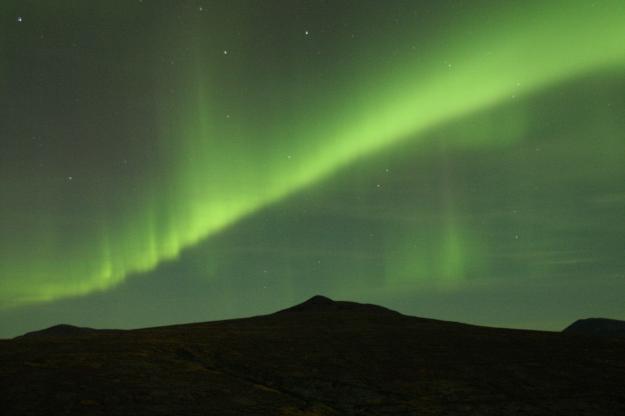
Image credit: TW
As predicted by analysts at the Goddard Space Weather Lab, a coronal mass ejection (CME) hit Earth's magnetic field at ~03:30 UT on Sept 17th. The impact sparked a moderate geomagnetic storm (in progress) and auroras around the Arctic Circle. High-latitude sky watchers should remain alert for auroras tonight as Earth's magnettic field continues to reverberate from the CME's impact. (SpaceWeather)
Solar wind
speed: 433.4 km/sec
density: 2.4 protons/cm3
The Radio Sun
10.7 cm flux: 143 sfu
Planetary K-index
Now: Kp= 6 storm
24-hr max: Kp= 6 storm
Interplanetary Mag. Field
Btotal: 13.5 nT
Bz: 0.6 nT north

The solar wind measured by the ACE Spacecraft increased from 400 km/s to near 550 km/s and this indicates a small CME impact. Minor geomagnetic storming reaching the G1 level is now taking place with the help of a southward Bz.
The solar X-Ray background levels have been hovering near the C1 level for the last several hours, but only a few C-Class flares have taken place. Sunspots 1291,1293 and 1297 have rotated onto the western limb and 1289 and 1290 will soon follow this weekend. Sunspots 1292 and 1294 have faded away. There will remain the chance for an isolated M-Class event.
Again because of the amount of sunspot regions on the face of the sun, the official Sunspot number count for Sept 16 is 173. This is another new record for Cycle 24 . Before the past few days, the previous mark of 153 was set on 4/13/2011.
The daily sunspot number will now decrease because of multiple regions rotating onto the western limb and out of direct earth view. (SolarHam)
 The Coronal Mass Ejection arrived overnight, as forecast. So far, the geomagnetic response has been underwhelming, but possibilities for reaching Minor (G1) Geomagnetic Storm levels remain as long as we are under the influence of the CME. Conditions are expected to return to quiet levels mid-afternoon Eastern Time (evening GMT). (NOAA/SWPC)
Alerts / Bulletins
Latest Alert: Sep 17 1754 UTC EXTENDED WARNING: Geomagnetic K-index of 5 expected
Last Advisory Bulletin: None in last 7 days.
| Range 1 (minor) to 5 (extreme) | ||
| NOAA Scale | Past 24 hrs | Current |
| Geomagnetic Storms |  |
 |
| Solar Radiation Storms |  |
 |
| Radio Blackouts |  |
 |


3-day Solar-Geophysical Forecast issued Sep 16 22:00 UTC
Solar Activity Forecast: Solar activity is expected to be low with a chance for isolated M-class flares during the period (17-19 September).
Geophysical Activity Forecast: Geomagnetic field activity is expected to be at unsettled to active levels, with isolated minor storm levels at high latitudes, on day one (17 September), due to the effects of the full halo CME observed at 14/0000Z. Activity is expected to decrease to quiet to active levels on day two (18 September). Predominantly quiet levels are expected on day three (19 September).


Earlier reporting
Nothing on Watchers was published in the last 24 hours. These are older articles.
- On October 22, 2017, a single flash of lightning stretched 515 miles from eastern Texas to near Kansas City, a distance that takes eight hours to drive, and nobody realized how far it had gone until scientists went back through the satellite data years later Epicenter
- CPC posts a slight risk of heavy rain from the Gulf Coast to the Northeast urban corridor November 25-29, and a moderate risk of West Coast wind and Sierra snow on November 25
- Florida's east coast faces a moderate flash flood risk Wednesday through Friday, with 4 to 8 inches of rain forecast and the St. Johns River near Cocoa already in major flood at 17.13 feet
- Cyclone Akvan to make landfall between Nellore and Visakhapatnam around noon on November 20, IMD forecasts 120-130 km/h winds gusting to 145
