
Bermuda Triangle to become humpback whale sanctuary
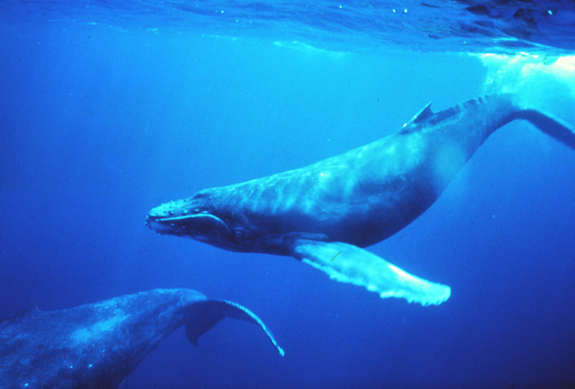
Image credit: TW
The National Oceanic and Atmospheric Administration (NOAA) recently announced a letter of intent signed by the Bermuda Department of Environmental Protection to establish a sister sanctuary to NOAA’s Stellwagen Bank National Marine Sanctuary for the gentle giants.
The sister sanctuary would not be the first for Stellwagen Bank, located in the Gulf of Maine, and its humpback whales. Beginning in 2007, Stellwagen established the world’s first sister sanctuary with the Dominican Republic’s Santuario de Mamiferos Marinos de la República Dominicana to protect the endangered migratory marine mammal on both ends of its range.

There are five distinct populations of humpbacks in the North Atlantic, with Stellwagen Bank being the feeding grounds for one of the groups. The other four are off the coasts of Nova Scotia, Norway, Greenland and Iceland. Down in the Caribbean, the whales mingle during breeding season, and one of the largest congregation spots is off the coast of the Dominican Republic.
But protecting just two points in the humpbacks’ range is not enough to ensure their survival. Bermuda will protect the species in its migratory corridor, rather than the furthest reaches of its range, the first marine mammal sanctuary to offer such a waypoint.
When the Bermuda sanctuary is established, hopefully by the end of this year, NOAA will issue a memorandum of understanding to exchange data that will include photos of the whales and coordinate research, education and strategies for engaging locals in whale conservation. The massive creatures are threatened not only from direct human pressures, such as ship strikes or fishing net entanglement, but also indirect pressures such as pollution and ocean noise.
The goal is to grow the family of sanctuaries throughout the Caribbean. NOAA is currently negotiating memorandums of understandings with the French Antilles and some Dutch territories in the eastern Caribbean.

The sanctuaries allow for more focused research that can reap benefits for the whales. In Stellwagen Bank, renowned for its whale watching, researchers looked at more than 20 years of whale sighting reports to establish where the whales spent most of their time. The effort resulted in a proposal to shift shipping lanes northward by just 12 degrees, which scientists estimated could reduce whale strikes by 81 percent.

Information like that in other regions of the whales’ migration path could help inform similar management techniques, as well as help boost local economies by establishing whale watching and other tourism that supports both the sanctuary and the people who live nearby. (OurAmazingPlanet)

Published in the last 24 hours
- High Risk of excessive rainfall covers Florida’s Space Coast as St. Johns River near Cocoa reaches 5.67 m
- Asteroid 2026 WJ to pass Earth at 1.7 lunar distances at 04:20 UTC on November 22, with 2026 WD following at 4.4 lunar distances on November 23
- Cyclone Akvan crossed the north Andhra Pradesh and south Odisha coasts close to Gopalpur on November 20 with 70-80 km/h winds gusting to 90, and has weakened into a deep depression
- A broad low over southeastern Florida and the northwestern Bahamas has a 30 percent chance of subtropical or tropical development within 48 hours and a 50 percent chance within 7 days, the National Hurricane Center says

good news, thanks