
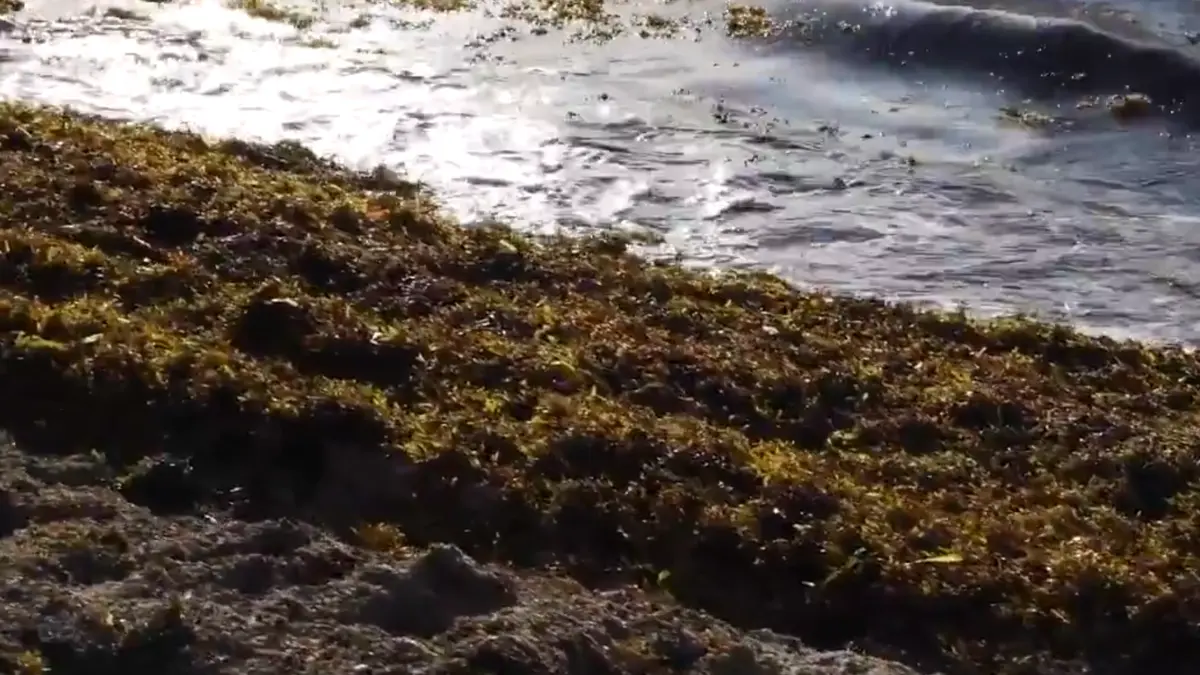
Dense mats of decomposing sargassum invade Dania Beach, Florida
Thick accumulations of decomposing sargassum seaweed washed ashore in Dania Beach, Florida on July 23, 2025, releasing hydrogen sulfide odors and prompting cleanup efforts. The event was part of a broader seasonal trend affecting Florida’s coastlines, driven by ocean currents and wind patterns transporting offshore blooms inland.
Large patches of Sargassum adrift near the island of Saint Martin. Credit: Vely Michel
Sargassum blooms in the Atlantic Ocean continued to impact Florida’s coastline, with a dense and malodorous influx reaching Dania Beach on July 23. Observations from the site showed expansive brown mats covering the shoreline, releasing hydrogen sulfide as decomposition progressed under high ambient temperatures.
Brandy Campbell of FOX Weather reported on-site, noting the extent of the stranding and the odor, often likened to rotten eggs. The conditions deterred typical beach activity, leaving the sands nearly deserted despite the summer season.
This local impact is part of a broader Atlantic-wide phenomenon. The University of South Florida’s Optical Oceanography Lab reported approximately 38 million metric tons of sargassum present in the Atlantic basin in May 2025, the highest volume recorded since satellite monitoring began in 2011.
That figure exceeds the previous peak by 42% and reflects contributions from both the eastern Atlantic (off Africa and Brazil) and the Caribbean.
The mass of floating macroalgae, known as the Great Atlantic Sargassum Belt is composed largely of Sargassum fluitans and Sargassum natans. These species proliferate in nutrient-rich, warm waters. The growth is sustained by runoff from the Amazon and West African rivers, combined with ocean circulation patterns and rising sea surface temperatures.
The transport of sargassum to Dania Beach was driven by an easterly swell, a common vector during Florida’s summer months. Once onshore, the seaweed begins to rot, producing hydrogen sulfide gas. While not toxic at typical beach concentrations, this gas can irritate the eyes, nose, and respiratory systems of sensitive individuals, particularly those with asthma.
Local authorities have not reported any health emergencies, but cleanup operations were mobilized quickly to mitigate impacts on public access and tourism. Manual and mechanical removal of beached sargassum is resource-intensive and often constrained by ecological regulations protecting sea turtle nesting zones and dune vegetation.
Despite its nuisance on land, sargassum plays a crucial ecological role in the ocean. Floating mats provide critical habitat and food sources for juvenile fish, crustaceans, and endangered species such as sea turtles.
July’s stranding follows similar events along Florida’s southeast coast earlier this year, including large landings in April and May. Forecasts from USF and other agencies suggest that such events will continue episodically through late summer, driven by regional wind and current patterns.
References:
1 Mounds of smelly seaweed return to South Florida beaches amid heat wave – FOX Weather – July 24, 2025

I’m a science journalist and researcher at The Watchers, contributing to the Epicenter edition, where I cover peer-reviewed scientific research and emerging discoveries across Earth and space sciences. With a background in astronomy and a passion for environmental science, I’ve worked in shark and coral conservation in Fiji, conducting reef and shark-behavior research, contributing to mangrove restoration, and earning PADI Open Water and Coral Reef Certifications. I bring a blend of scientific rigor and storytelling to illuminate the discoveries shaping our planet and beyond.

Commenting rules and guidelines
We value the thoughts and opinions of our readers and welcome healthy discussions on our website. In order to maintain a respectful and positive community, we ask that all commenters follow these rules.