
Scientists reconstruct Sun’s coronal magnetic field in three dimensions from existing observations
Researchers have reconstructed the strength and three-dimensional direction of the Sun’s coronal magnetic field across regions visible to instruments at the Mauna Loa Solar Observatory, extracting information that was previously inaccessible from existing observations. The result adds an observational constraint to models of the corona, where magnetic fields store and release the energy that powers solar eruptions and shapes space weather.
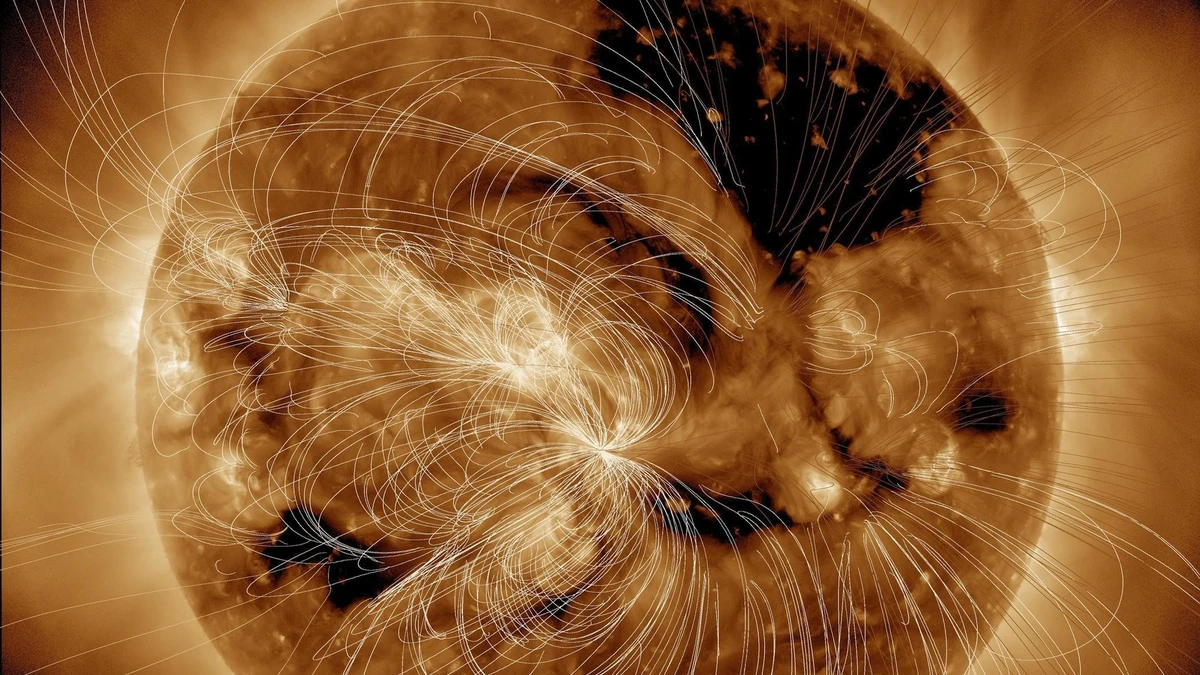
Magnetic Field Illuminated. Credit: NASA/GSFC/Solar Dynamics Observatory
Paraschiv et al. (2026) applied a previously developed inversion method to real observations from the Coronal Multi-channel Polarimeter (CoMP) and its upgraded successor, UCoMP, at the Mauna Loa Solar Observatory (MLSO). The study moves the method from theoretical and statistical tests to an observational demonstration using the solar corona itself.
That distinction matters because measurements of the Sun’s visible surface have long provided the lower boundary for models that calculate how magnetic fields extend into the corona. Researchers can readily see coronal loops and other plasma structures shaped by magnetism, but determining the full magnetic vector above the surface has remained much harder. Earlier UCoMP work produced routine large-scale measurements of the field projected onto the plane of the sky; the new analysis adds information about its three-dimensional orientation.
The team analyzed CoMP observations from October 14, 2016, and UCoMP observations from June 1, 2022. Those datasets already contained measurements used to estimate the magnetic field in the plane of the sky. The researchers combined that information with the polarization of near-infrared Fe XIII emission from the corona to infer additional magnetic-field components.
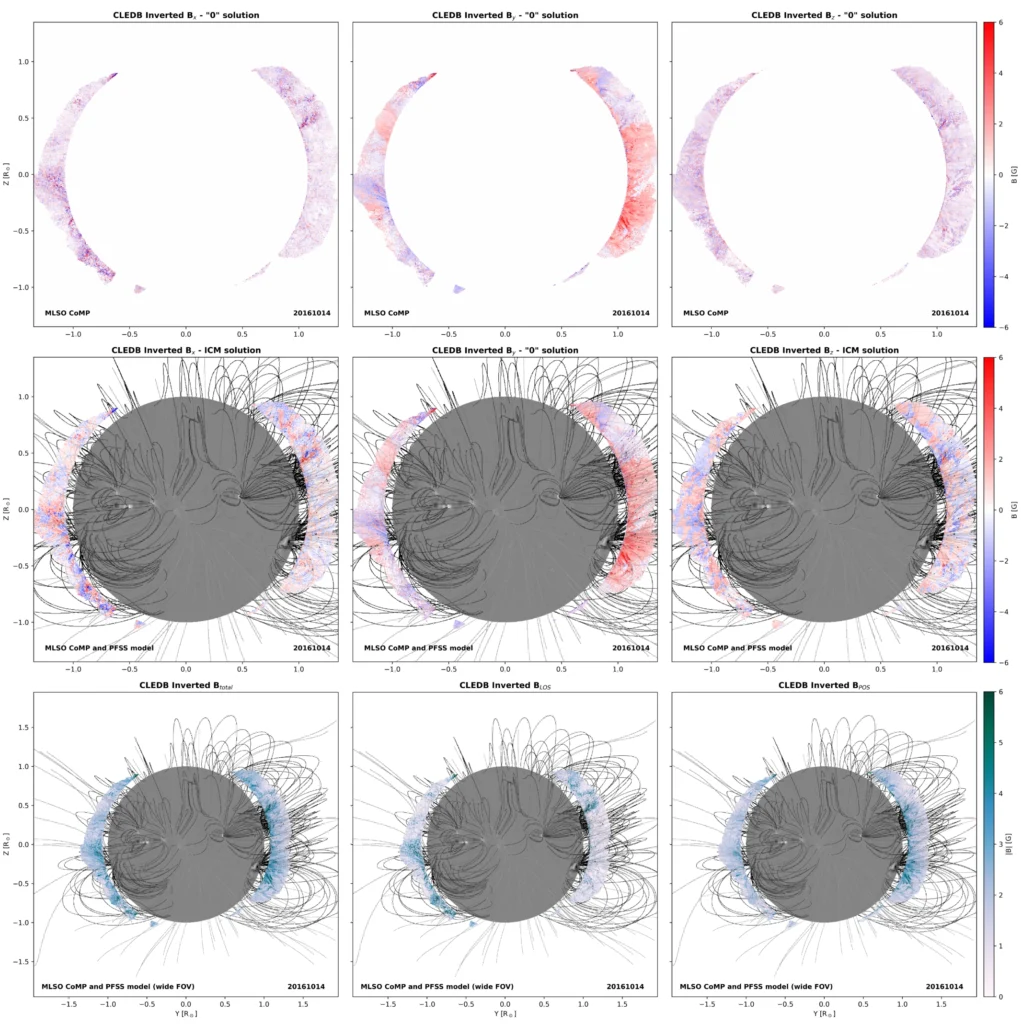
The physical principle combines two different signatures of the same magnetic environment. Coronal plasma supports Alfvénic waves, disturbances that propagate along magnetic structures. Measurements of their motion, together with information about plasma density, constrain the strength of the magnetic field projected across the observer’s view. Polarized coronal light carries separate information about magnetic-field orientation. The CLEDB IQUD inversion brings those constraints together to recover vector-field solutions rather than a single projected component.
The result is a reconstruction, not a direct unrestricted measurement of the Sun’s entire magnetic field. Paraschiv et al. recovered full-vector solutions across portions of the off-limb corona accessible to the CoMP and UCoMP observations. That scope is narrower than a complete three-dimensional map of the whole corona, but it adds information that earlier large-field observations did not contain.
The 2016 CoMP analysis recovered magnetic structures associated with active regions around the solar limb. The inversion also exposed one of the method’s limitations: no valid magnetograms were recovered over the north and south polar coronal holes in that dataset, where weak signals and cancellation of emission along the line of sight reduced the usable information. The paper reports that CoMP produced reasonable results to apparent heights of roughly 1.15–1.25 solar radii in the analyzed case.
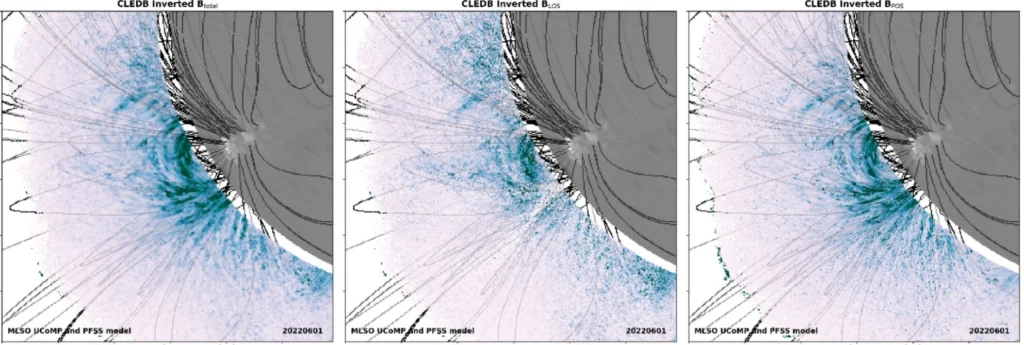
The June 1, 2022 UCoMP observations produced higher-quality reconstructions. Above decaying active region AR13006, the inferred field contained substantial components both along the observer’s line of sight and across the plane of the sky. The researchers also recovered changes in field orientation across the structure. In this dataset, usable results extended to approximately 1.20–1.45 solar radii in favorable regions, although the effective range depends on signal quality, coronal structure and line-of-sight complexity.
The reconstruction retains an important mathematical ambiguity. The IQUD inversion produces four degenerate solutions associated with different signs of two magnetic-vector components. The researchers used an iterative procedure to choose spatially coherent solutions for visualization, but the paper treats that selection as qualitative rather than a physical resolution of the ambiguity. The method therefore recovers substantially more information about the field without uniquely determining every local field direction.
Time resolution imposes another constraint. The current CoMP and UCoMP approach requires about an hour of Doppler-oscillation tracking to obtain statistically useful wave measurements. The method is consequently best suited to magnetic structures that remain comparatively stable over the observing interval; rapidly changing eruptive regions are more difficult because the plasma and field can evolve while the required measurements are being accumulated.
For space-weather research, the value lies in providing observations higher in the corona against which magnetic models can be constrained and tested. Coronal magnetic fields determine magnetic connectivity and energy storage and influence the development of coronal mass ejections and the solar wind. Current operational and research models still depend heavily on photospheric measurements and mathematical extrapolation into the corona. The new work provides a route toward adding measurements derived from the corona itself.
The study does not demonstrate an improvement in operational space-weather forecasting. NSF NCAR states that the method has not yet been integrated into operational observatory data-product pipelines, and both NCAR and NSO describe additional development and validation as necessary before routine use. The authors have made analysis software and datasets available so other researchers can reproduce, test and refine the approach.
The observations also provide a test case for the next generation of coronal magnetometry. NSF NCAR identifies the proposed COronal Solar Magnetism Observatory (COSMO) as a future system intended to extend wide-field measurements of the Sun’s magnetic environment. Whether full-vector coronal magnetograms can become sufficiently routine, rapid and unambiguous for data assimilation and forecasting will depend on resolving the present limitations in coverage, temporal sampling and magnetic-field disambiguation.
References:
1 Coronal magnetic fields in 3D – NSF National Center for Atmospheric Research – October 28, 2026
2 Scientists Find a New Way to Map the Sun’s Hidden Magnetic Field – U.S. National Science Foundation National Solar Observatory – October 28, 2026
3 Paraschiv, A. R., Yang, Z., Lacatus, D. A., & Molnar, M. (2026). A First Global Full-Vector Coronal Magnetic Field Inference Using MLSO CoMP and UCoMP Observations. The Astrophysical Journal Letters, 1011. DOI 10.3847/2041-8213/aead9e

I’m a science journalist and researcher at The Watchers, contributing to the Epicenter edition, where I cover peer-reviewed scientific research and emerging discoveries across Earth and space sciences. With a background in astronomy and a passion for environmental science, I’ve worked in shark and coral conservation in Fiji, conducting reef and shark-behavior research, contributing to mangrove restoration, and earning PADI Open Water and Coral Reef Certifications. I bring a blend of scientific rigor and storytelling to illuminate the discoveries shaping our planet and beyond.
