
Dust and clouds blew over the Taklimakan Desert in western China
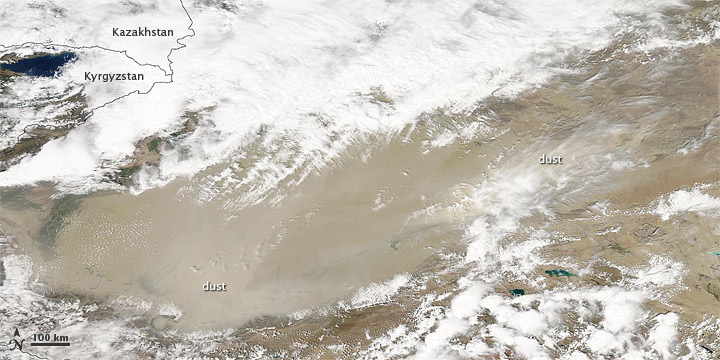
Image credit: TW
Dust and clouds blew over the Taklimakan Desert in western China on August 11, 2011. The Moderate Resolution Imaging Spectroradiometer (MODIS) on NASA’s Aqua satellite took this picture the same day.
Sitting inside the Tarim Basin, the Taklimakan Desert is the warmest, driest, largest desert in China, and it ranks among the world’s largest shifting-sand deserts. Sand dunes cover about 85 percent of the desert floor, some of them reaching 200 meters (650 feet). The sand dunes provide plentiful material for dust storms, which often blow eastward out of the Tarim Basin.
Despite the basin’s aridity, it does support some vegetation, which is apparent in the summertime. In this image, dust plumes along the basin’s southern margin hide vegetation in that region. Along the basin’s northern edge is a large cloudbank, which might be associated with the same weather system that has stirred the desert dust. (EarthObservatory)

Published in the last 24 hours
- Male toads abandoned a pond in Italy five days before a deadly 2009 earthquake, while a scientist was counting them Epicenter
- An asteroid was spotted 19 hours before it exploded over Sudan in 2008, and students picked its pieces off the desert Epicenter
- A wave up to 3 m (10 feet) high rose out of Lake Michigan on a sunny June morning in 1954 and swept fishermen off Chicago’s piers, and when a second came 10 days later, warnings had cleared the shore Epicenter
- Just 12 inches of rushing water can carry away most cars, and more than half of US flood drownings happen to people who drive into flood water Epicenter
