
Solar winds blowing earthward from Sun’s new coronal hole
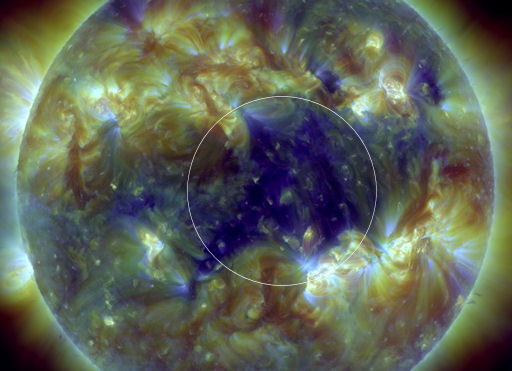
Image credit: TW
NASA’s Solar Dynamics Observatory is monitoring a hole in the sun’s atmosphere – a “coronal hole.” It is the dark region circled in this extreme ultraviolet image taken during the early hours of April 28th:
Coronal holes are places where the sun’s magnetic field opens up and allows the solar wind to escape. A stream of solar wind flowing from this coronal hole is expected to reach Earth on April 30th-May 1st. NOAA forecasters estimate a 35% chance of geomagnetic activity at that time. (SpaceWeather)
Currently the visible solar disk consists of Sunspot 1195 in the southern hemisphere and new Sunspot 1199 which is located in the northern hemisphere. The solar X-Rays have been very quiet with only a C2.0 flare around a plage region with no visible sunspots. Solar activity should continue at very low levels in the short term.
Solar activity has been at low levels for the past 24 hours. New Region 1201 (N16E40), grew rapidly early in the period, producing a C2 flare at 27/0301Z with a non-Earth directed CME. A Type II radio sweep, with a shock velocity of 845 km/s, was also associated with this event. Region 1201 has since decayed and is
now spotless plage. A second, back-sided CME, first visible in LASCO C2 imagery at 27/0800Z, was also observed during the period. Neither CME is expected to become geoeffective. Region 1199 (N21W34)
continues to grow and evolve. (SolarHam)


Earlier reporting
Nothing on Watchers was published in the last 24 hours. These are older articles.
- On October 22, 2017, a single flash of lightning stretched 515 miles from eastern Texas to near Kansas City, a distance that takes eight hours to drive, and nobody realized how far it had gone until scientists went back through the satellite data years later Epicenter
- CPC posts a slight risk of heavy rain from the Gulf Coast to the Northeast urban corridor November 25-29, and a moderate risk of West Coast wind and Sierra snow on November 25
- Florida's east coast faces a moderate flash flood risk Wednesday through Friday, with 4 to 8 inches of rain forecast and the St. Johns River near Cocoa already in major flood at 17.13 feet
- Cyclone Akvan to make landfall between Nellore and Visakhapatnam around noon on November 20, IMD forecasts 120-130 km/h winds gusting to 145
