
Unsettled to active geomagnetic field levels expected, G1 geomagnetic storm watch in effect
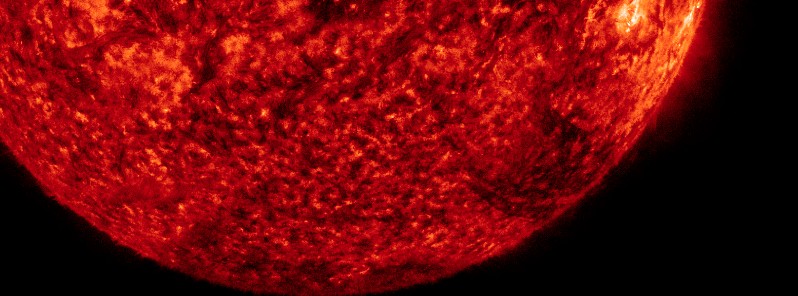
Featured image: Filament eruption at 11:19 UTC on January 2, 2021. Credit: NASA/SDO AIA304, TW
Unsettled to active geomagnetic field levels are possible on January 5, 2021, due to the onset of an anticipated Solar Sector Boundary Crossing (SSBC) followed by coronal hole influence late in the day. G1 – Minor geomagnetic storm conditions are likely on January 6 due to the forecasted arrival of the coronal mass ejection (CME) produced on January 2 combined with ongoing coronal hole influence. Unsettled, with a chance for early, isolated active periods, are expected on January 7.
The CME was produced by a filament eruption in the Sun's southern hemisphere on January 2. Another CME was produced on January 1 — but it was a slow-moving CME overtaken by the faster CME produced on January 2.
While model runs suggest CME arrival on January 6, confidence is somewhat low in timing due to the anticipated interactions between the two CMEs coupled with a weak coronal hole high speed stream (CH HSS) due to arrive late on January 5.
G1 – Minor geomagnetic storm watch is in effect for January 6.


Image credit: NASA/SDO AIA304, Helioviewer
Solar activity was at very low levels over the past 24 hours, and the solar disk was spotless.
Solar wind parameters reflected nominal conditions during the same period.
Total field ranged from 3 – 7 nT, the Bz component saw no significant deflections, and wind speeds averaged near 300 km/s. Phi was in a positive solar sector.
The greater than 2 MeV electron flux reached moderate levels and the greater than 10 MeV proton flux was at background values.

Teo Blašković founded The Watchers in 2011 and edited it until 2026, covering seismic and volcanic activity, extreme weather, space weather and near-Earth objects. Articles on this page are his archive.
Published in the last 24 hours
- Radio pulses every 7.9 minutes reveal binary with white dwarf and Sun-like star Epicenter
- Hera begins close survey to explain why DART deflected Dimorphos so strongly Epicenter
- NASA’s STRIVE mission targets long-standing 3D observing gap in the upper atmosphere Epicenter
- Three Australian estuarine fish species maintain performance across thermal extremes Epicenter
