• EU physicists use 20 new satellites to forecast space weather

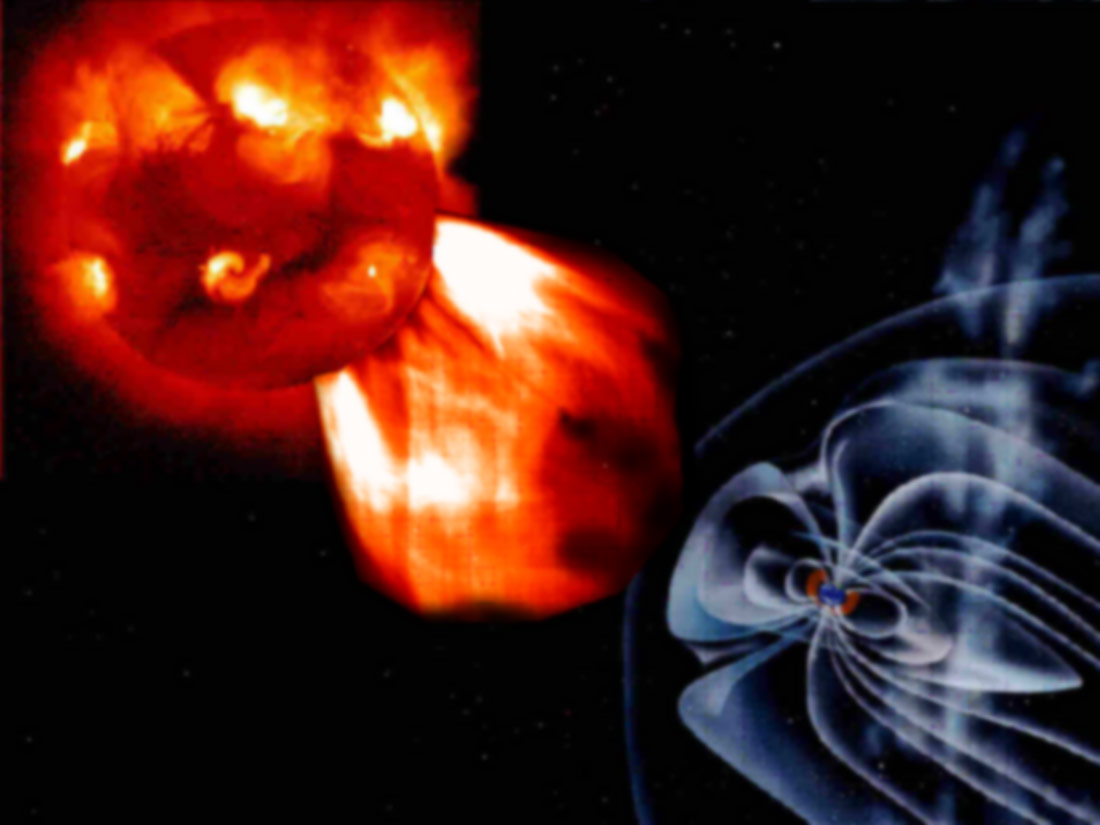
    The northern lights interfere with radio communications, GPS navigation and satellite communications. Researchers are now going to launch 20 satellites containing world class instruments from the University of Oslo to find out why.Satellites are becoming increasingly

  • Solar ‘climate change’ could cause rougher space weather

    Recent research shows that the space age has coincided with a period of unusually high solar activity, called a grand maximum. Isotopes in ice sheets and tree rings tell us that this grand solar maximum is one of 24 during the last 9300 years and suggest the high

  • Another Venus-directed CME

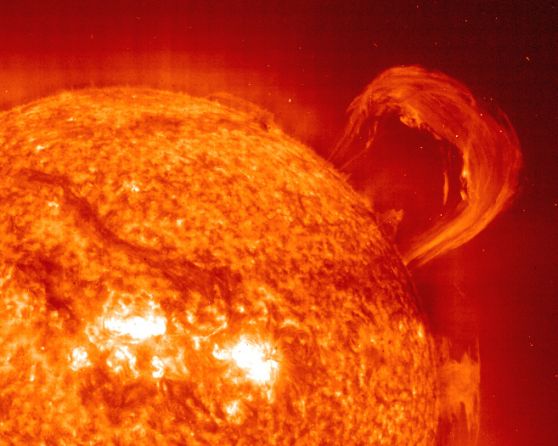
    A magnetic prominence dancing along the sun’s southeastern limb became unstable on Nov. 15th and slowly erupted. NASA’s Solar Dynamics Observatory recorded the coronal mass ejection (CME), which unfolded over a period of thirteen hours: The eruption hurled a cloud

  • Sun is active again: M1.6 flare & sundiving comet

    A Solar Flare reaching M1.6 peaked at 03:25 UTC Thursday morning and appears to be centered off the northwest limb near Sunspot 1318 which is rotating out of direct earth view.Solar activity remains at fairly low levels with only small to mid sized C-Class flares

  • Farside CME heading for Mercury

    Yesterday, October 4th, something exploded on the far side of the sun and propelled a spectacular CME into space. The Solar and Heliospheric Observatory recorded the cloud as it emerged from behind the sun’s limb:Analysts at the Goddard Space Weather Lab have

  • Geomagnetic storm subsiding, expecting more CMEs

    The first of several CMEs en route to Earth struck our planet’s magnetic field on Sept. 9th around 1130UT. The impact sparked a strong (Kp=7) geomagnetic storm, which is now subsiding. Last night Northern Lights were spotted in the United States as far south

  • Spacecraft sees solar storm engulf Earth

    For the first time, a spacecraft far from Earth has turned and watched a solar storm engulf our planet. The movie, released today during a NASA press conference, has galvanized solar physicists, who say it could lead to important advances in space weather forecasting.

  • Another M-class solar flare

    A second M-Class flare, this time a M2.5 took place at 03:54 UTC Tuesday morning around Sunspot 1263. This is in addition to the earlier M3.5 flare which we reported yesterday. The first flare produced a small, but fast moving (2010 km/s) Coronal Mass Ejection…