
When the Sun’s stormy peak dragged NASA’s 77-tonne Skylab out of orbit earlier than expected in 1979, debris rained across Western Australia and the town of Esperance fined NASA $400 for littering; a California radio host finally paid it 30 years later
Higher-than-predicted solar activity expanded Earth’s upper atmosphere and increased drag on NASA’s approximately 77-tonne Skylab, accelerating its orbital decay until reentry at 16:37 UTC on July 11, 1979. Debris reached Western Australia, where the municipality of Esperance fined the United States $400 for littering; California radio host Scott Barley raised the money from listeners and paid the fine on NASA’s behalf in April 2009.
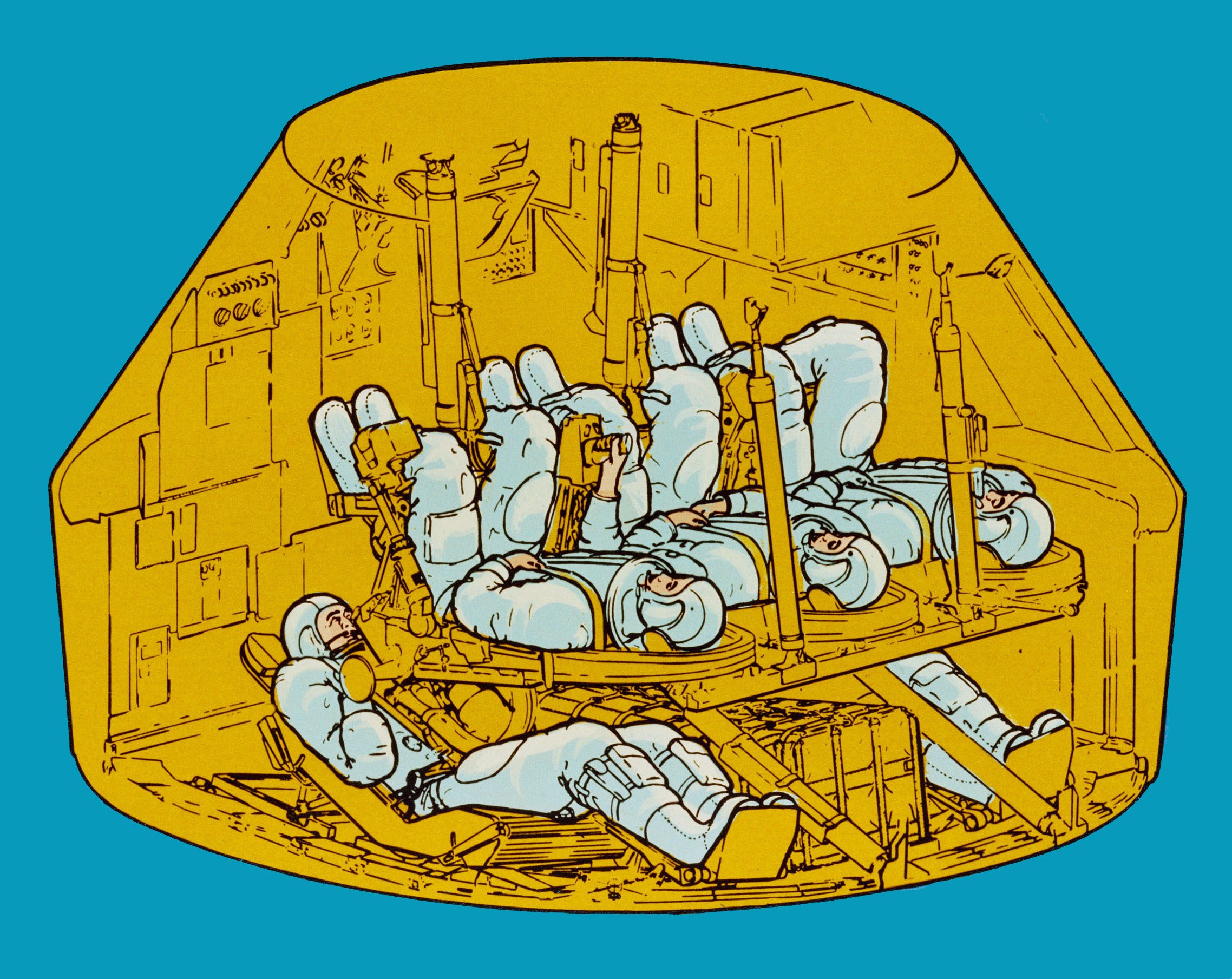
Skylab rescue cm. Credit: NASA (public domain), via Wikimedia Commons.
Before the final Skylab crew departed on February 8, 1974, the astronauts used their Apollo spacecraft to raise the station’s orbit. They left Skylab at approximately 433 × 455 km (269 × 283 miles), hoping the additional altitude would keep NASA’s first space station aloft long enough for a future Space Shuttle mission to revisit it or attach a propulsion stage capable of raising or deliberately deorbiting the station.
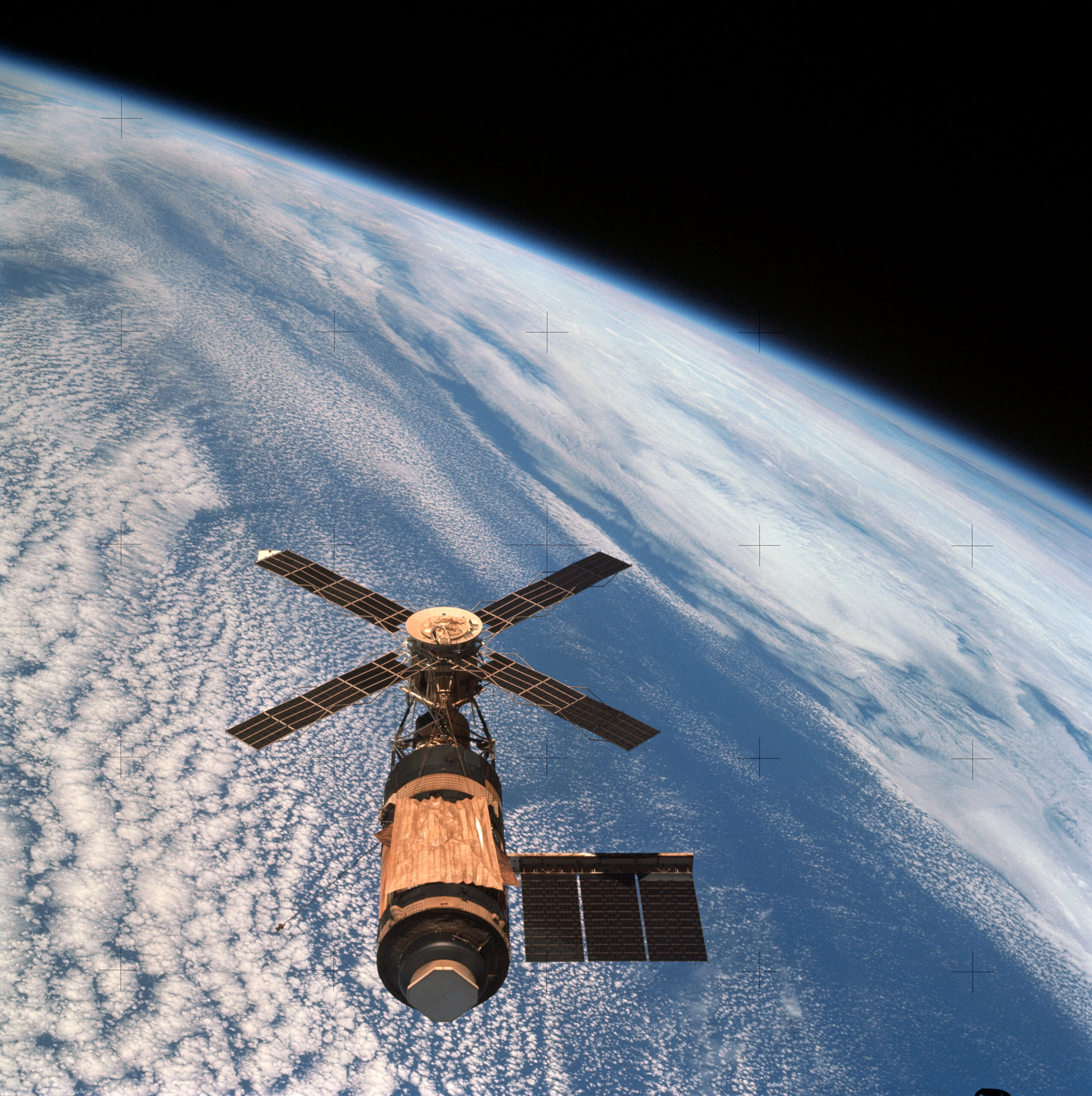
NASA’s later orbital-decay analysis shows that the expected lifetime was not a single fixed date. At the end of the crewed period, calculations based on the March 1974 Solar Cycle 21 prediction, Skylab’s aerodynamic characteristics and an assumed gravity-gradient attitude placed reentry between November 1979 and March 1983, a range of approximately 5½ to 9 years.
Solar Cycle 21 changed those calculations. NASA’s technical reconstruction records that the 162-day average F10.7 solar flux, a radio measurement used as a proxy for solar activity, remained relatively low through early 1977 before increasing markedly during that year. By the fall of 1977, NASA concluded that Skylab had undergone a substantial increase in orbital decay following the unexpectedly sharp rise in solar activity.
The physical connection was atmospheric density. Increased solar activity heats and expands Earth’s upper atmosphere, placing more atmospheric particles at the altitudes occupied by low-Earth-orbit spacecraft. Skylab’s large structure therefore encountered greater aerodynamic drag, lost orbital energy faster and descended more rapidly than the earlier solar-cycle forecasts had indicated.
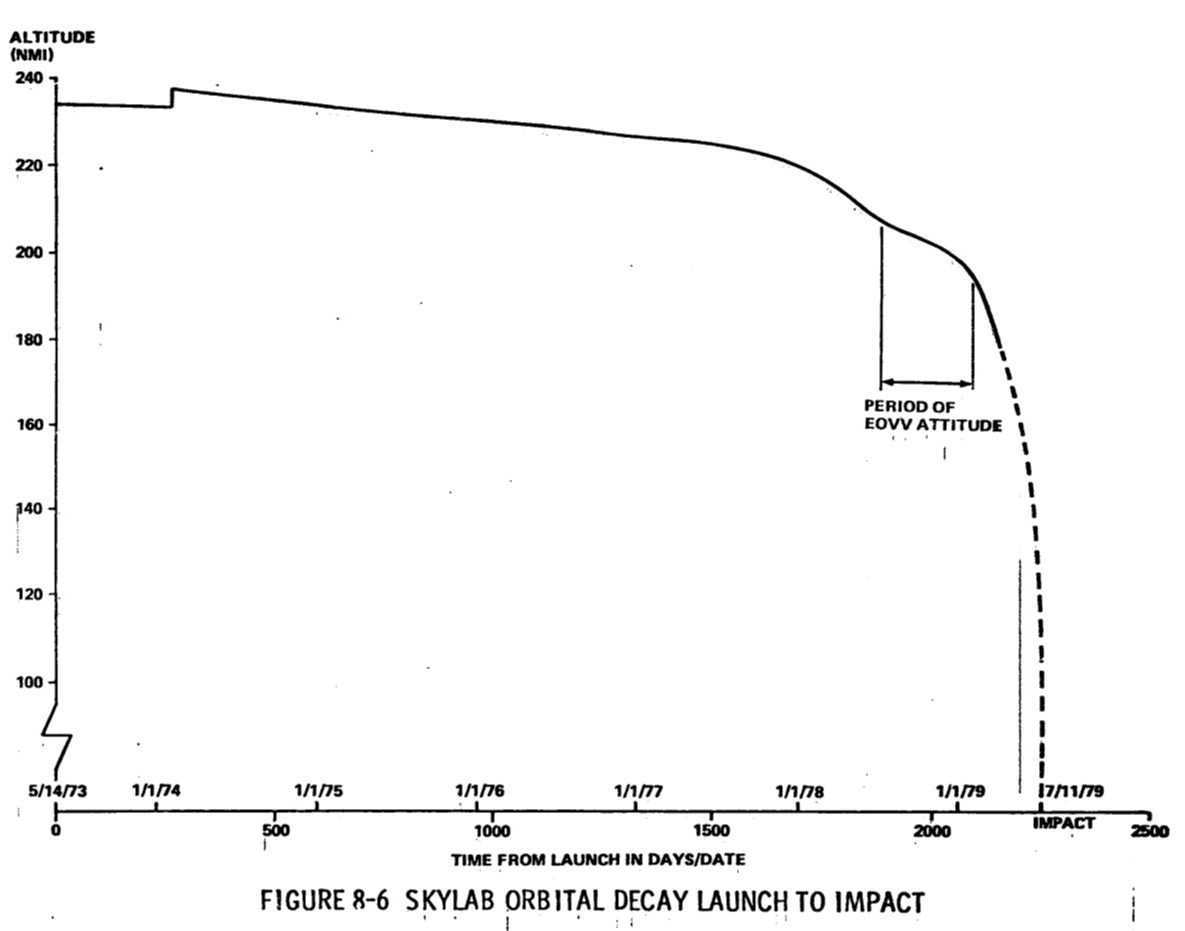
NASA began reactivating Skylab on March 6, 1978, after more than four years of passive operation. Controllers brought the station back under active control in June, and by June 11 its altitude had fallen to about 402 km (250 miles). Communication was limited to passes over five ground stations, requiring controllers to manage the large spacecraft without continuous contact.
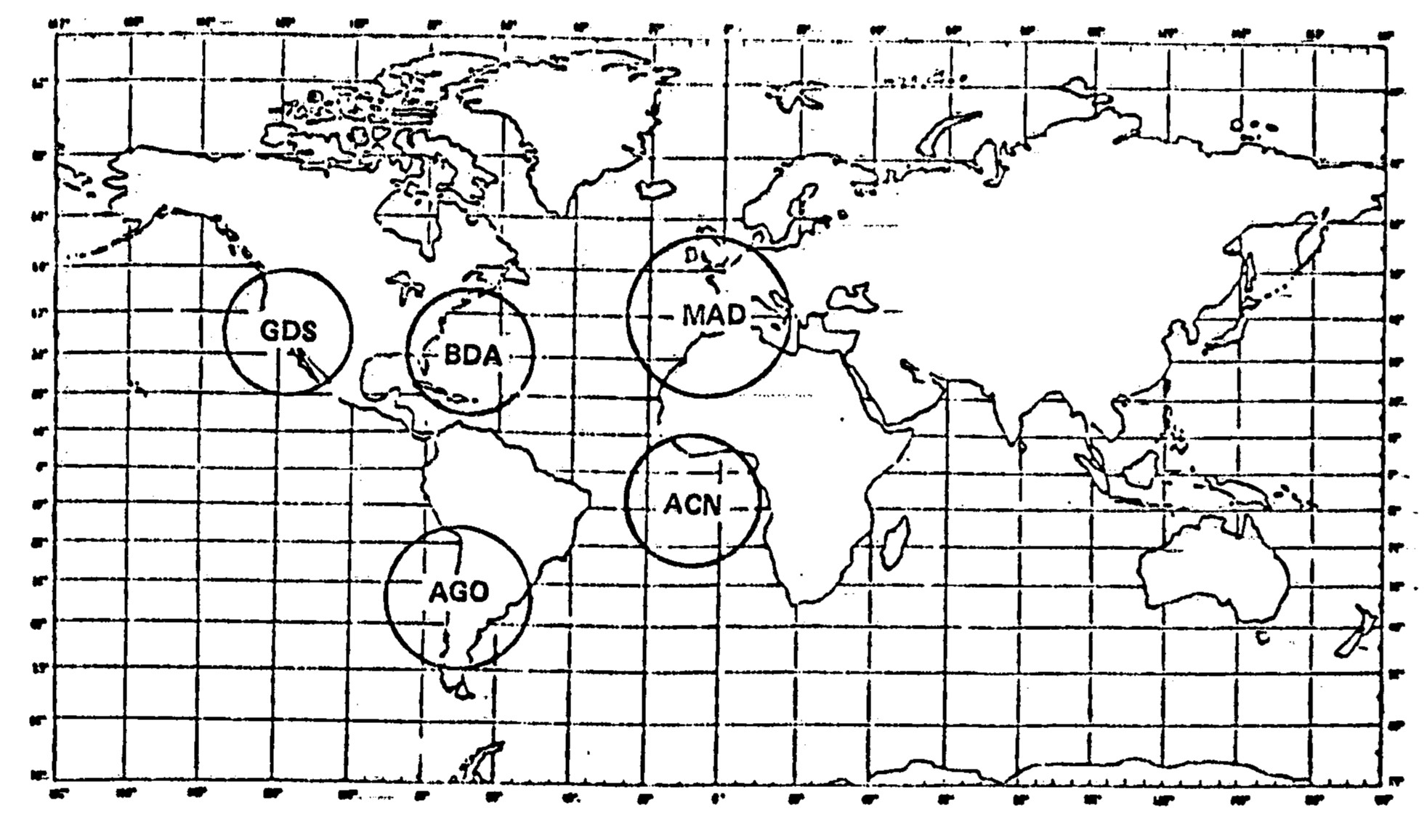
With no propulsion system capable of reboosting Skylab on its own, NASA used attitude control to change how much of the spacecraft was exposed to the atmosphere. Controllers placed Skylab in an End On Velocity Vector (EOVV) minimum-drag attitude, pointing its forward end into the direction of flight. NASA estimated that maintaining this configuration extended the station’s orbital lifetime by about 3.5 months.

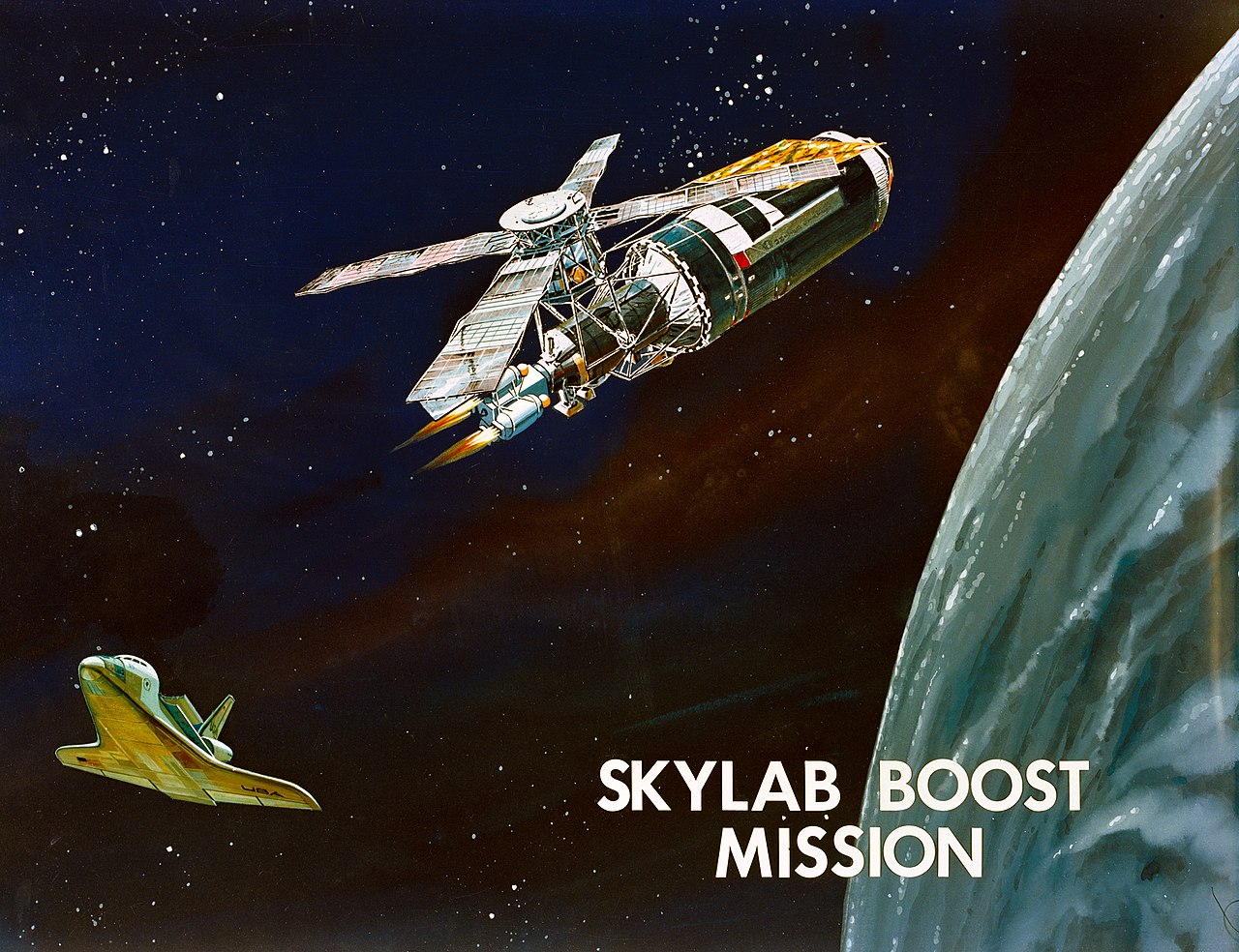
The additional time could not close the gap to the Space Shuttle program. NASA had planned for an early shuttle mission to carry a rocket stage to Skylab, allowing astronauts to place the station into a higher storage orbit or deliberately deorbit it over the Pacific Ocean. Continued shuttle delays made the mission impractical, and NASA announced the cancellation of the reboost effort on December 19, 1978.
Controllers moved Skylab out of the EOVV configuration on January 25, 1979, returning it to a solar-inertial attitude so its arrays remained pointed toward the Sun. As the orbit continued to decline, NASA shifted the station into a high-drag Torque Equilibrium Attitude on June 20 at an altitude of approximately 262 km (163 miles), giving controllers another means of adjusting the remaining lifetime and selecting a more favorable final orbit.
Orbit 34 981 on July 11 was selected because its ground track crossed mainly ocean before reaching sparsely populated parts of Australia. Skylab passed southeast across the Atlantic Ocean, around southern Africa and northeast over the Indian Ocean. At 07:45 UTC, controllers commanded the station into its final tumble; NASA’s public reconstruction places the maneuver at an altitude of about 150 km (93 miles). Active control ended after the maneuver.
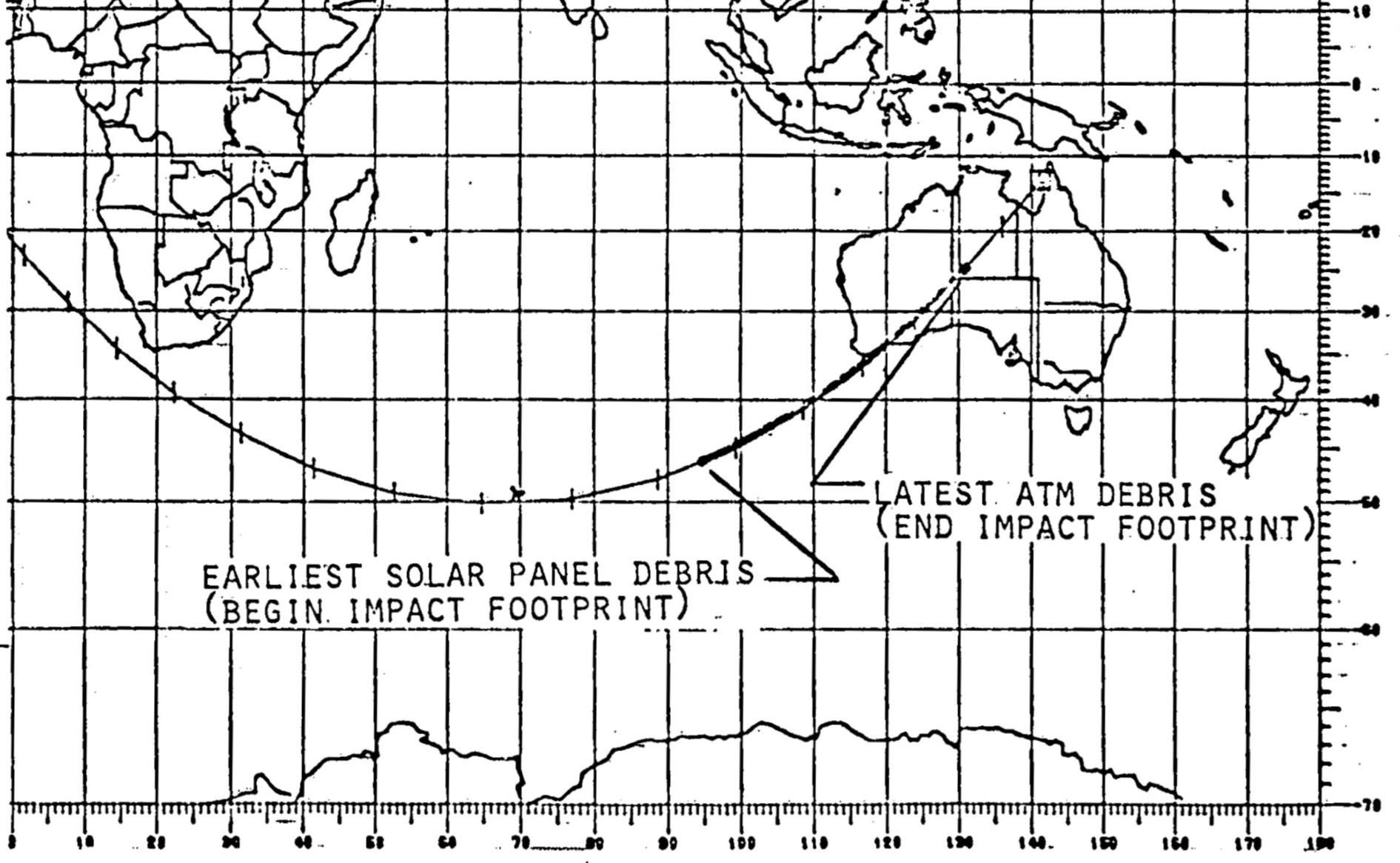
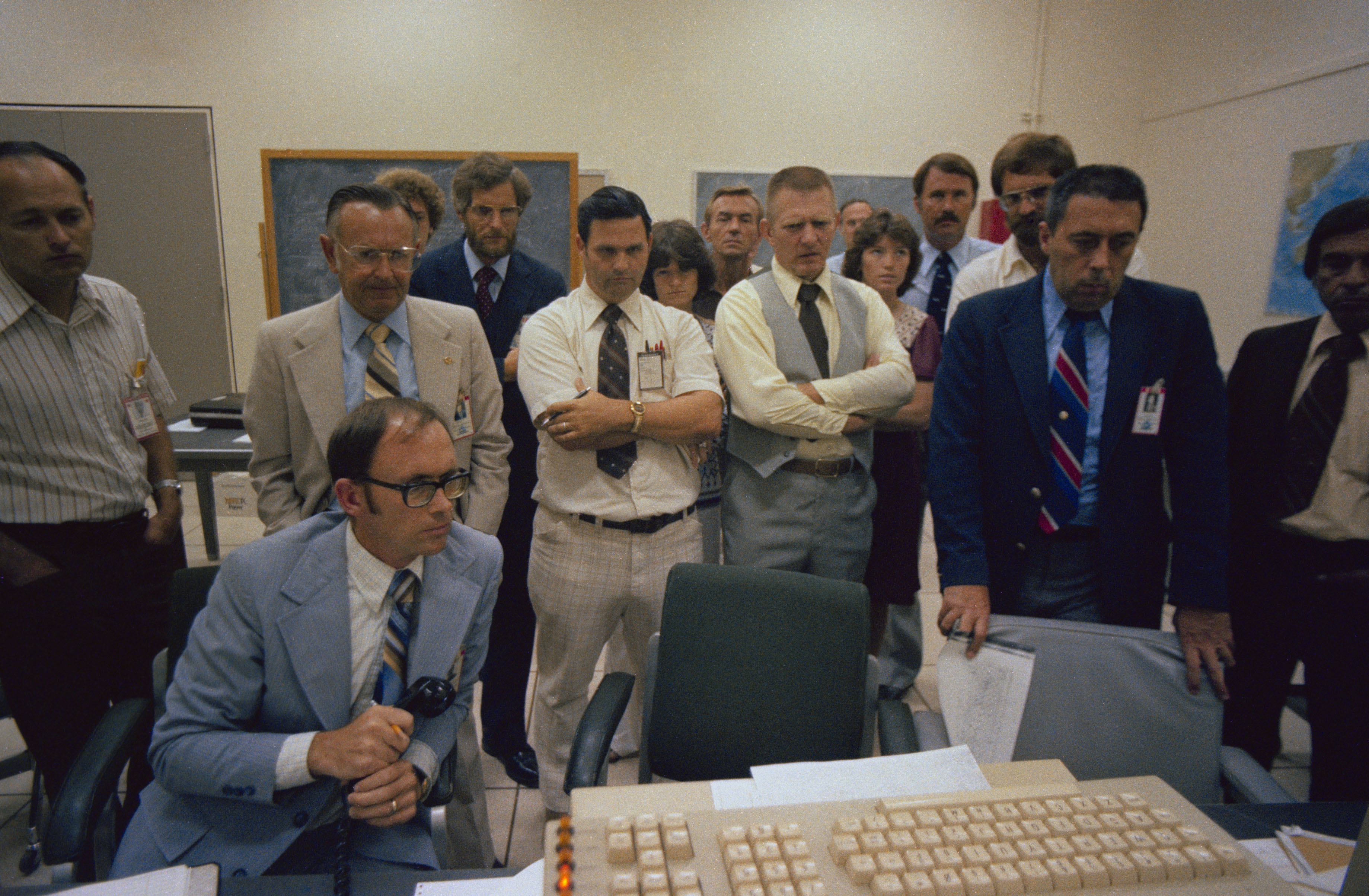
Skylab reentered at 16:37 UTC on July 11, 1979. At approximately 169 000 lb, or about 76.7 tonnes, it was the heaviest spacecraft to have reentered up to that time. Tracking stations observed the station beginning to break apart, and NASA’s later reconstruction placed the final breakup at an altitude of about 16 km (10 miles), lower than expected and therefore farther east along the ground track.
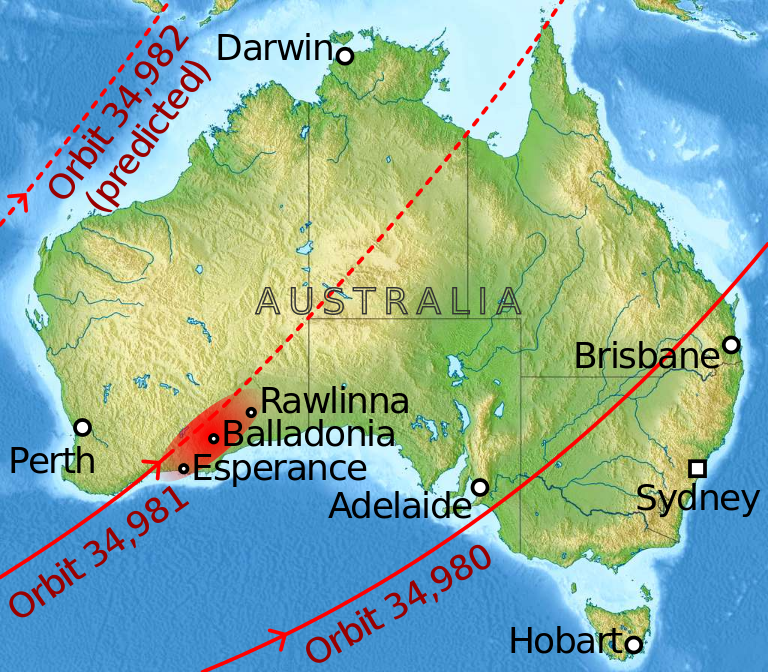
The later-than-expected breakup shifted surviving fragments farther downrange. NASA documented a debris footprint extending approximately 3 940 km (2 450 miles) from the Indian Ocean into Western Australia. People in the Outback heard sonic booms as fragments crossed the region, and recovered pieces were later associated with locations including Esperance, Balladonia and Rawlinna.

Esperance supplied the reentry with an unusual civic aftermath. A historical account published by the Shire of Esperance states that pieces of Skylab crashed in and around the town after the spacecraft broke apart and that the municipality fined the United States $400 for littering.
The fine remained part of the town’s Skylab history for three decades. In April 2009, California radio host Scott Barley of Highway Radio raised the $400 from listeners to his morning program and paid the fine on NASA’s behalf, according to the Shire’s account.

Skylab’s descent became a documented example of how solar variability can alter the lifetime of a large spacecraft in low Earth orbit. Its orbital history records the complete physical chain: stronger-than-forecast solar activity changed upper-atmospheric density, the denser atmosphere increased aerodynamic drag, and the additional drag accelerated the loss of orbital altitude while controllers attempted to manage the remaining lifetime through spacecraft attitude.

The reentry also changed how the consequences of large orbital structures were understood. NASA’s later history of the event treats Skylab alongside subsequent space-station reentries as part of the experience used to plan more controlled disposal of large spacecraft, where surviving debris can be directed toward remote ocean areas rather than allowing the final footprint to depend primarily on atmospheric drag and remaining attitude control.
References:
1 Dreher, P. E., Little, R. P., & Wittenstein, G. (1980). Skylab orbital lifetime prediction and decay analysis (NASA-TM-78308). NASA Marshall Space Flight Center. NASA Technical Reports Server
2 45 Years Ago: Skylab Reenters Earth’s Atmosphere – NASA – July 11, 2024
3 Esperance SuperTown Interim Growth and Implementation Plan – Shire of Esperance – March 6, 2012

I’m a science journalist and researcher at The Watchers, contributing to the Epicenter edition, where I cover peer-reviewed scientific research and emerging discoveries across Earth and space sciences. With a background in astronomy and a passion for environmental science, I’ve worked in shark and coral conservation in Fiji, conducting reef and shark-behavior research, contributing to mangrove restoration, and earning PADI Open Water and Coral Reef Certifications. I bring a blend of scientific rigor and storytelling to illuminate the discoveries shaping our planet and beyond.
Published in the last 24 hours
- A rose-colored rock found in the Sahara in 2022 turned out to be a piece of Mars more than 4.1 billion years old Epicenter
- Neptune's moon Triton has the coldest surface ever measured in the solar system, minus 391 degrees Fahrenheit, yet Voyager 2 caught geysers on it blasting dark plumes 5 miles high Epicenter
- Flying glass cut a teacher in Russia but none of her 44 pupils, because when a meteor flashed across the sky in 2013, she told them to get under their desks Epicenter
- Marine iguanas in the Galápagos got shorter by as much as 6.8 cm (2.7 inches), or a fifth of their length, when El Niño left them short of the seaweed they can digest, and the biggest ones shrank the most and lived the longest Epicenter
