
Ten grams from Phobos may reveal how Mars got its moons
A sample weighing at least 10 g from Mars’ moon Phobos could contain enough individual grains for scientists to separate native moon material from contamination and test two competing ideas for how the Martian moons formed, according to the scientific framework developed for Japan’s Martian Moons eXploration (MMX) mission. The mission design links the chemistry, mineralogy and isotopic composition of those grains to a long-standing question: whether Phobos is a captured primitive body from elsewhere in the Solar System or material assembled after a giant impact on early Mars.
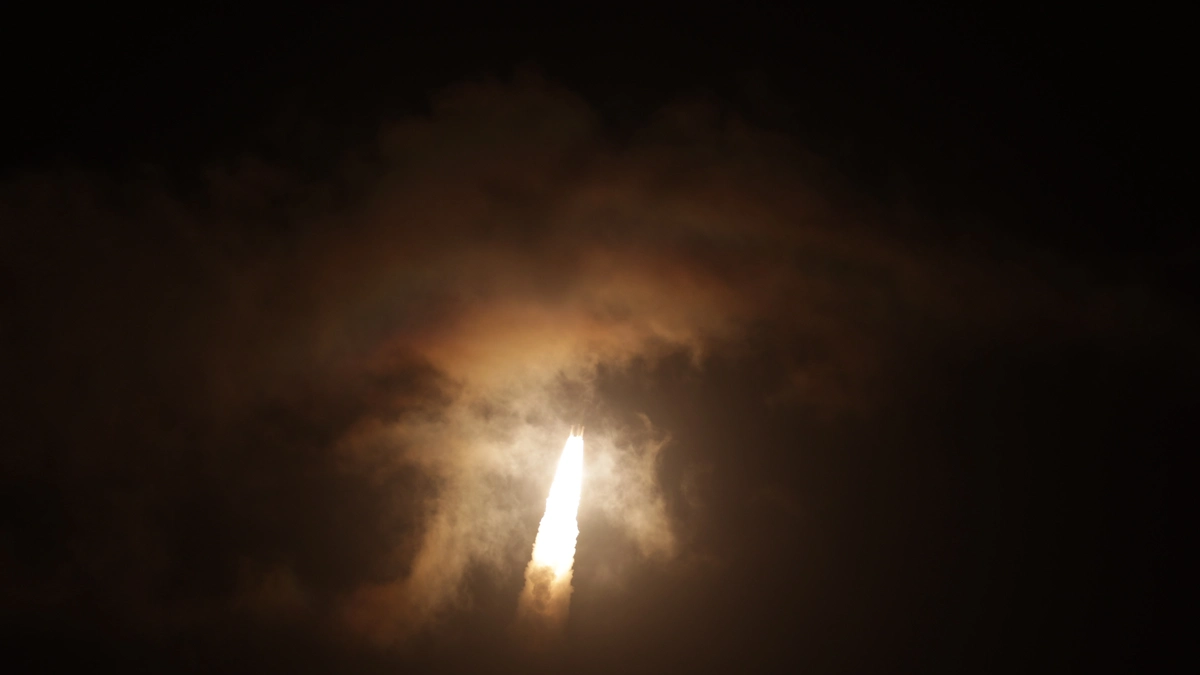
JAXA launched the Martian Moons eXploration (MMX) spacecraft aboard H3 Launch Vehicle flight No10 at 044103 JST on October 20, 2026 from the Tanegashima Space Center. Credit: JAXA
The test has moved from mission planning into flight. The Japan Aerospace Exploration Agency (JAXA) launched MMX from Tanegashima Space Center at 04:41:03 JST on October 20, 2026, and confirmed spacecraft separation about 1 hour 11 minutes 13 seconds later. JAXA reported the following day that the spacecraft had completed its initial critical operations and was healthy for preparation toward its outbound cruise.
The scientific problem awaiting MMX at Phobos predates the spacecraft by decades. Phobos and Deimos look in some respects like dark primitive asteroids, supporting the possibility that Mars captured bodies that formed elsewhere. Their nearly circular, near-equatorial orbits are harder to reconcile with straightforward capture, however, and can instead be explained by models in which a large collision with early Mars produced a debris disk from which moons formed. Neither line of evidence has been sufficient to settle the moons’ origin.
Kuramoto et al. (2022) translated that unresolved problem into measurable tests. If Phobos is a captured primitive body, its native material should resemble volatile-rich, chondritic material, with mineralogical, chemical and isotopic properties linked to primitive meteorites. If it formed after a giant impact, the samples should instead carry evidence of high-temperature processing and mixtures of impactor and Martian material. The authors identify petrology, elemental chemistry and isotopic composition as key discriminants between those alternatives.

The mission’s 10 g sampling requirement follows from statistics rather than an arbitrary mass target. Assuming a typical grain density of 3 g/cm3, the study estimates that 10 g of Phobos material would contain roughly 10³ to 10⁵ grains. About one-tenth of the returned material could therefore provide approximately 100 to 10⁴ grains for initial analysis after screening, giving researchers a population large enough to identify the principal compositional component of the sample. That dominant component would then be compared with measurements of Phobos’ exposed bedrock to determine whether it represents indigenous material. These are mission-design estimates, not measurements of material already collected from Phobos.
MMX is designed to reduce another source of ambiguity by sampling more than one place and more than one depth. Kuramoto and colleagues specified collection of at least 10 g from two sites, including material from deeper than 2 cm below the surface. The distinction matters because Phobos’ regolith has been repeatedly disturbed by impacts and exposed to material arriving from outside the moon. Sampling below the immediate surface and documenting the geological setting of each collection site are intended to help researchers distinguish local bedrock-derived grains from altered or imported material.
That contamination is scientifically useful in its own right. Numerical work incorporated into the MMX science plan estimates that Phobos’ regolith may contain Martian debris excavated by younger impacts. Under one set of assumptions in the mission study, an average abundance of at least 340 ppm of such Martian ejecta accumulated over the past 500 million years would mean that a 10 g sample dominated by grains about 300 μm across could contain several tens of grains originating from Mars. The figure is a model-based estimate and depends strongly on grain size and impact-transport assumptions, but it raises the possibility that a Phobos return capsule could carry fragments recording parts of Mars’ own geological history.

The two origin scenarios lead to very different interpretations of early Solar System history. A captured Phobos would preserve evidence about primitive bodies that formed farther from the Sun and later moved inward, potentially constraining how volatile-rich material was transported toward the region where the rocky planets formed. The 2022 mission paper treats this as one route to studying the delivery of water and other volatile material across the early Solar System.
A giant-impact origin would tell a different story. Simulations cited by the MMX team produce debris containing mixtures of material from an impactor and proto-Mars. Chemical and isotopic measurements of returned grains could therefore constrain the composition of the colliding body, while crystallization ages and patterns of volatile loss could place limits on when the impact occurred and how much heating the debris experienced. The mission is not expected to establish such a history from a single measurement; its strategy depends on combining returned-sample analysis with remote sensing and geological context from Phobos.
Some observations can begin testing the alternatives before any sample reaches Earth. MMX’s remote-sensing payload is designed to map Phobos’ composition, topography and physical properties. For example, the science requirements identify the silicon-to-iron ratio as one possible discriminator: a value in the range of chondritic meteorites would support the capture interpretation, while the giant-impact models considered by the team can produce a substantially higher ratio through incorporation of Martian mantle material. Those measurements will provide the planetary-scale context needed to interpret individual grains later studied in terrestrial laboratories.
Returned samples add capabilities that an orbiting instrument cannot reproduce. The MMX analysis plan includes optical screening, Raman and infrared spectroscopy, electron microscopy, X-ray techniques, magnetometry, isotopic measurements and radiometric dating. These measurements are intended to establish what minerals and chemical components the grains contain, where their source material formed, and when important events recorded in the samples occurred.
The scientific framework was published in 2022, when MMX was still scheduled for a 2024 launch and a 2029 return. Those operational dates are obsolete; the mission launched in October 2026. The scientific logic of the sampling strategy, however, remains the basis for interpreting what MMX is trying to recover: not merely a handful of material from another moon, but a statistically useful population of grains whose composition can be compared with measurements of Phobos itself.
The decisive evidence therefore remains in the future. The capture and giant-impact hypotheses both remain viable, alternative formation scenarios have not been completely excluded, and the returned material may prove more heterogeneous than mission models assume. MMX’s strongest scientific contribution will come from linking each grain-scale result to the moon-scale observations around it — a combination designed to determine not only what Phobos is made of, but what that material records about the formation of Mars and the movement of matter through the early Solar System.
References:
1 H3ロケット10号機による火星衛星探査機(MMX)の打上げ結果 – JAXA – October 20, 2026
2 火星衛星探査機(MMX)の初期クリティカル運用フェーズ終了 – JAXA – October 21, 2026
3 Kuramoto, K., Kawakatsu, Y., Fujimoto, M., Araya, A., Barucci, M. A., Genda, H., Hirata, N., Ikeda, H., Imamura, T., Helbert, J., Kameda, S., Kobayashi, M., Kusano, H., Lawrence, D. J., Matsumoto, K., Michel, P., Miyamoto, H., Morota, T., Nakagawa, H., … Yokota, S. (2022). Martian moons exploration MMX: Sample return mission to Phobos elucidating formation processes of habitable planets. Earth, Planets and Space, 74, Article 12. https://doi.org/10.1186/s40623-021-01545-7

I’m a science journalist and researcher at The Watchers, contributing to the Epicenter edition, where I cover peer-reviewed scientific research and emerging discoveries across Earth and space sciences. With a background in astronomy and a passion for environmental science, I’ve worked in shark and coral conservation in Fiji, conducting reef and shark-behavior research, contributing to mangrove restoration, and earning PADI Open Water and Coral Reef Certifications. I bring a blend of scientific rigor and storytelling to illuminate the discoveries shaping our planet and beyond.

Commenting rules and guidelines
We value the thoughts and opinions of our readers and welcome healthy discussions on our website. In order to maintain a respectful and positive community, we ask that all commenters follow these rules.