• Extreme space weather event that could have led to a nuclear war

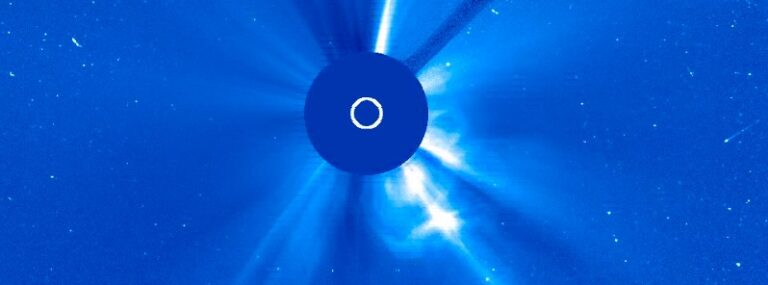
    For the first time, retired U.S. Air Force officers involved in forecasting and analyzing the extreme space weather event of May 23, 1967, collectively and publicly describe how great solar and geomagnetic storm at the height of the Cold War almost led to a…

  • Robust CME simulation model developed for future of space weather forecasting

    Japanese scientists have developed a new and robust simulation code for Coronal Mass Ejection (CME) events based on the realistic description of the mechanisms behind their generation and propagation through space. The method has been successfully validated using…

  • Using maths to reveal the Sun’s magnetic field mysteries

    An important research project, led by the UK's University of Dundee, aims to improve knowledge of Sun's complex magnetic fields using mathematics. The goal is to find out the effects of space weather caused by the Sun and its magnetic structures origins….

  • THEMIS discovers new process that protects Earth from space weather

    In the giant system that connects Earth to the sun, one key event happens over and over: solar material streams toward Earth and the giant magnetic bubble around Earth, the magnetosphere helps keep it at bay. The parameters, however, change: The particles streaming in

  • Intro to space weather vocabulary – video

    Heliophysics scientists study energy transformation from one event to the other and which electromagnetic waves create which conditions near Earth. Space weather effects can disrupt satellites in space, so scientists need to understand the system in even more detail.

  • New research to focus on energy distribution in upper atmosphere

    “Understanding interaction between the Earth’s magnetic field, or magnetosphere, and its upper atmosphere – known as the thermosphere/ionosphere – is especially important this year and in 2014, said Yue Deng, an assistant physics professor at University of Texas.

  • Steps to organize an international response to space weather effects

    We are now fully into solar maximum and the United Nations is taking steps to organize an international response to space weather effects. Space weather was added to the regular agenda of the COPUOS Science and Technical Subcommittee, which means the UN is recognizing

  • Space weather highlights: October 15 – 21, 2012

    Solar activity ranged from low to high levels in last 7 days. Activity was low during October 15 – 19 due to mostly low-level C-class flares. The largest flare of this interval was a C7 on October 17, 2012 at 08:02 UTC from Region 1596 (N07, L=150, class/area