
First indication of diffuse supernova neutrino background emerges from Super-Kamiokande
Researchers with the Super-Kamiokande Collaboration have reported the first observational indication of the Diffuse Supernova Neutrino Background (DSNB), a long-predicted flux of neutrinos produced by core-collapse supernovae throughout cosmic history. Based on approximately 5 000 days of observations, the result, presented on June 25, 2026, during the XXXII International Conference on Neutrino Physics and Astrophysics (Neutrino 2026) at the University of California, Irvine, represents the strongest observational evidence to date for one of neutrino astronomy’s most persistent experimental goals.
A supernova in space. Credit: Tohoku University
The DSNB consists of neutrinos released by every core-collapse supernova since the early Universe. Unlike neutrinos detected from individual nearby stellar explosions, the DSNB is composed of particles arriving from countless supernovae over billions of years, leaving an extremely faint signal that is easily obscured by natural background events.
Detecting this background would provide the first direct observational record of the cumulative history of stellar explosions, allowing scientists to investigate how stars formed, synthesized heavy elements and ultimately produced neutron stars and black holes throughout cosmic history.
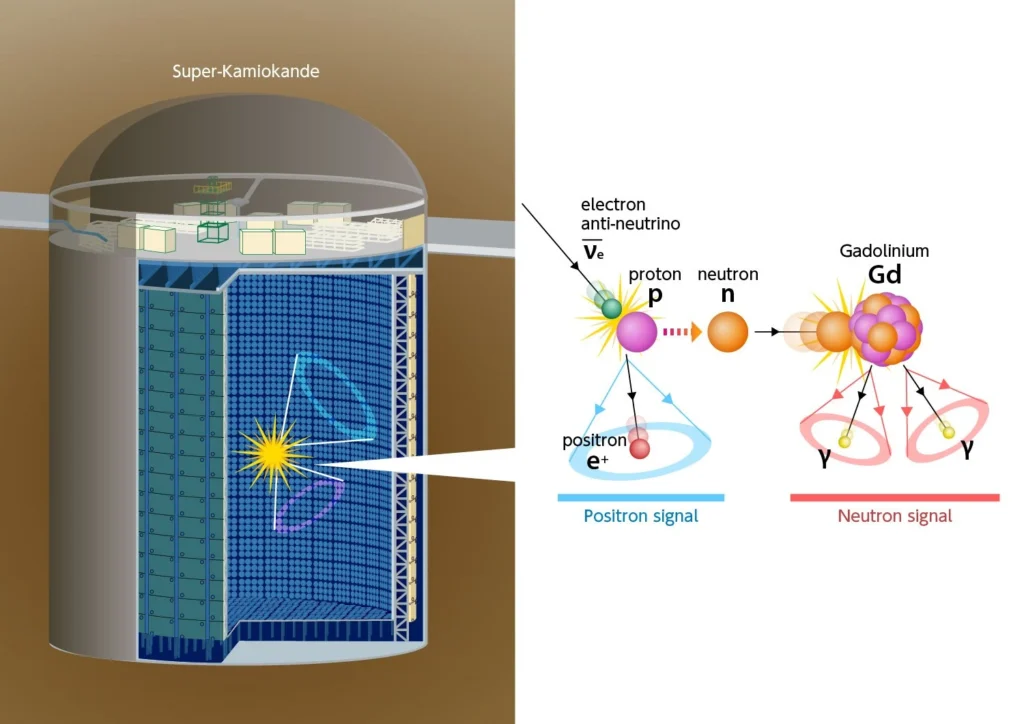
The achievement is the result of an international collaboration involving approximately 250 researchers from 60 universities and research institutions. Their observations were carried out with the Super-Kamiokande detector, located approximately 1 000 m underground in Gifu Prefecture, Japan. The facility contains a 50 000-ton tank of ultrapure water instrumented with approximately 13 000 photomultiplier tubes that record the faint flashes of Cherenkov light produced when neutrinos interact with water.
Detecting the DSNB has remained one of the most difficult objectives in experimental particle physics because neutrinos interact only weakly with matter while cosmic rays and naturally occurring radioactivity generate background signals that can mimic genuine events. Operating deep underground shields the detector from much of this background, allowing researchers to search for the extremely rare interactions expected from relic supernova neutrinos.
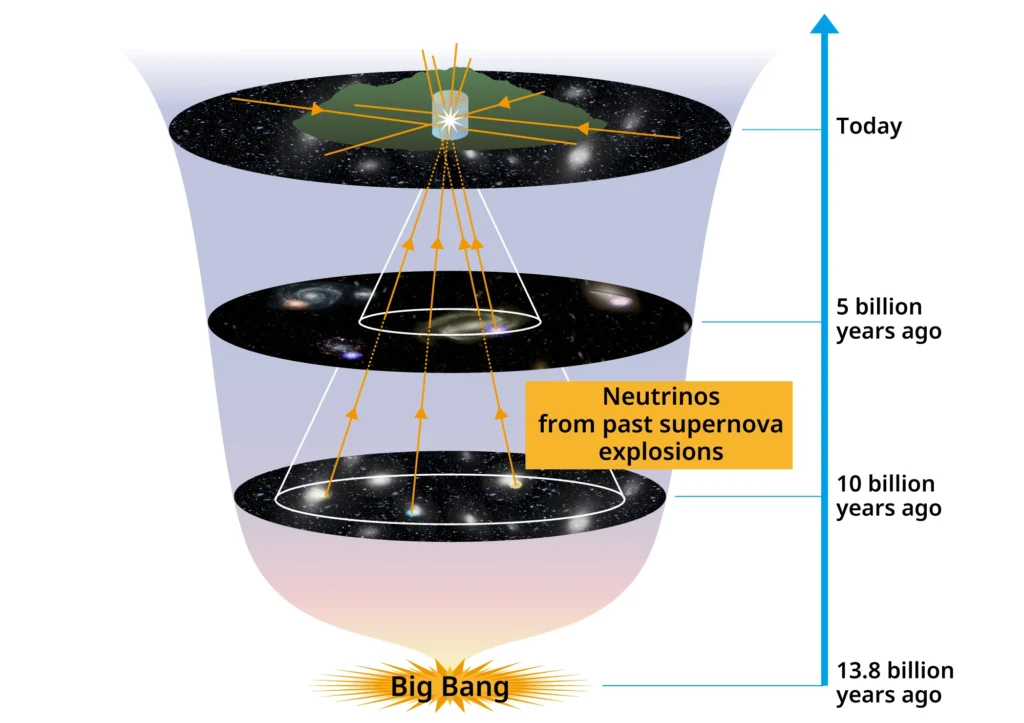
To improve sensitivity, the collaboration analyzed approximately 5 000 days of observations collected during two operational phases. The first used ultrapure water alone, while the second followed the addition of gadolinium to the detector. Dissolved gadolinium captures neutrons produced during inverse beta decay, allowing electron antineutrino interactions to be identified more efficiently while substantially reducing background contamination.
The analysis identified a statistically significant excess of candidate events in the neutrino energy range between 13.3 and 81.3 MeV. The excess corresponds to a statistical significance of 2.6 sigma, equivalent to a confidence level of approximately 99.5%, and is best explained by a DSNB flux of 3.6 cm⁻² s⁻¹.
Although the probability that the excess is a statistical fluctuation is low, the result remains below the 5 sigma threshold conventionally required in particle physics to claim a discovery. The collaboration therefore describes the finding as an indication rather than a confirmed detection.
“We are already planning on incorporating ongoing observations at Super-Kamiokande together with its successor detector, Hyper-Kamiokande, to further improve sensitivity in future collaborative studies,” said Yosuke Ashida, Assistant Professor at Tohoku University.
Hiroyuki Sekiya, Associate Professor at the University of Tokyo and spokesperson for the Super-Kamiokande experiment, described the result as the culmination of decades of work.
“Observing the world’s first indication of the Diffuse Supernova Neutrino Background is a deeply meaningful achievement and has been a long-cherished goal since the beginning of the Super-Kamiokande project.”
Future observations by Super-Kamiokande together with Hyper-Kamiokande are expected to increase detector sensitivity and determine whether the observed excess develops into a discovery-level signal.
If confirmed, the Diffuse Supernova Neutrino Background would become a unique observational tool for studying the cumulative history of stellar explosions and the evolution of the Universe across billions of years.
References:
1 Super-Kamiokande Unveils a Clue to the Faint “Whispers” Imprinted Across Cosmic History – Tohoku University – July 3, 2026

I’m a science journalist and researcher at The Watchers, contributing to the Epicenter edition, where I cover peer-reviewed scientific research and emerging discoveries across Earth and space sciences. With a background in astronomy and a passion for environmental science, I’ve worked in shark and coral conservation in Fiji, conducting reef and shark-behavior research, contributing to mangrove restoration, and earning PADI Open Water and Coral Reef Certifications. I bring a blend of scientific rigor and storytelling to illuminate the discoveries shaping our planet and beyond.

Commenting rules and guidelines
We value the thoughts and opinions of our readers and welcome healthy discussions on our website. In order to maintain a respectful and positive community, we ask that all commenters follow these rules.