
Solar filament eruption, possible glancing blow on November 29
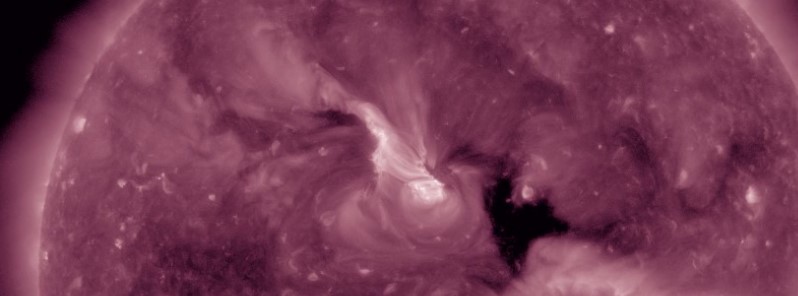
Image credit: NASA SDO/AIA 211.
A solar filament was observed lifting off the Sun's northeastern quadrant beginning at approximately 04:45 UTC on November 25, 2017.
An associated weak Coronal Mass Ejection (CME) was observed in SOHO/LASCO C2 and C3 imagery and the analysis shows a potential glancing blow arriving at Earth on November 29.

CME created by solar filament eruption on November 25, 2017. Credit: ESA/NASA SOHO C3

Credit: SWPC
Another filament is anchored in the southwest filament and is rotating away from the geoeffective position.
Solar activity was at very low levels today and is expected to remain like that, with just a slight chance for C-class flares over the next three days
There is only one numbered sunspot region on the Earth side of the Sun – AR 2689. Although this region showed signs of growth over the past 24 hours, it lacked significant flare activity.
The greater than 2 MeV electron flux was at normal to moderate levels over the past 24 hours, with a peak flux of 309 pfu observed at 15:05 UTC on November 25.
Solar wind parameters are currently at ambient background conditions and expected to become enhanced on November 27 and 28 as a negative polarity coronal hole high speed stream (CH HSS) becomes geoeffective.
Unsettled to active geomagnetic field levels are expected on November 27 and 28 due to the onset of negative polarity CH HSS.

Sunspots and coronal holes late November 25, 2017. Credit: SDO, Solen.Info

Teo Blašković founded The Watchers in 2011 and edited it until 2026, covering seismic and volcanic activity, extreme weather, space weather and near-Earth objects. Articles on this page are his archive.
Published in the last 24 hours
- High Risk of excessive rainfall covers Florida’s Space Coast as St. Johns River near Cocoa reaches 5.67 m
- Four small asteroids will pass close to Earth from November 21 to 23
- Cyclone Akvan weakens after landfall near Gopalpur; more than 300 000 evacuated in Odisha, India
- A broad low over southeastern Florida and the northwestern Bahamas has a 30 percent chance of subtropical or tropical development within 48 hours and a 50 percent chance within 7 days, the National Hurricane Center says
