• Mega tsunamis in Greenland fjord confirmed as source of nine-day global seismic signal

    A persistent, ultra-low frequency seismic vibration was detected worldwide in September 2023 and traced to Dickson Fjord, East Greenland, after two large landslides triggered tsunamis and a long-lasting seiche. For the first time, researchers directly observed this standing wave using NASA’s SWOT satellite mission, providing new insights into the connection between global seismic signals and surface water motion in remote coastal environments.

  • Ground sinking affects 28 major U.S. cities

    The ground beneath major U.S. cities is slowly sinking, according to new research that documents land subsidence in all 28 of the nation’s most populous urban areas. Driven primarily by groundwater extraction, the phenomenon poses a structural risk to homes, roads, and infrastructure in cities such as New York, Houston, and Chicago.

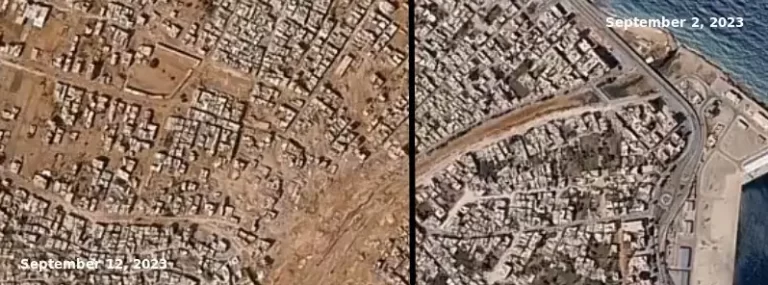
  • High-resolution satellite images of the port city of Derna after massive floods, Libya

    Derna, a northeastern Libyan town, grappled with catastrophic flooding after Medicane “Marquesa” made landfall on September 10, 2023. The subsequent deluge, equivalent to several months of rain in just a day, resulted in extensive damage and a rising death toll, with thousands still missing.

  • Decades-long growing rift in Brunt Ice Shelf finally breaks, creating new iceberg, Antarctica

    On January 22, 2023, a massive rift on the Brunt Ice Shelf in Antarctica finally gave way, resulting in the formation of a new iceberg measuring 1 550 km2 (~600 mi2). The U.S. National Ice Center has named it Iceberg A-81. The rift, spanning most of the Brunt Ice Shelf in Antarctica, appeared ready to spawn an iceberg in 2019, posing an uncertain future for scientific infrastructure and a human presence on the shelf that was first established in 1955 by the British Antarctic Survey (BAS).