
Twin 15th-century eruptions plunged the planet into decades of cold
A new analysis of Antarctic ice cores reveals that two volcanoes, Kuwae in Vanuatu and a yet-unidentified Southern Hemisphere volcano, erupted almost simultaneously around 1458–1459 CE, releasing sulfur and ash that triggered one of the coldest decades of the last millennium.
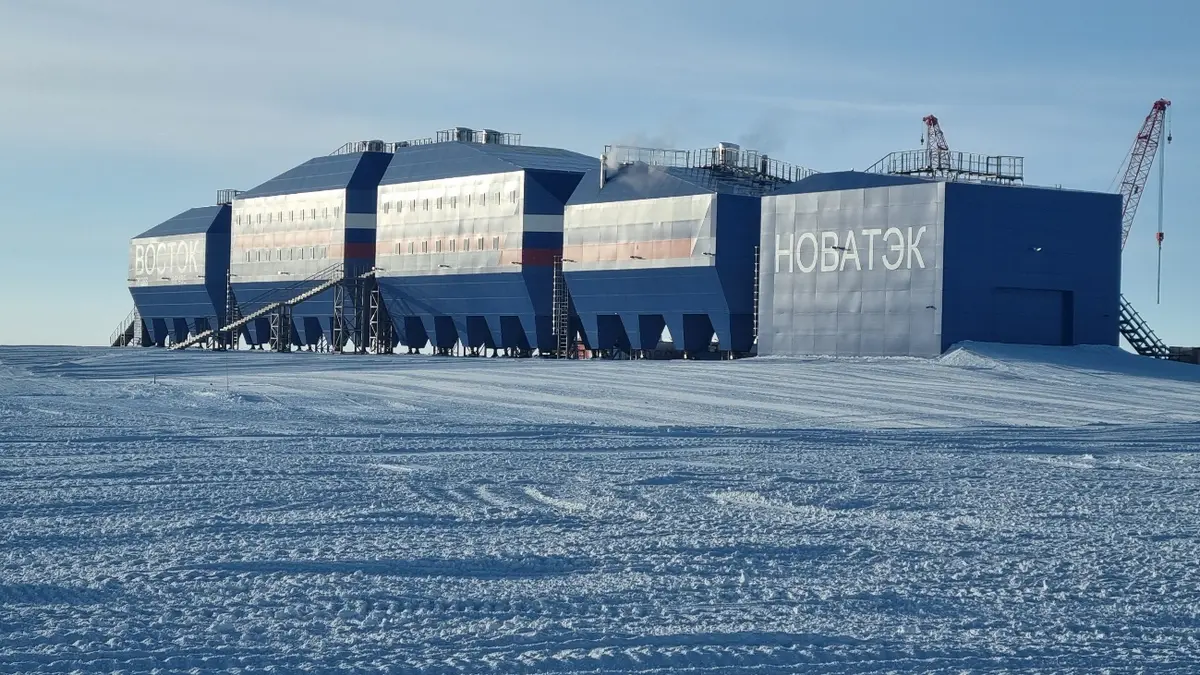
Vostok Station as of 2024. Credit: Arctic and Antarctic Research Institute
Nearly 600 years ago, two massive volcanoes erupted almost simultaneously, shrouding the planet in a veil of ash and sulfur. The twin blasts cooled global temperatures for decades and altered weather across both hemispheres.
New evidence preserved in Antarctic ice now shows that the event long blamed on a single volcano in the Pacific was in fact a dual eruption, one from Kuwae in Vanuatu and another from an unidentified volcano somewhere in the Southern Hemisphere.
The findings come from a collaboration between Korean and Russian scientists who analyzed microscopic volcanic glass trapped deep inside Antarctic ice. These fragments, smaller than a red blood cell, hold chemical clues that reveal both the timing and origin of ancient eruptions.
The study, published in Communications Earth & Environment in 2025, redefines what scientists thought they knew about one of the coldest periods of the last millennium.
When two volcanoes changed the course of the global climate
The 1450s were already one of the coldest decades in the Common Era. Historical records describe failed harvests, advancing glaciers, and sudden frosts stretching from Europe to Asia. For decades, these anomalies were blamed on the eruption of Kuwae, a massive submarine volcano in the Pacific, believed to have erupted in 1452.
But Antarctic and Greenland ice cores tell a different story. They reveal two distinct sulfur spikes: one in 1452 and another in 1458. The stronger signal in 1458 suggested the main cooling began several years later than previously thought. Scientists began to suspect that something else, possibly another volcano, was responsible.
The new study confirms that suspicion. It found that glass shards in the 1458–1459 layer of Antarctic ice have two distinct chemical compositions: one dacitic, matching Kuwae, and another rhyolitic, belonging to a different source.
This means two large eruptions struck the planet within months of each other. Both released sulfur and ash that merged high in the stratosphere, thickening the global aerosol haze and amplifying the cooling that followed.
Together, the twin plumes reduced global temperatures by roughly 0.4°C (0.7°F) for several years. Tree rings from Asia, Europe, and North America confirm a period of shortened growing seasons and unusually cold summers that lasted well into the late 1460s.
Secrets hidden inside Antarctic ice
The evidence comes from a 30.18 m (99 feet) firn core drilled near Vostok Station in East Antarctica in 2021. The ice at that depth formed roughly six centuries ago, capturing the chemical fingerprints of the 1458/59 event.
Scientists at the Korea Polar Research Institute and Inha University extracted 14 volcanic glass shards from that layer. Each particle was less than 11 micrometers wide, too small to analyze using conventional laboratory techniques.
Using scanning electron microscopy with energy-dispersive X-ray spectrometry, the team measured the chemical composition of each shard. To increase precision, they applied a Monte Carlo simulation that corrects for the shape and geometry of unpolished samples.
Half of the shards showed a dacitic composition typical of Kuwae, while the rest were rhyolitic—richer in silica but inconsistent with samples from Reclus, a Chilean volcano once suspected of being the second source.
Because Reclus has no recorded eruption in the 1450s, the researchers suggest the rhyolitic shards came from an undocumented volcano somewhere in the far south. The likely candidates lie in southern South America, the sub-Antarctic islands, or even the Antarctic Peninsula itself.
How two plumes traveled the planet
Large volcanic eruptions release ash and sulfur dioxide (SO2) into the atmosphere. When the gases reach the stratosphere, they form sulfate aerosols that reflect sunlight and cool Earth’s surface. The ash, however, reveals timing and transport. Large particles fall quickly, while fine dust can circle the globe for months.
In Antarctic cores, coarse particles appeared first, followed by finer ones—a pattern consistent with two separate eruptions. Models show that ash from a high-latitude volcano could reach Antarctica within weeks through tropospheric winds, while ash from Kuwae, near the equator, would take months to arrive via the stratosphere.
This explains the two-stage deposition seen in ice: large local ash first, fine tropical ash second. Together, they created a hemispheric sulfate veil that lingered for years, blocking sunlight and altering the global climate.
The study also examined particle-size data from the South Pole and West Antarctic Ice Sheet cores. Both show a similar two-step volcanic signal during the same period, reinforcing the idea that two plumes reached Antarctica from opposite hemispheres.
The evidence strongly supports a near-simultaneous eruption scenario, where the combined atmospheric load intensified cooling beyond what either eruption could have achieved alone.
Rethinking volcanic forcing in climate models
Most climate models treat major eruptions as single, isolated events. The discovery of two overlapping plumes challenges that view. When eruptions occur close together in time but in different hemispheres, they can distribute aerosols more evenly across the planet.
Such dual eruptions prolong cooling by keeping sunlight blocked from both hemispheres simultaneously. This helps explain why the 1450s cooling was stronger and longer-lasting than expected from Kuwae alone.
Including dual-plume behavior in climate models could improve predictions of post-eruption temperature changes and recovery times. It could also refine historical reconstructions of volcanic forcing, giving a clearer picture of how natural variability shaped pre-industrial climate.
The research shows the importance of combining data from both polar regions. Only by comparing ice records from Greenland and Antarctica can scientists distinguish between tropical, northern, and southern eruptions.
By expanding this bipolar approach, future studies may uncover other overlooked multi-eruption events hidden in the ice archives.
Antarctica’s ice — the silent historian of Earth’s most powerful events
Each layer of Antarctic ice holds traces of ancient skies. As snow compacts over time, it traps gases, dust, and volcanic ash, preserving them in perfect order. The VK22 core shows how even invisible ash, known as cryptotephra, can record eruptions too distant or faint to be seen.
Modern electron microscopy now allows scientists to analyze shards smaller than 5 micrometers (0.0002 inches), providing direct chemical fingerprints for eruptions never documented by humans.
These fingerprints link events separated by oceans and centuries, connecting ice, sea, and land into one planetary record. The twin eruptions of the 1450s prove how two volcanoes can act together to reshape the global climate.
Somewhere beneath the snow of the Southern Hemisphere lies the trace of the missing volcano that shared the stage with Kuwae. Finding it will close a chapter in Earth’s volcanic history and deepen our understanding of how nature cools its own climate.
References:
1 Antarctic ice reveals two volcanoes erupting simultaneously may have caused 15th-century cooling – Phys.org – October 22, 2025
2 Origin of the 1458/59 CE volcanic eruption revealed through analysis of glass shards in the firn core from Antarctic Vostok station – Seokhyun Ro et al. – Nature – October 20, 2025 – https://doi.org/10.1038/s43247-025-02797-x – OPEN ACCESS

I’m a science journalist and researcher at The Watchers, contributing to the Epicenter edition, where I cover peer-reviewed scientific research and emerging discoveries across Earth and space sciences. With a background in astronomy and a passion for environmental science, I’ve worked in shark and coral conservation in Fiji, conducting reef and shark-behavior research, contributing to mangrove restoration, and earning PADI Open Water and Coral Reef Certifications. I bring a blend of scientific rigor and storytelling to illuminate the discoveries shaping our planet and beyond.

How are you not connecting these eruptions to the Atlantic conveyor belt of warm water known as the Gulf Stream stopped in the late 1400’s causing the “Little ice Age” in the Northern Hemisphere for almost 400 years, which lead to a lot of stuff including the French Revolution and crop failure thoughout Northern Europe. Scientists never knew what caused this. These two eruptions are clearly the most likely Smoking Gun for the cause. Publish this EVERYWHERE. Also, in the North of Italy where Stradivarius got the wood for his instruments, were from tight-ringed dense slow-growing trees from this period of cold which produced super-resonate wood, the reason Stradivarius violins sound so good. -P