
Rogue lightning and what it tells us about explosive eruptions
Volcanic eruptions can generate spectacular “rogue lightning,” as ash-filled plumes become electrically charged and discharge massive bolts, the U.S. Geological Survey (USGS) and National Oceanic and Atmospheric Administration (NOAA) report. Lightning detection networks have helped identify eruptions within second, a critical tool for aviation and hazard monitoring.
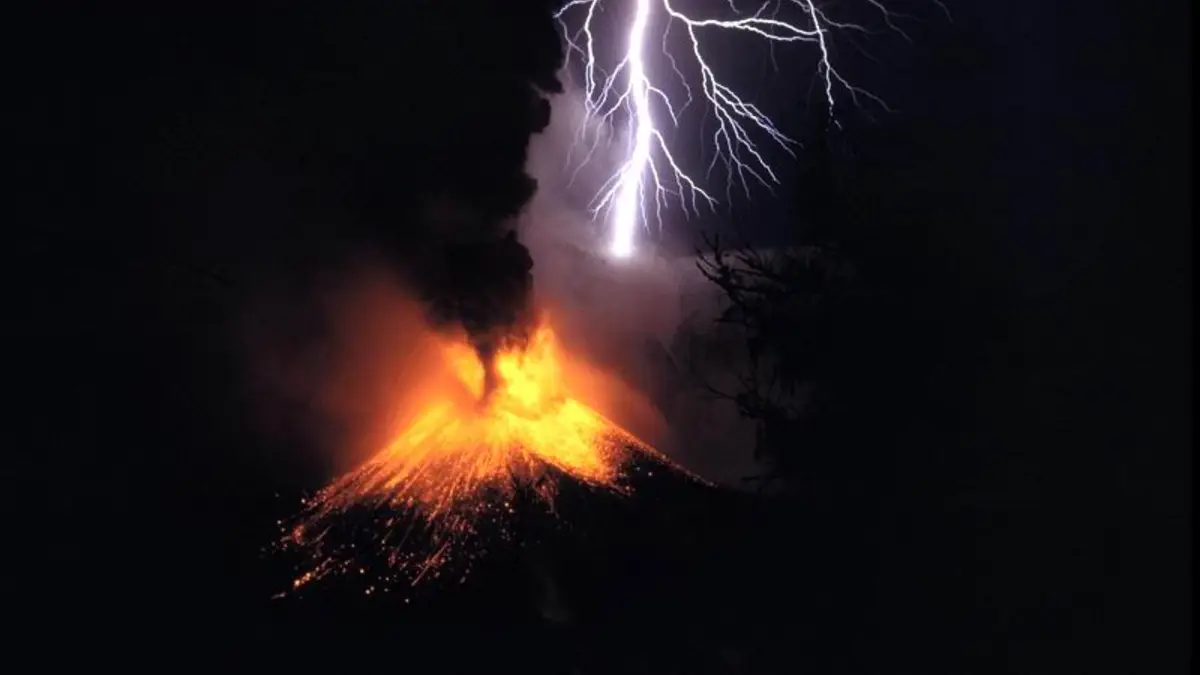
Volcanic lightning produced during the 1994 eruption of Mount Rinjani. Credit: Oliver Spalt
Volcanic lightning is one of nature’s rarest and most captivating displays. During explosive eruptions, ash and gas rising from the vent can build powerful electrical fields that discharge as brilliant flashes of light. Both the U.S. Geological Survey (USGS) and the National Oceanic and Atmospheric Administration (NOAA) recognize volcanic lightning as a genuine and measurable phenomenon that accompanies many large eruptions.
The lightning appears when ash plumes become so electrically charged that they act like self-contained thunderclouds. These discharges can happen only seconds after an explosion begins, making them an early signature of activity. Detection networks operated by NOAA and its partners have identified eruptions within moments of onset, giving scientists a new tool for rapid monitoring.
The 2022 Hunga Tonga–Hunga Ha‘apai eruption remains the most extreme case recorded so far. Satellite data showed up to 2 600 lightning flashes per minute while the plume shot to about 58 km (36 miles) high. That event demonstrated how lightning reveals the scale of an eruption long before ash observations or seismic readings are complete.
Unlike typical thunderstorms, volcanic lightning originates from collisions between rock fragments, ash, and water droplets. The result is sometimes called a “dirty thunderstorm,” where plumes of dust and steam briefly mimic the structure of storm clouds. Observers have noted this phenomenon for centuries; even ancient descriptions of Mount Vesuvius in 79 AD mention “fitful gleams of lightning” above the eruption column.
For scientists, these flashes are more than a spectacle. They are data points. Each burst of light carries information about plume size, intensity, and composition. In remote regions such as Alaska or Tonga, lightning may provide the first confirmation that an eruption has begun when no other instruments are close enough to detect it.
The hidden electricity inside volcanic plumes
The source of volcanic lightning lies in how materials inside the eruption column exchange charge. As magma fragments into ash and debris, the particles collide millions of times each second. Each impact transfers tiny amounts of electrical charge. When these charged grains separate, the surrounding air becomes polarized, allowing electrical potential to build until lightning arcs through the plume.
One of the main processes is triboelectrification, or frictional charging. Laboratory experiments using ash from the 2011 Grímsvötn eruption in Iceland showed that smaller ash grains tend to become negatively charged while larger grains gain positive charge.
This size-dependent bipolar charging creates distinct regions of electric potential inside the plume. The process works even in completely dry conditions, explaining why lightning sometimes appears right above the vent before any water vapour condenses.
A second process, fractoemission, happens when rocks and minerals physically break apart. Each crack exposes new surfaces and releases electrons, creating an electrical spray. Experiments that mimic explosive jets in shock tubes confirm that even without ice or moisture, fragmented magma can self-charge strongly enough to produce miniature sparks. Near-vent lightning — tiny, fast discharges that flicker close to the eruption source — is often attributed to this mechanism.
Higher in the atmosphere, a third process takes over. When the plume cools and mixes with moist air, water droplets freeze into ice crystals. Collisions between these ice particles and ash grains exchange charge in the same way as in thunderstorms. This ice-phase charging explains the most intense flashes observed in tall plumes above 7 km (4 miles), where temperatures drop below −20°C (−4°F).
In reality, all three mechanisms operate together. Friction and fragmentation dominate the lower column, while ice processes amplify the charge as the plume rises. The combined effect creates electric fields strong enough to trigger kilometre-long discharges visible from space. The larger and wetter the eruption column becomes, the more frequent and powerful the lightning tends to be.
Detecting eruptions by their electromagnetic fingerprints
Because lightning radiates bursts of radio and optical energy, it can be detected at great distances in near real time. Global networks such as the World Wide Lightning Location Network and the Earth Networks Total Lightning Network monitor these signals continuously. When a cluster of lightning strikes appears over a volcano, scientists can confirm an eruption even before visual plumes are visible on satellite imagery.
NOAA’s Geostationary Operational Environmental Satellites, GOES-16 and GOES-17, carry sensors known as the Geostationary Lightning Mapper. These instruments detect optical flashes from orbit, including those generated in dense volcanic plumes. On the ground, antennas triangulate the radio waves emitted by each discharge, locating flashes to within a few kilometres (miles).
USGS and NOAA volcanologists integrate lightning detections with seismic and acoustic data to refine early warnings. In some cases, lightning signatures appear earlier than seismic activity, giving extra minutes of notice for hazard alerts. For remote volcanoes that lack ground monitoring, like those in the Aleutian Islands, lightning often serves as the first clear indicator that an eruption is underway.
This technology has become especially important for aviation safety. Volcanic lightning data feed directly into Volcanic Ash Advisory Centers managed by NOAA, the Federal Aviation Administration, and international partners. Tracking lightning clusters helps estimate plume height and movement, information used to reroute aircraft away from hazardous airspace.
Lightning detection also provides insight into eruption strength. A sudden surge in flash rate can signal that an eruption is intensifying or that new vents have opened. By linking these patterns with radar and satellite observations, researchers can model the evolution of the plume in real time, improving both scientific understanding and emergency response.
The fingerprints lightning leaves behind
When lightning strikes through a volcanic plume, it can permanently alter the ash it passes through. The intense heat, often above 30 000°C (54 000°F), melts or vaporizes particles along its path. As these droplets cool, they form tiny glassy spheres known as lightning-induced volcanic spherules.
Scientists have identified these spherules in deposits from eruptions at Mount Redoubt in Alaska, Sakurajima in Japan, and Eyjafjallajökull in Iceland. Under a microscope, the beads appear as smooth, reflective spheres a few micrometres across. Their presence in ash layers provides forensic evidence that lightning occurred during the eruption, even when eyewitnesses or electronic records are missing.
The energy released by volcanic lightning can also change the magnetic properties of ash, altering how it reflects radar signals and how easily it clumps in the atmosphere. These changes affect how ash clouds disperse and how long fine particles remain airborne.
Studying these lightning-altered materials helps volcanologists reconstruct eruption dynamics long after the event. By analysing the chemistry and shape of the spherules, researchers can estimate discharge temperatures and electric field strength within the plume. The work also informs models of atmospheric chemistry, since lightning can influence how volcanic gases interact with water and oxygen.
Beyond Earth, such analyses may even help planetary scientists. Similar glassy particles might form in dusty volcanic eruptions on other worlds such as Venus or Io, providing indirect evidence of electrified activity in alien atmospheres.
What remains to be understood
Although volcanic lightning is now routinely observed, many questions remain open. Researchers still debate which charging process dominates under specific eruption conditions and how environmental factors like humidity or plume composition influence electrification. Laboratory experiments show clear trends, but real eruptions are far more chaotic and vary widely from one volcano to another.
Another mystery involves how long ash remains charged once it leaves the eruption column. Some satellite and aircraft measurements suggest that electrified ash can persist for hundreds of kilometres (miles), continuing to influence atmospheric conditions well after the lightning subsides. The mechanisms that allow this residual charge to survive remain poorly understood.
Scientists are also exploring how to combine lightning data with seismic, acoustic, and thermal measurements to improve eruption forecasts. Integrating these diverse signals could produce a more reliable early-warning system for both ground hazards and aviation threats.
USGS and NOAA teams are developing systems that automatically compare lightning detections with other sensor data to issue alerts faster and with fewer false positives.
Volcanic lightning also raises questions beyond Earth. On planets with dense atmospheres and active volcanism, such as Venus, similar processes might occur, hinting at shared physical principles that govern how particles generate electricity in turbulent flows. Studying the phenomenon here may therefore improve understanding of electrified dust storms and eruptions across the Solar System.
Each new eruption brings new data. As more sensors come online, scientists are beginning to see patterns linking eruption style, plume height, and lightning intensity. These discoveries are gradually turning what was once an unpredictable spectacle into a measurable diagnostic of volcanic behaviour.
A storm born from the planet itself
Rogue lightning fascinates because it merges fire, rock, and atmosphere into one fleeting display of power. For observers, it is a rare visual phenomenon; for scientists, it is a window into the violent physics of eruptions. Lightning exposes how fast ash rises, how particles interact, and how energy moves between the ground and the sky.
For monitoring agencies, it has become an indispensable tool. Each flash offers a clue about the state of the volcano beneath it, giving forecasters minutes or even hours of advantage in protecting lives and aircraft. The same sensors that once tracked thunderstorms are now helping to watch over the planet’s most explosive landscapes.
As technology advances, every strike detected by satellite or ground array adds another piece to the puzzle of how Earth generates and releases electrical energy. The study of volcanic lightning connects the deep interior to the upper atmosphere, uniting geology, meteorology, and plasma physics in a single phenomenon.
What once appeared as random bolts above an eruption is now a rich source of data. These fiery flashes reveal that even the most chaotic natural events follow patterns that science can trace and decode. They remind us that the Earth, in its most violent moments, still follows the rules of physics—and that within those rules lies both beauty and understanding.
When a volcano sparks its own storm, the world witnesses electricity born not from clouds but from the planet’s molten heart.

I’m a science journalist and researcher at The Watchers, contributing to the Epicenter edition, where I cover peer-reviewed scientific research and emerging discoveries across Earth and space sciences. With a background in astronomy and a passion for environmental science, I’ve worked in shark and coral conservation in Fiji, conducting reef and shark-behavior research, contributing to mangrove restoration, and earning PADI Open Water and Coral Reef Certifications. I bring a blend of scientific rigor and storytelling to illuminate the discoveries shaping our planet and beyond.

Commenting rules and guidelines
We value the thoughts and opinions of our readers and welcome healthy discussions on our website. In order to maintain a respectful and positive community, we ask that all commenters follow these rules.