
NOAA’s SOLAR-1 enters operational service as first dedicated U.S. space weather satellite
NOAA’s Space Weather Observations at L1 to Advance Readiness-1 (SOLAR-1) observatory has entered operational service, becoming the first U.S. satellite dedicated exclusively to continuous operational space weather observations. The spacecraft is stationed at the Sun-Earth Lagrange Point 1 (L1), where it monitors solar wind conditions and coronal mass ejections moving away from the Sun and toward Earth.
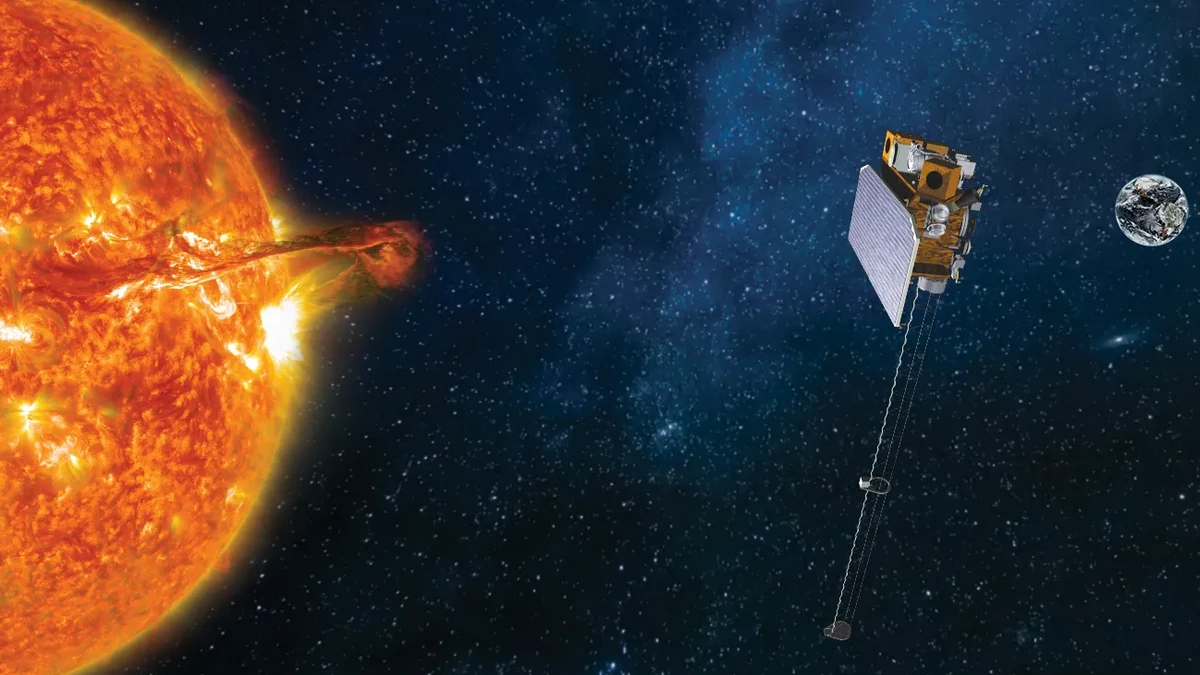
An artist rendering of NOAA's SOLAR-1 satellite (formerly SWFO-L1) in its final position in space orbit next to an image of the sun producing a coronal mass ejection. Credit: NOAA
NOAA’s Space Weather Observations at L1 to Advance Readiness-1 (SOLAR-1) observatory has entered operational service, becoming the first U.S. satellite dedicated exclusively to continuous operational space weather observations.
The spacecraft now provides around-the-clock monitoring of solar wind conditions and coronal mass ejections from the Sun-Earth Lagrange Point 1 (L1). According to NOAA, the mission will deliver continuous observations needed to support operational space weather monitoring and forecasting activities.
SOLAR-1 is intended to strengthen the nation’s readiness for solar storms capable of affecting critical infrastructure.
NOAA said the observatory will provide improved observations and high-quality 24/7 data about the Sun, supporting efforts to protect systems that can be disrupted by space weather, including satellites, communications networks, navigation systems such as GPS, aviation operations, national security activities, electric power infrastructure, and human spaceflight.
The spacecraft launched at 07:30 EST on September 24, 2025, from NASA’s Kennedy Space Center in Florida aboard a SpaceX Falcon 9 rocket. Following launch, SOLAR-1 traveled nearly one million miles before reaching the L1 region, where it now continuously samples solar wind conditions and observes coronal mass ejections emitted from the Sun. NOAA selected the location to provide continuous monitoring of solar activity approaching Earth.
The Sun-Earth L1 region occupies a unique position between Earth and the Sun, allowing spacecraft stationed there to continuously observe incoming solar wind and solar eruptions before they interact with Earth’s space environment. For operational forecasters, measurements collected from this upstream location provide a continuous stream of observations used to assess changing space-weather conditions and support warning operations.
Before entering operational service, the observatory completed an eight-month post-launch testing and commissioning period. During that phase, NOAA and NASA teams evaluated scientific instruments and primary spacecraft systems, including power, onboard computing, propulsion, attitude control, communications, and data-storage capabilities. The testing campaign verified mission readiness before operational activation.
Continuous measurements from SOLAR-1 provide operational forecasters with upstream observations of solar wind conditions and coronal mass ejections. These observations support the assessment of solar disturbances that can affect technological systems in space and on the ground, providing data used in operational space weather forecasting and warning activities.
Operational space-weather monitoring at L1 has long been considered a critical component of forecasting infrastructure because conditions measured there represent the near-Earth solar environment before it reaches the planet. SOLAR-1’s transition into service helps ensure continuity of these observations as reliance on satellite communications, navigation services, power-grid operations, and human spaceflight continues to increase.
The mission was previously known as Space Weather Follow-On–Lagrange 1 (SWFO-L1). With the transition to operational status, SOLAR-1 becomes a dedicated component of NOAA’s space weather monitoring architecture, providing continuous observations needed for long-term forecasting and warning operations.
References:
1 NOAA’s SOLAR-1 enters new era of space weather monitoring – NOAA – June 10, 2026

I am an Assistant Editor and Severe Weather & Science Journalist at The Watchers, specializing in real-time severe weather coverage, geophysical event reporting, and research-driven scientific analysis. You can reach me at rishav(at)watchers(.)news.

Commenting rules and guidelines
We value the thoughts and opinions of our readers and welcome healthy discussions on our website. In order to maintain a respectful and positive community, we ask that all commenters follow these rules.