
Hidden magma pathway revealed by 2025 Santorini crisis
An intense earthquake swarm shook the Santorini–Amorgos region of Greece beginning on January 27, 2025, lasting about 45 days and producing more than 16 000 tremors between 5–15 km (3–9 miles) below the seafloor. A joint seismological study has revealed that the 2025 Santorini crisis was not a typical tectonic swarm. It was the signature of magma moving through a hidden corridor connecting the Santorini and Kolumbo volcanoes, two of the most active systems in the eastern Mediterranean.
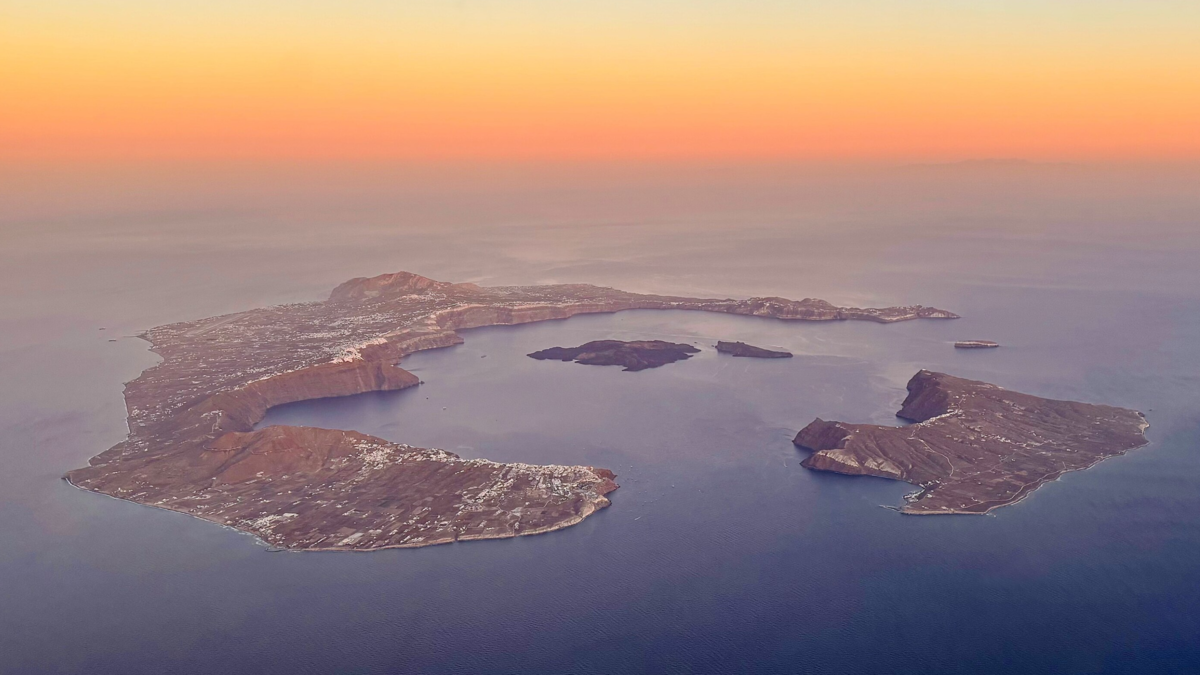
Photograph of Santorini caldera from the air. Credit: kallerna/Wikimedia Commons
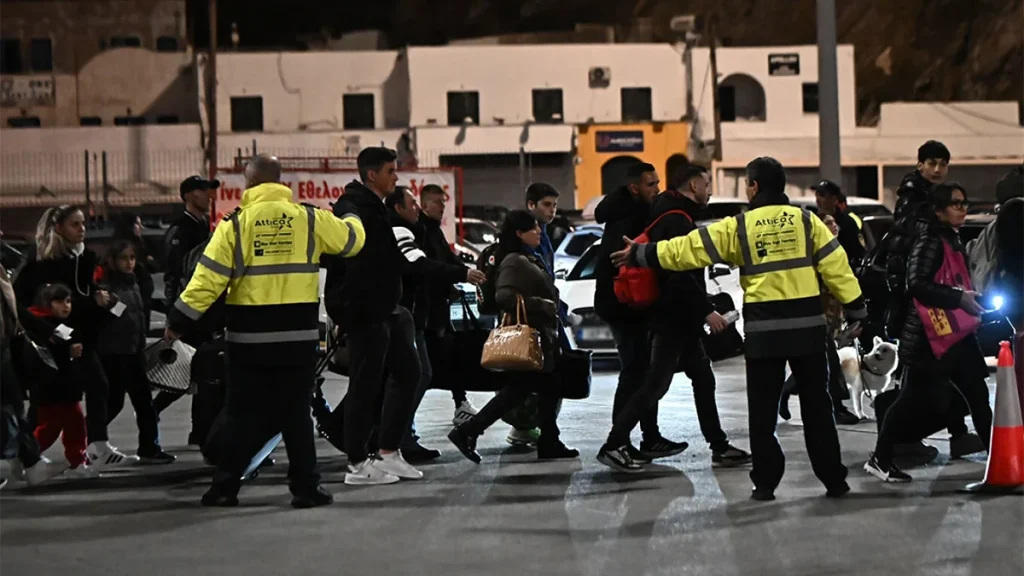
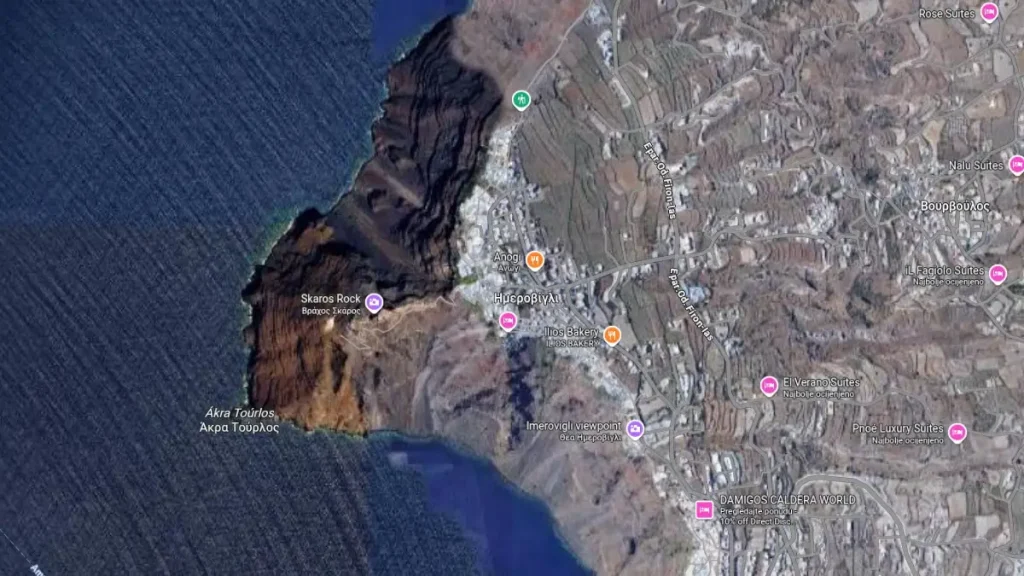
In late January 2025, residents of Santorini and nearby islands began feeling near-continuous vibrations. Hundreds of small quakes struck daily, and ground instruments recorded enough shaking to trigger landslides along the caldera cliffs. The Greek authorities issued emergency alerts as scientists debated whether the activity was purely tectonic or a sign of volcanic unrest.
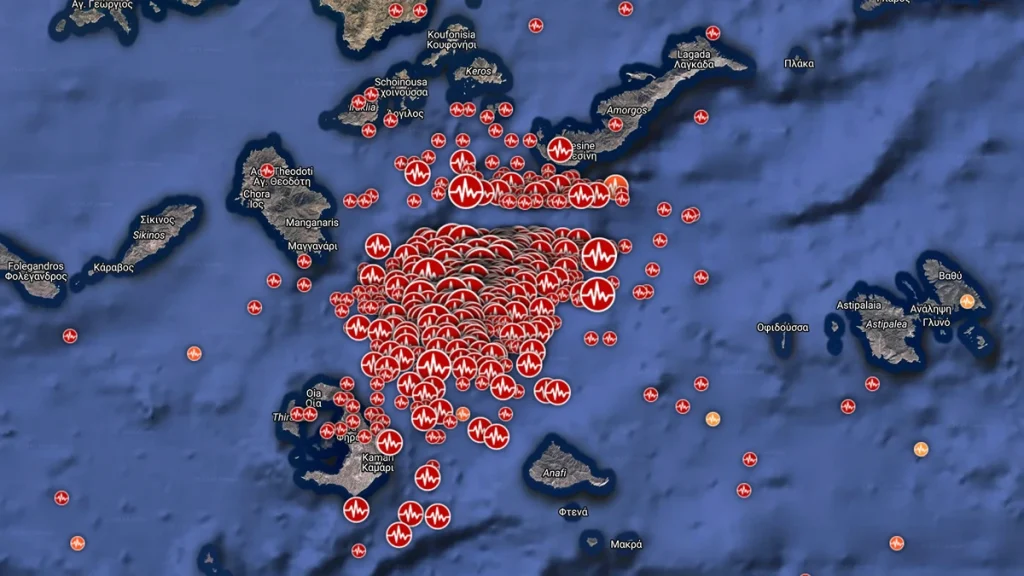
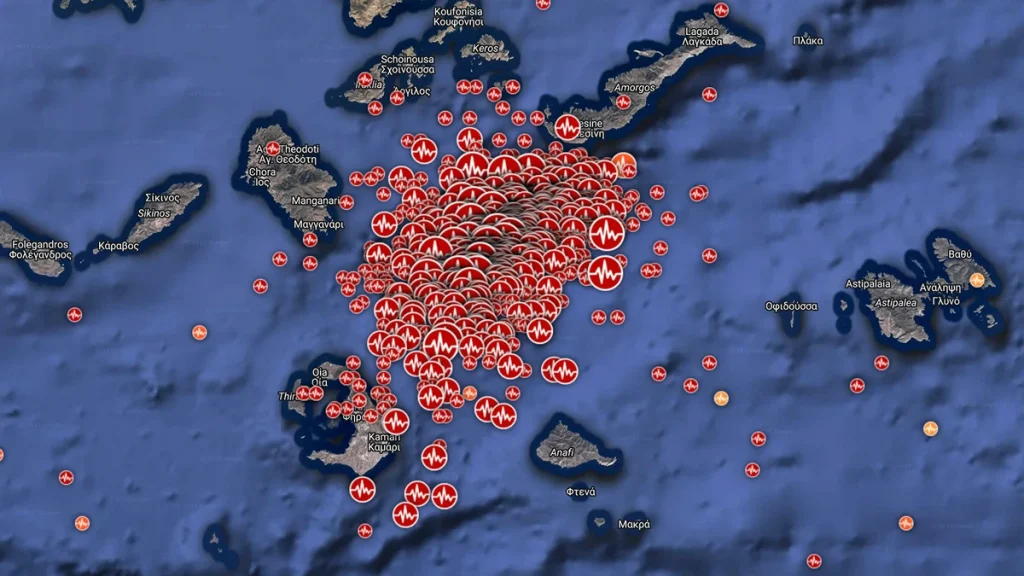
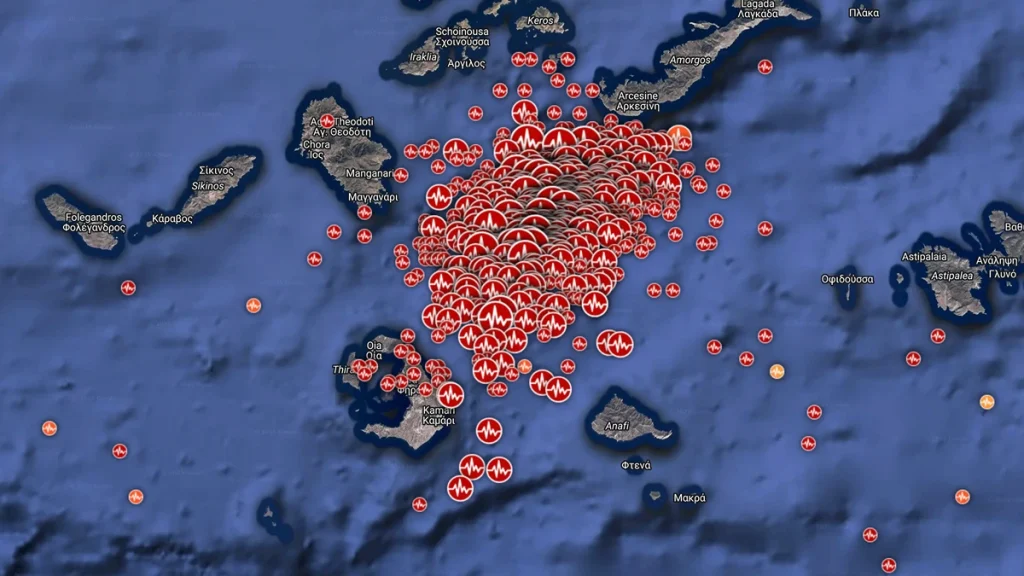
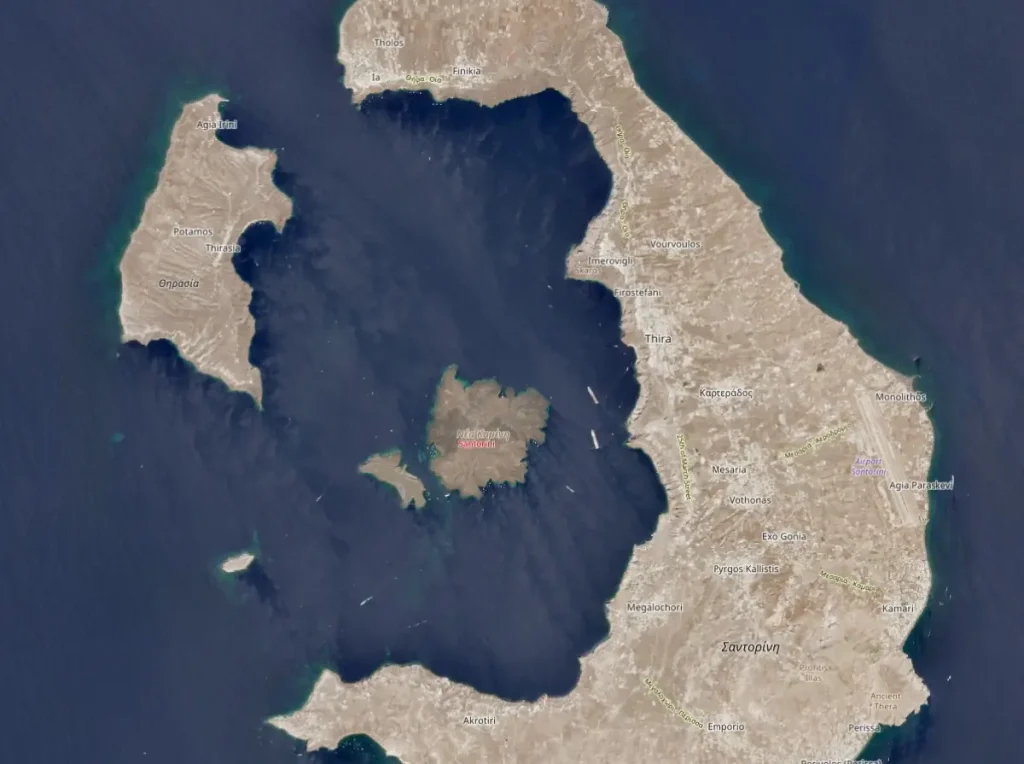
Satellite and ground sensors soon revealed a pattern. The swarm began beneath the Kolumbo submarine volcano, located about 7 km (4 miles) northeast of Santorini, before migrating southwest toward the island. By early February, the swarm had extended along a corridor nearly 30 km (19 miles) long and 5 km (3 miles) wide, following the Kameni line, a fracture zone associated with past eruptions.
This sequence was not an isolated event. Since September 2024, subtle microearthquakes and gradual ground inflation inside the Santorini caldera had hinted that magma pressure was building. The 2025 swarm represented a sharp escalation, releasing energy equivalent to thousands of minor quakes but without a single dominant shock.
The crisis peaked around February 14, 2025, when instruments across the southern Aegean recorded a continuous low-frequency vibration known as seismic tremor. This tremor, lasting several hours, differed from typical earthquake signals and strongly suggested a volcanic process at depth. For an island famous for one of history’s most devastating eruptions, it reignited concern that Santorini’s magmatic system might be reawakening.
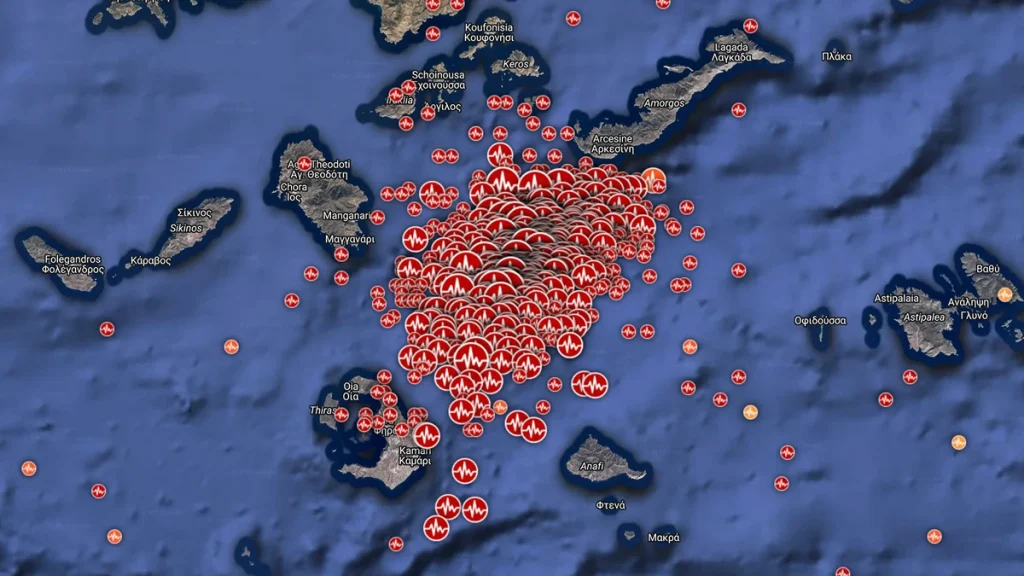
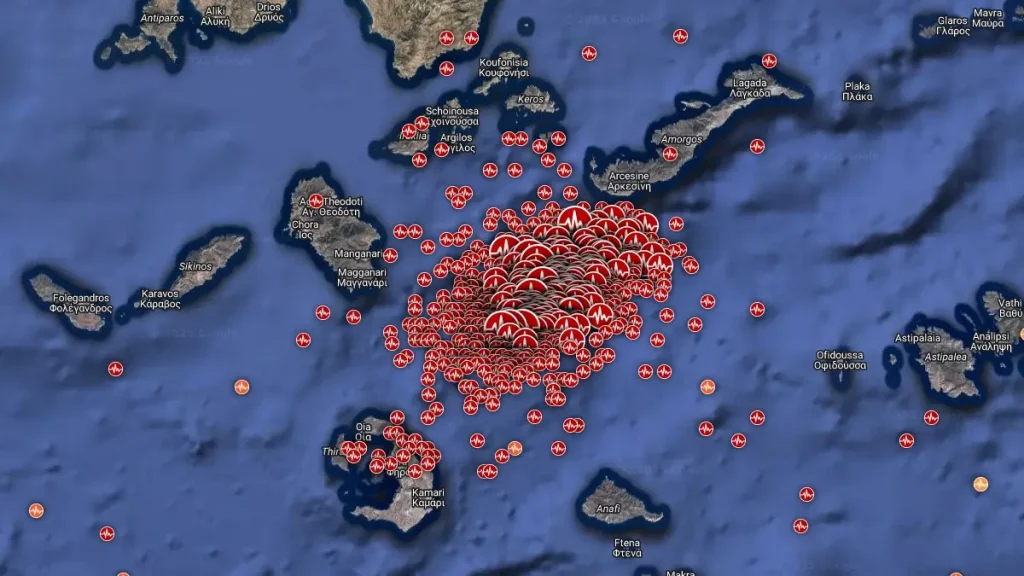
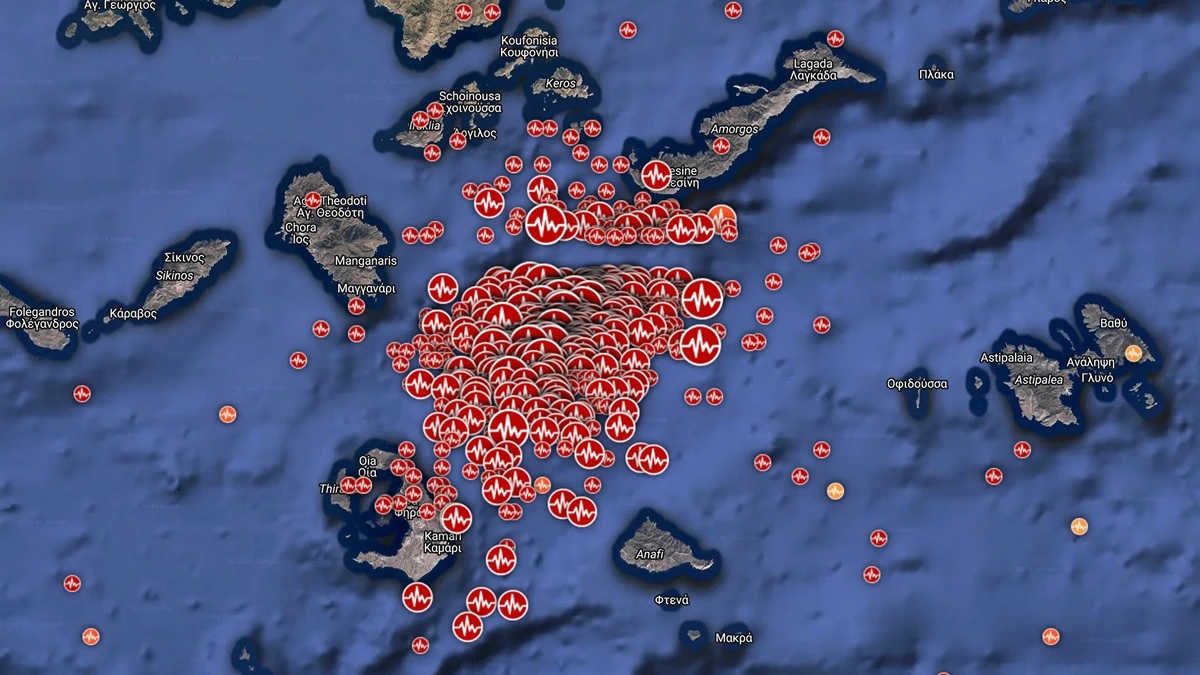
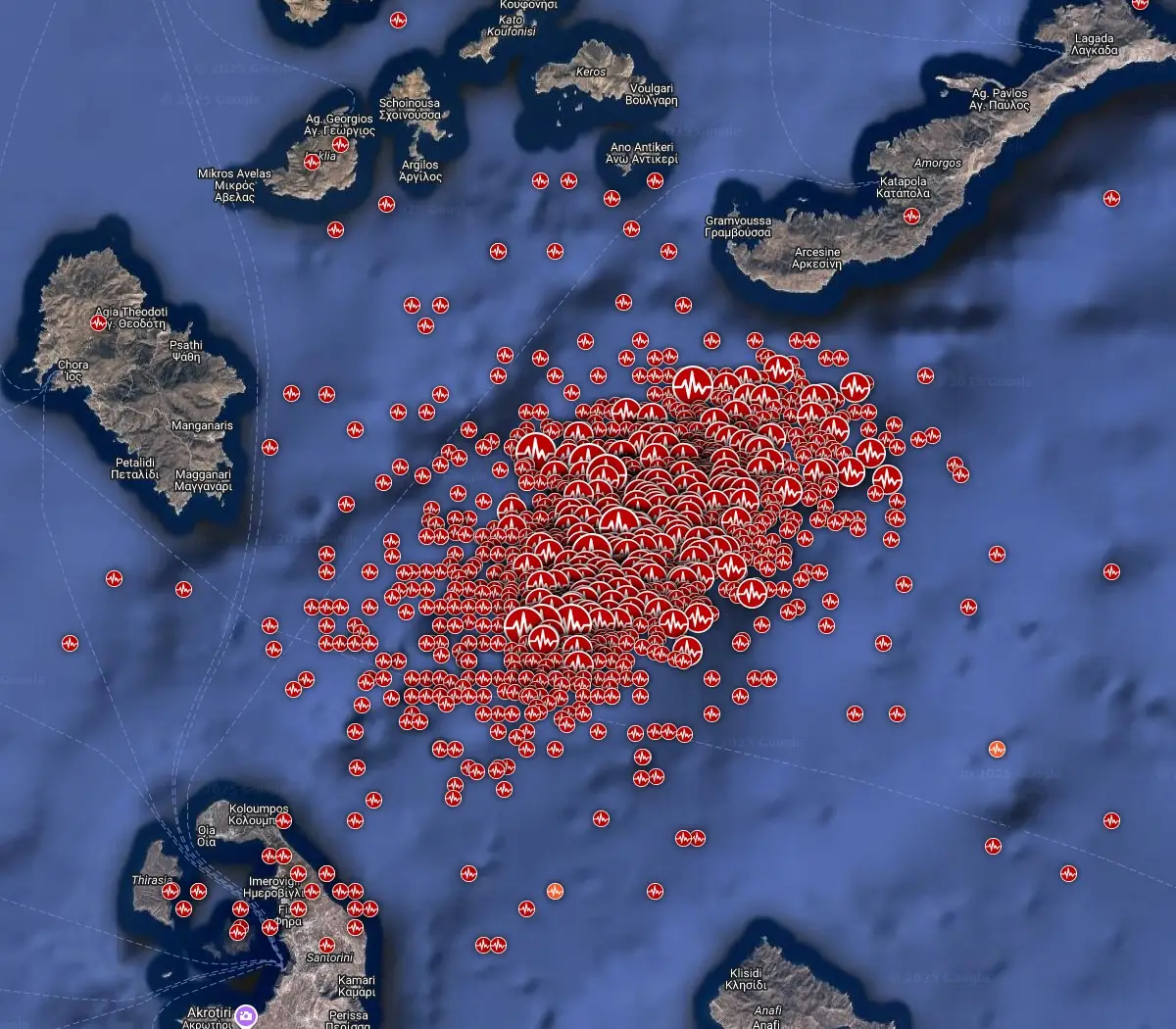
 Earthquakes near Santorini, Greece on February 20, 2025, from last 30 days. Image credit: TW/SAM, Google
- Image credit: TW/SAM, Google
- Image credit: TW/SAM, Google
- Image credit: TW/SAM, Google
- Image credit: TW/SAM, Google
- Earthquakes near Santorini, Greece – 30 days to February 11, 2025. Image credit: TW/SAM, Google



Listening beneath the Aegean
To understand what was happening below, researchers at Université Grenoble Alpes and European partners carried out a detailed joint analysis of the earthquake swarm and the simultaneous tremor signals. They used both classic and modern approaches, combining high-resolution earthquake catalogs with advanced signal processing.
Earthquakes were detected using PhaseNet, a deep-learning algorithm trained to identify the arrival of P and S seismic waves. These were grouped using PyOcto, which links related events through consistent wave arrivals. After this, each event’s position was refined using HypoDD, which corrects for local velocity variations and improves relative locations.
For tremor detection, the scientists applied CovSeisNet, a network covariance method that identifies coherent continuous vibrations across multiple stations. Unlike conventional approaches that look at each station individually, this method interprets the entire network’s behavior. Continuous, low-frequency signals that appear simultaneously at many stations are typical of magma or fluid movement, while impulsive spikes belong to earthquakes.
By combining the two datasets, the team could separate distinct sources of seismic energy. They found that some tremor was directly related to dense clusters of earthquakes, while another, deeper component was independent of any identifiable quakes.
Two families of tremor and what they reveal
The merged catalog contained over 16 000 earthquakes detected between January 27–February 19. When plotted in three dimensions, the events traced narrow conduits and zones of concentrated activity. Within these patterns, two distinct tremor families emerged.
The first family, the swarm-related tremor, consisted of densely overlapping earthquakes. Each signal originated at depths of 6–10 km (4–6 miles), the same as the main swarm. These tremors migrated along the same northeast–southwest path connecting Kolumbo, Anhydros, and Santorini. To observers at the Santorini THERA station, they appeared as rapid bursts of microearthquakes merging into a nearly continuous tone.
The second family, called the Santorini–Kolumbo tremor, was smoother and deeper. It originated between 8 and 25 km (5–15 miles) below the seafloor, in the region between the two volcanoes. The waveforms were lower in frequency and lacked clear P and S phases, implying they were not typical earthquakes. Their steady rhythm and wide frequency band indicated a fluid-driven source, such as magma or pressurized gas moving through porous rock.
These deep tremors appeared on February 7, 13, 14, and 18, 2025, roughly coinciding with shallow earthquake bursts above them. The pattern suggests that pressure pulses traveling upward through the crust caused both deep tremor and shallow cracking. While their amplitude was about 50 times weaker than the swarm-related signals, their persistence pointed to ongoing magma migration.
The hidden corridor beneath the sea
As seismologists decoded the signals, geodesists tracked changes at the surface using satellite radar and GPS instruments. Their data revealed a combination of uplift inside Santorini’s caldera—several centimeters (about one inch)—and subsidence northeast of Kolumbo. This opposing movement could only be explained by a 13 km (8 miles) long dike filled with magma intruding between the two volcanoes.
The discovery confirmed that Santorini and Kolumbo are linked by a shared magmatic system. The intrusion began in late January and continued through mid-February, matching the timing of the tremor episodes. Pressure redistribution between the two volcanoes explains why one inflated while the other deflated.
For decades, geochemical and isotopic analyses suggested that Santorini and Kolumbo had separate magma sources. The 2025 data changed that view. The two reservoirs appear to be connected at mid-crustal depths, where fluids and melt can move laterally through interconnected fractures. The evidence points to a hydraulically coupled magma system, capable of transferring pressure across a network extending tens of kilometers.
Comparable behavior has been observed in other volcanic regions, such as the Klyuchevskoy Group in Kamchatka and the Mauna Loa–Kilauea complex in Hawaii, where magma migration between neighboring volcanoes has been directly imaged. The Aegean event now stands as the first clear case of such inter-volcano coupling in the Mediterranean.
Why understanding tremor is critical
The two tremor families illustrate how magma movement can express itself through different seismic signatures. Shallow tremor, produced by overlapping quakes, marks the brittle response of the crust as magma forces its way through solid rock. Deep, fluid-driven tremor captures the ductile response of partially molten regions where magma flows more smoothly.
Together, these processes form a transcrustal magma system reaching from about 25 kilometers (15 miles) depth to near the surface. This continuous conduit allows magma to redistribute without necessarily erupting, explaining why the region can experience months of intense seismic activity without an explosion.
For volcanic monitoring, this distinction is crucial. Earthquake catalogs show where stress is released, but tremor analysis reveals where magma is moving. Without both, the picture is incomplete. The Santorini study demonstrates that integrated analysis—combining earthquakes, tremor, and ground deformation—can uncover hidden dynamics in complex volcanic systems.
Researchers have proposed continuous covariance-based monitoring as part of future surveillance in the Aegean. This would allow early detection of deep magmatic activity before it triggers surface unrest. Such a system could serve as an early warning framework for other volcanic arcs worldwide.
Echoes of the past and implications for the future
The 2025 crisis has clear historical echoes. Santorini last experienced significant unrest in 2011–2012, when the caldera inflated by about 15 cm (6 in), but no eruption occurred. The difference in 2025 was the simultaneous deflation near Kolumbo, a sign of interconnected reservoirs rather than an isolated magma pocket.
Historical records reveal that the 1650 CE Kolumbo eruption produced a tsunami and ash fallout on Santorini, suggesting that coupling between the volcanoes has existed for centuries. The 2025 evidence provides the first real-time observation of that link in action.
Similar swarm–tremor interactions have been recorded in Iceland’s Reykjanes Peninsula (2021) and Italy’s Campi Flegrei (1980s–2020s), but the Aegean event is unique in showing direct magma transfer between volcanoes beneath the sea. Each of these cases underscores how non-eruptive intrusions can still reshape underground plumbing and alter future eruption paths.
Following the 2025 crisis, the National Observatory of Athens strengthened its regional monitoring network, deploying new ocean-bottom seismometers and improving data sharing with European institutions. The goal is to maintain constant, multi-sensor surveillance capable of distinguishing tectonic from volcanic events in real time.
A new view of Santorini’s restless depths
The 2025 Santorini crisis has transformed how scientists understand the volcanoes of the Aegean arc. What initially appeared as a random swarm of small quakes was, in fact, the pulse of magma migrating through a deep corridor between two volcanoes.
The discovery that Santorini and Kolumbo share a common magma pathway means that future unrest at either site cannot be studied in isolation. Activity beneath one volcano may signal changes in the other, with implications for hazard forecasting and long-term volcanic evolution.
This event also shows the growing power of modern geophysics. Machine learning, network covariance analysis, and satellite geodesy together revealed a dynamic system invisible to older methods. For civil authorities and researchers alike, it emphasizes the need for sustained, integrated monitoring of this geologically active region.
References:
1 Joint seismological analysis of earthquake swarm and tremor episodes during the 2025 Santorini volcanic crisis – Jean Soubestre et al. – ESS Open Archive – October 28, 2025 – DOI: 10.22541/essoar.176166735.51043791/v1 – OPEN ACCESS

I’m a science journalist and researcher at The Watchers, contributing to the Epicenter edition, where I cover peer-reviewed scientific research and emerging discoveries across Earth and space sciences. With a background in astronomy and a passion for environmental science, I’ve worked in shark and coral conservation in Fiji, conducting reef and shark-behavior research, contributing to mangrove restoration, and earning PADI Open Water and Coral Reef Certifications. I bring a blend of scientific rigor and storytelling to illuminate the discoveries shaping our planet and beyond.

Commenting rules and guidelines
We value the thoughts and opinions of our readers and welcome healthy discussions on our website. In order to maintain a respectful and positive community, we ask that all commenters follow these rules.